
3.3V-3A-step down converter powered by-USB-C

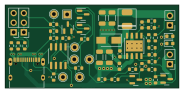
About the 3.3V-3A-step down converter powered by-USB-C PCB
3.3V-3A-step down converter powered by-USB-C is an open source PCB design by maudeve-it, published on GitHub under the MIT license. It is a 2-layer board measuring 45.9 × 21.9 mm, with 53 components from 37 distinct parts.
Other key parts include the TPS54331 and LM358. By type, the board carries 21 resistors, 9 capacitors, 7 test points, 5 transistors, 5 connectors and 3 diodes.
It belongs with the power & battery designs in this gallery.
From the project
Without using a USB-C PD controller chip, handling communication over the USB cable, USB-C standard allows to get 5V up to 3A through a hardware availability detection. Here I show a design developed on KiCad and made through JLCPCB, powering from a USB-PD source and providing 5V and 3.3 (through a step-down converter) up to 3A.
PLEASE NOTE Seeing the video is strongly suggested. Project stored here is what developed and tested on YouTube. Once connected to a USB-C PD source it shows a "transient" for about 12 seconds. Avoiding it, a filtering caoacitor should be added. Again as shown in the video.
NOTA BENE Vedere il video è fortemente suggerito. Il progetto archiviato qui è quello sviluppato e testato su YouTube. Connesso ad una alimentazione USB-C PD, mostra un "transitorio" di circa 12 secondi e per evitarlo si deve aggiungere un condensatore di filtro. Ancora come mostrato nel video.
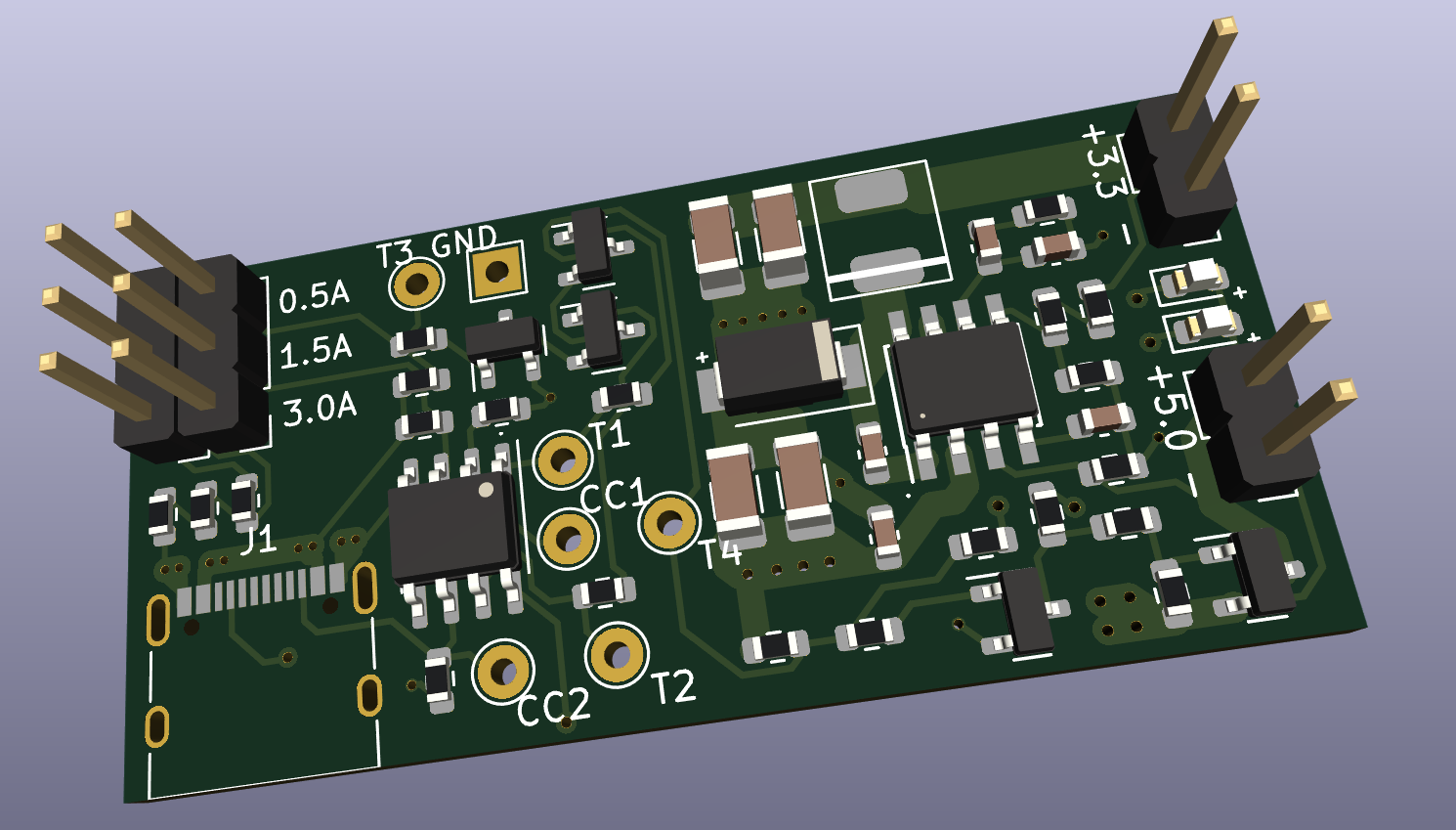
Main components on the 3.3V-3A-step down converter powered by-USB-C
3.3V-3A-step down converter powered by-USB-C bill of materials (BOM)
53 components, 37 distinct parts.
| Qty | Part | Footprint | Refs |
|---|---|---|---|
| 1 | TPS54331 | TI_SO-PowerPAD-8_ThermalVias | U1 |
| 1 | LM358 | SOIC-8_3.9x4.9mm_P1.27mm | U2 |
| 1 | SS8050 | SOT-23 | Q1 |
| 1 | AO3401A | SOT-23 | Q2 |
| 3 | 2N7002 | SOT-23 | Q4, Q5, Q6 |
| 1 | USB port | USB_C_Receptacle_XKB_U262-16XN-4BVC11 | J1 |
| 2 | Selector | PinHeader_1x03_P2.54mm_Vertical | J2, J3 |
| 1 | 3.3V conn. | PinHeader_1x02_P2.54mm_Vertical | J4 |
| 1 | 5V conn. | PinHeader_1x02_P2.54mm_Vertical | J5 |
| 1 | CC2 | TestPoint_THTPad_D2.0mm_Drill1.0mm | TP1 |
| 1 | CC1 | TestPoint_THTPad_D2.0mm_Drill1.0mm | TP2 |
| 1 | GND | TestPoint_THTPad_2.0x2.0mm_Drill1.0mm | TP3 |
| 1 | T1 | TestPoint_THTPad_D2.0mm_Drill1.0mm | TP4 |
| 1 | T2 | TestPoint_THTPad_D2.0mm_Drill1.0mm | TP5 |
| 1 | T3 | TestPoint_THTPad_D2.0mm_Drill1.0mm | TP6 |
| 1 | T4 | TestPoint_THTPad_D2.0mm_Drill1.0mm | TP7 |
| 1 | SS34 | D_SMA | D1 |
| 1 | RED | LED_0603_1608Metric | D2 |
| 1 | GREEN | LED_0603_1608Metric | D3 |
| 1 | 3.3uH | MWSA0402 | L1 |
Show 17 more
| Qty | Part | Footprint | Refs |
|---|---|---|---|
| 2 | 4.7 uF | C_1206_3216Metric | C1, C2 |
| 3 | 0.1uF | C_0603_1608Metric | C3, C4, C7 |
| 1 | 1.5nF | C_0603_1608Metric | C5 |
| 1 | 27pF | C_0603_1608Metric | C6 |
| 2 | 47uF | C_1206_3216Metric | C8, C9 |
| 1 | 47k | R_0603_1608Metric | R1 |
| 5 | 5.1k | R_0603_1608Metric | R2, R3, R12, R13, R19 |
| 1 | 1.2k | R_0603_1608Metric | R4 |
| 1 | 820 | R_0603_1608Metric | R5 |
| 1 | 180 | R_0603_1608Metric | R6 |
| 1 | 330 | R_0603_1608Metric | R7 |
| 2 | 10k | R_0603_1608Metric | R8, R22 |
| 1 | 3.3K | R_0603_1608Metric | R9 |
| 2 | 6.8k | R_0603_1608Metric | R10, R11 |
| 4 | 100 | R_0603_1608Metric | R14, R16, R17, R18 |
| 1 | 2k | R_0603_1608Metric | R20 |
| 1 | 1.1k | R_0603_1608Metric | R21 |
3.3V-3A-step down converter powered by-USB-C design files
The KiCad project lives in the maudeve-it/3.3V-3A-step-down-converter-powered-by-USB-C repository on GitHub; these links point at the commit this page was built from.
- LayoutKiCad/USB power port.kicad_pcb
- SchematicKiCad/USB power port.kicad_sch
3.3V-3A-step down converter powered by-USB-C: common questions
How big is the 3.3V-3A-step down converter powered by-USB-C PCB?
The 3.3V-3A-step down converter powered by-USB-C measures 45.9 × 21.9 mm, has 2 copper layers and is 1.6 mm thick.
How many components are on the 3.3V-3A-step down converter powered by-USB-C?
53 components, from 37 distinct parts. The full bill of materials is listed on this page.
Where can I download the 3.3V-3A-step down converter powered by-USB-C design files?
From the maudeve-it/3.3V-3A-step-down-converter-powered-by-USB-C repository on GitHub, which has the KiCad layout and the schematic; the links under Design files point to each one.
Can I use the 3.3V-3A-step down converter powered by-USB-C design in my own project?
Yes, under the terms of its MIT license, which maudeve-it chose for the repository.
Similar boards
Stack chan
stack-chan
50 × 50 mm33 parts2LApache-2.01.7k
Display Carrier
AxxAxx
35.6 × 58.2 mm5 parts2LGPL-3.01.7k
ControllerCurrentShuntAddOn
stuartpittaway
26 × 16.9 mm9 parts2LCC-BY-NC-4.01.1k
Module 16S PassiveBalanceAddOn
61 × 74 mm86 parts2LCC-BY-NC-4.01.1k
TemperaturePCB PANEL
116 × 75.5 mm178 parts2LCC-BY-NC-4.01.1k
ProgrammingAdapter
10.5 × 83 mm3 parts2LCC-BY-NC-4.01.1k