
Rhizomatic sublime

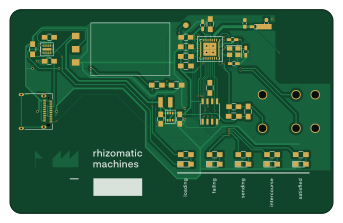
About the Rhizomatic sublime PCB
Rhizomatic sublime is an open source ESP8266 PCB design by maxwolfs, published on GitHub. It is a 2-layer board measuring 85.6 × 54 mm, with 48 components from 31 distinct parts.
Its main chip is the ESP8266EX, from the ESP8266 family. Other key parts include the LTC3225, TPS61221DCKR and AT25SF041-SSHD-B. By type, the board carries 15 resistors, 14 capacitors, 7 connectors, 5 diodes, 4 ICs and 1 crystal.
From the project
Becoming a manifesto
We object to the mundane paradigm of Human-Computer-Interaction and demand a Human-Human-Interaction. It's pyhsicial, it's intimate, it's exciting. Rhizm is a device in the shape of a credit card that connects over a satisfying magnetic click. Caution: Hands may touch. The connection of two cards creates a new bond in a decentralized social mesh network. Combined with a web interface that shows the verified encrypted interactions, Rhizm can be used for many different scenarios in which a physicial interaction between nodes must be safe. Or appealing. We understand our project as fundamental…
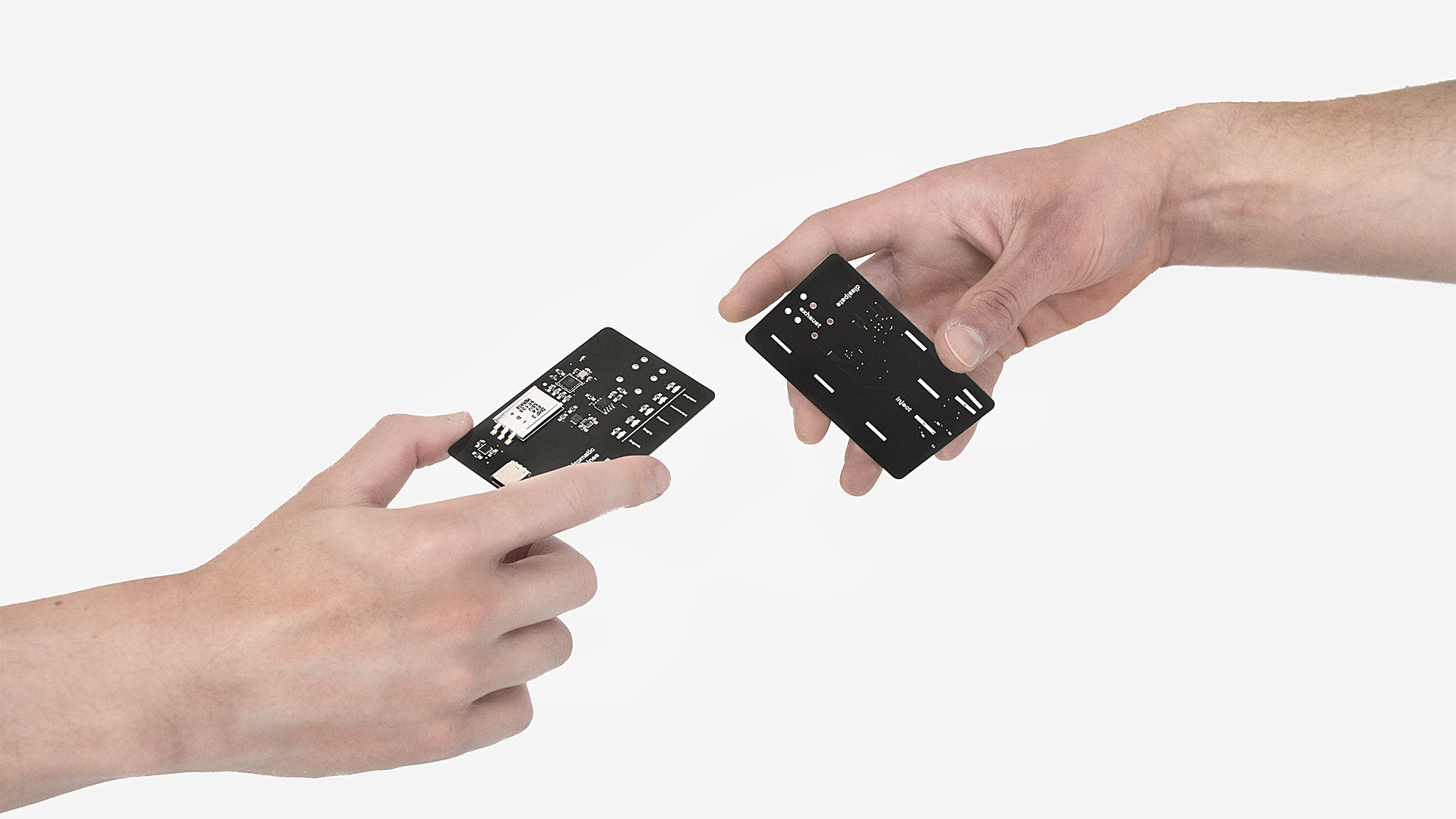
Main components on the Rhizomatic sublime
Rhizomatic sublime bill of materials (BOM)
48 components, 31 distinct parts — part numbers from the project's BOM.
| Qty | Part | Footprint | Refs |
|---|---|---|---|
| 1 | LTC3225 Analog Devices Inc. | DFN-10-1EP_2x3mm_Pitch0.5mm | U1 |
| 1 | TPS61221DCKR Texas Instruments | sc_70-6 | U2 |
| 1 | AT25SF041-SSHD-B W25Q32FVSSIG Adesto Technologies | SOIC-8_3.9x4.9mm_Pitch1.27mm | U3 |
| 1 | ESP8266EX Espressif | QFN-32-1EP_5x5mm_Pitch0.5mm | U4 |
| 1 | ABM8W-26.0000MHZ-4-B1U-T3 26 MHz Abracon | Crystal_SMD_Abracon_ABM8G-4pin_3.2x2.5mm | Y1 |
| 1 | 12401610E4-2A USB_C_Receptacle Amphenol | USB_C_Receptacle_Amphenol_12401610E4-2A | J1 |
| 1 | TP_RST | C_Connector_2mm | J2 |
| 1 | TP_TX | C_Connector_2mm | J3 |
| 1 | TP_RX | C_Connector_2mm | J4 |
| 1 | TP_GND1 | C_Connector_2mm | J6 |
| 1 | TP_GND2 | C_Connector_2mm | J7 |
| 1 | TP_GND3 | C_Connector_2mm | J8 |
| 1 | Antenna_Dipole | AN91445_47_mils | AE1 |
| 5 | LTW-220DS5 LED Lite-On | LED_0805_HandSoldering | D1, D2, D3, D4, D5 |
| 1 | LQH3NPN4R7MJRL 4.7μH Murata | LQH3NPN4R7MJRL | L1 |
| 1 | DMF3 | Murata_DMF3Z | C1 |
| 4 | GRM21BR61C106KE15L 10μF Murata | C_0805_HandSoldering | C2, C4, C8, C11 |
| 1 | GCM21BR71H105KA03L 1μF Murata | C_0805_HandSoldering | C3 |
| 1 | CGA4J3X7R1C225K125AB 2.2μF TDK | C_0805_HandSoldering | C5 |
| 2 | GCM1885C2A100FA6D 10pF Murata | C_0603_HandSoldering | C6, C7 |
Show 11 more
| Qty | Part | Footprint | Refs |
|---|---|---|---|
| 1 | GCM188R71C105KA64D 1μF Murata | C_0603_HandSoldering | C9 |
| 1 | VJ0603A5R6BXJPW1BC 5.6pF Vishay | C_0603_HandSoldering | C10 |
| 1 | GCM188R91E104KA37D 0.1μF Murata | C_0603_HandSoldering | C12 |
| 2 | ? | C_0603_1608Metric_Pad1.05x0.95mm_HandSolder | C13, C14 |
| 2 | CRCW080512K0FKEA 12K Vishay | R_0805_HandSoldering | R1, R6 |
| 1 | ERJ-6GEYJ183V 17K Panasonic | R_0805_HandSoldering | R2 |
| 1 | CRCW080533K0JNEA 33K Vishay | R_0805_HandSoldering | R3 |
| 2 | RT0805FRE0710KL 10K Yageo | R_0805_HandSoldering | R4, R5 |
| 1 | CRCW0805200RFKEA 200 Vishay | R_0805_HandSoldering | R7 |
| 5 | CRCW0805220RFKEAC ? Vishay | R_0805_HandSoldering | R8, R9, R10, R11, R12 |
| 3 | RR1220P-102-D 1000 Susumu | R_0805_HandSoldering | R13, R14, R15 |
Rhizomatic sublime design files
The KiCad project lives in the maxwolfs/rhizomatic-sublime repository on GitHub; these links point at the commit this page was built from.
Rhizomatic sublime: common questions
What microcontroller does the Rhizomatic sublime use?
The Rhizomatic sublime is built around the ESP8266EX, from the ESP8266 family.
How big is the Rhizomatic sublime PCB?
The Rhizomatic sublime measures 85.6 × 54 mm, has 2 copper layers and is 1.6 mm thick.
How many components are on the Rhizomatic sublime?
48 components, from 31 distinct parts, with part numbers taken from the project's own BOM. The full bill of materials is listed on this page.
Where can I download the Rhizomatic sublime design files?
From the maxwolfs/rhizomatic-sublime repository on GitHub, which has the KiCad layout and the BOM; the links under Design files point to each one.
Can I use the Rhizomatic sublime design in my own project?
The repository has no license, so all rights stay with maxwolfs. Use it as a reference, and ask the author before reusing the design.
Can I test firmware for the Rhizomatic sublime without the hardware?
Yes. HardLabs builds a simulation of the board from its netlist and BOM, so you can run and debug ESP8266 firmware against it before you order a PCB.
Similar boards
 ESP8266
ControllerCircuit
stuartpittaway
75 × 30 mm20 parts2LCC-BY-NC-4.01.1k ESP8266
HASwitchPlate
aderusha
60 × 40 mm8 parts2LMIT738 ESP8266
RatGDO-OpenSource-D1Mini-ESP8266
Kaldek
47.8 × 63.3 mm12 parts2LMIT506 ESP8266
Goatgdo
32.9 × 53.3 mm23 parts2LMIT506 ESP8266
RatGDO-OpenSource-Bare-ESP8266
55 × 82.7 mm20 parts2LMIT506 ESP8266
Iaq board
nkitanov
70.1 × 43.2 mm17 parts2LNo license398