
RGB-LED-and-High-Dencity-CCT-Controller

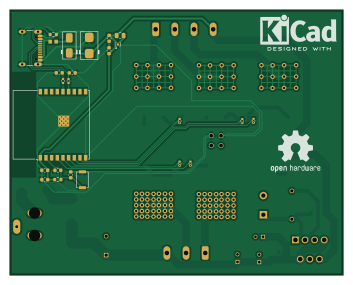
About the RGB-LED-and-High-Dencity-CCT-Controller PCB
RGB-LED-and-High-Dencity-CCT-Controller is an open source ESP32 PCB design by MbFredys, published on GitHub under the CERN-OHL-W-2.0 license. It is a 2-layer board measuring 88.2 × 70.2 mm, with 53 components from 33 distinct parts.
Its main chip is the ESP32-C3-WROOM-02-N4, from the ESP32 family. Other key parts include the LM2678T-ADJ and TPS7A20XXXDQN. By type, the board carries 16 capacitors, 15 resistors, 6 diodes, 5 transistors, 4 connectors and 3 ICs.
It belongs with the iot & wireless designs in this gallery.
From the project
Five-channel RGB+CCT LED-controller PCB design based on ESP32-C3, with documented power conversion, switching, and manufacturing outputs.
Five-channel RGB and tunable-white LED-controller PCB based on the ESP32-C3.
The project explores a compact controller capable of driving RGB, warm-white, and cool-white LED channels while integrating wireless control, local power conversion, and USB-C programming.
- Controller: ESP32-C3-WROOM-02 - Outputs: Five low-side PWM channels: R, G, B, warm white, and cool white - Switching devices: IRLZ44N MOSFETs - Power input: 12 V nominal - Conversion: LM2678T-ADJ buck stage and TPS7A20 3.3 V regulation - Programming: USB-C interface - Protection: Input fuse and transient-protection components -…
Main components on the RGB-LED-and-High-Dencity-CCT-Controller
RGB-LED-and-High-Dencity-CCT-Controller bill of materials (BOM)
53 components, 33 distinct parts — part numbers from the project's BOM.
| Qty | Part | Footprint | Refs |
|---|---|---|---|
| 1 | LM2678T-ADJ | TO127P1041X469X2199-7N | U1 |
| 1 | TPS7A20XXXDQN TPS7A20xxxDQN | Texas_X2SON-4_1x1mm_P0.65mm | U2 |
| 1 | ESP32-C3-WROOM-02-N4 ESP32-C3-WROOM-02 | ESP32-C3-WROOM-02 | U3 |
| 5 | IRLZ44NSPBF-VB IRLZ44N | TO254P1524X483-4N | Q1, Q2, Q3, Q4, Q5 |
| 1 | RGB_Strip | PhoenixContact_MCV_1,5_4-G-5.08_1x04_P5.08mm_Vertical | J1 |
| 1 | CW/WW_Strip | PhoenixContact_MCV_1,5_3-G-5.08_1x03_P5.08mm_Vertical | J2 |
| 1 | EJ503A CON_12VDC_IN | MPD_EJ503A | J3 |
| 1 | USB_C_PLUG_USB2.0 USB_C_Plug_USB2.0 | USB_C_Receptacle_GCT_USB4105-xx-A_16P_TopMnt_Horizontal | P1 |
| 1 | 0ZCF0600FF2C Polyfuse | FUSC7351X170N | F1 |
| 1 | Polyfuse | FUSC1608X100N | F2 |
| 1 | uC_Reset | SW_Push_SPST_NO_Alps_SKRK | SW1 |
| 1 | SS54 | D_SMC | D1 |
| 2 | SMBJ12A | D_SMB | D2, D5 |
| 1 | SMAJ5.0A | D_SMA | D3 |
| 1 | SS14 | D_SMA | D4 |
| 1 | MBR735 | TO-220-2_Vertical_KA | D6 |
| 1 | FXL1040-220-M 22uH | IND_XAL6060-223MEB | L1 |
| 1 | 16SEPF1000M 1000uF | CAPPRD500W60D1000H1300 | C1 |
| 3 | EEA-GA1E150 15uF | CAPPRD200W45D500H700 | C2, C3, C4 |
| 1 | GRM155R71C474KE01D 0.47uF | C_0805_2012Metric | C5 |
Show 13 more
| Qty | Part | Footprint | Refs |
|---|---|---|---|
| 2 | CL10A105KB8NNNC 1uF | C_0603_1608Metric | C6, C7 |
| 1 | ECQE4123JF 0.01uF | CAPRR750W60L1030T440H750 | C8 |
| 2 | EEEFNE181XUV 180uF | CAP_EEEFNE181XUV | C9, C10 |
| 1 | GRM155R71C474KE01D 10uF | C_0603_1608Metric | C11 |
| 2 | GRM155R71C474KE01D 0.1uF | C_0603_1608Metric | C12, C14 |
| 2 | GRM155R71C474KE01D 22pF | C_0603_1608Metric | C13, C15 |
| 1 | GRM155R71C474KE01D 1uF | C_0603_1608Metric | C16 |
| 1 | 5.1K 5.1k | R_0603_1608Metric | R1 |
| 5 | 100 | R_0402_1005Metric | R2, R3, R7, R8, R11 |
| 5 | 10K 10k | R_0603_1608Metric | R4, R9, R10, R12, R13 |
| 1 | 100K 100k | R_0603_1608Metric | R5 |
| 1 | RC0805FR-07100KL 100k | R_0805_2012Metric | R6 |
| 2 | 22 | R_0402_1005Metric | R14, R15 |
RGB-LED-and-High-Dencity-CCT-Controller design files
The KiCad project lives in the MbFredys/RGB-LED-and-High-Dencity-CCT-Controller repository on GitHub; these links point at the commit this page was built from.
RGB-LED-and-High-Dencity-CCT-Controller: common questions
What microcontroller does the RGB-LED-and-High-Dencity-CCT-Controller use?
The RGB-LED-and-High-Dencity-CCT-Controller is built around the ESP32-C3-WROOM-02-N4, from the ESP32 family.
How big is the RGB-LED-and-High-Dencity-CCT-Controller PCB?
The RGB-LED-and-High-Dencity-CCT-Controller measures 88.2 × 70.2 mm, has 2 copper layers and is 1.6 mm thick.
How many components are on the RGB-LED-and-High-Dencity-CCT-Controller?
53 components, from 33 distinct parts, with part numbers taken from the project's own BOM. The full bill of materials is listed on this page.
Where can I download the RGB-LED-and-High-Dencity-CCT-Controller design files?
From the MbFredys/RGB-LED-and-High-Dencity-CCT-Controller repository on GitHub, which has the KiCad layout, the schematic and the BOM; the links under Design files point to each one.
Can I use the RGB-LED-and-High-Dencity-CCT-Controller design in my own project?
Yes, under the terms of its CERN-OHL-W-2.0 license, which MbFredys chose for the repository.
Can I test firmware for the RGB-LED-and-High-Dencity-CCT-Controller without the hardware?
Yes. HardLabs builds a simulation of the board from its netlist and BOM, so you can run and debug ESP32 firmware against it before you order a PCB.
Similar boards
 ESP32
ESP32Open Book Abridged Edition
joeycastillo
85 × 115 mm65 parts2LCC-BY-SA-4.08.1k ESP32
ESP32Badge
atopile
56.3 × 39 mm239 parts4LMIT4.0k ESP32
ESP32Esp32 minimal
36.2 × 26.8 mm20 parts2LMIT4.0k ESP32
ESP32Racer
StuckAtPrototype
36 × 50.2 mm70 parts4LApache-2.03.8k ESP32
ESP32Controller
29 × 74 mm58 parts4LApache-2.03.8k ESP32
ESP32Bitaxe
skot
56.5 × 99.8 mm86 parts4LCERN-OHL-S-2.01.4k