
GlazerLab KStat

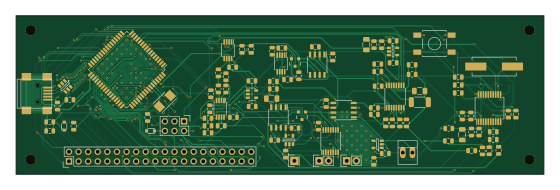
About the GlazerLab KStat PCB
GlazerLab KStat is an open source AVR/Arduino PCB design by nfroehberg, published on GitHub. It is a 2-layer board measuring 139.7 × 41.9 mm, with 116 components from 59 distinct parts.
Its main chip is the ATXMEGA256A3U, from the AVR/Arduino family. Other key parts include the TPS79933, TPS793475-EP, MAX4737, LMP7702 and LMP7715MF. By type, the board carries 59 capacitors, 26 resistors, 15 ICs, 5 connectors, 3 inductors and 2 crystals.
From the project
Firmware, PCB design and Python interface for the KStat potentiostat developed in the Glazer Lab, University of Hawaii.
The KStat is an adaptation with small changes to the firmware and PCB design of the open source DStat potentiostat by Michael Dryden for use with Hg/Au microelectrodes in in-situ meaurements.
Documentation for the original design: http://microfluidics.utoronto.ca/gitlab/dstat/dstat-documentation/wikis/home
For the KStat, the potential range of the potentiostat was increased from 3 to 4 (+- 2) V and the shape of the board changed from square to rectangular for easier integration in underwater housings. As it is intended to be used in conjunction with other sensors and manipulators, the KStat…
Main components on the GlazerLab KStat
GlazerLab KStat bill of materials (BOM)
116 components, 59 distinct parts.
| Qty | Part | Footprint | Refs |
|---|---|---|---|
| 1 | ATXMEGA256A3U | TQFP-64_14x14mm_P0.8mm | IC1 |
| 1 | TPS79933 | SOT-23-5 | U1 |
| 1 | TPS793475-EP | SOT-23-5 | U2 |
| 1 | MAX4737 | TSSOP-14_4.4x5mm_Pitch0.65mm | U3 |
| 1 | LMP7702 | SOIC-8_3.9x4.9mm_Pitch1.27mm | U4 |
| 2 | LMP7715MF | SOT-23-5 | U5, U9 |
| 1 | TPD2S017 | SOT-23-6 | U6 |
| 1 | MAX4477 | MSOP-8_3x3mm_Pitch0.65mm | U7 |
| 1 | MAX6126 | SOIC-8_3.9x4.9mm_Pitch1.27mm | U8 |
| 1 | LMP7721 | SOIC-8_3.9x4.9mm_Pitch1.27mm | U10 |
| 1 | OPA350 | MSOP-8_3x3mm_Pitch0.65mm | U11 |
| 1 | MAX4617 | TSSOP-16_4.4x5mm_Pitch0.65mm | U12 |
| 1 | ADS1255 | SSOP-20_5.3x7.2mm_Pitch0.65mm | U13 |
| 1 | MAX5441 | MSOP-8_3x3mm_P0.65mm | U14 |
| 1 | 7.68M | Crystal_HC49-SD_SMD | X1 |
| 1 | 12 MHz | Crystal_SMD_5032_2Pads | X2 |
| 1 | AVR-PDI | Pin_Header_Straight_2x03 | CON1 |
| 1 | RS | Pin_Header_Straight_1x01 | P1 |
| 1 | C R | Pin_Header_Straight_1x02 | P2 |
| 1 | W WS | Pin_Header_Straight_1x02 | P3 |
Show 39 more
| Qty | Part | Footprint | Refs |
|---|---|---|---|
| 1 | CONN_01X40 | Pin_Header_Straight_2x20 | P6 |
| 1 | RESET | SW_SPST_SMD | SW1 |
| 2 | MAX5491 | SOT-23 | UR1, UR2 |
| 1 | USB-MB-S | USB_Mini-B | USB1 |
| 2 | LED | D_0805 | D1, D2 |
| 2 | FILTER | C_0805_2012Metric | FB1, FB2 |
| 1 | FERRITE | C_0805_2012Metric | FB3 |
| 23 | 100n | C_0805_2012Metric | C1, C2, C6, C8, C11, C16, C17, C18 +15 |
| 5 | 1u | C_0805_2012Metric | C3, C19, C25, C31, C53 |
| 4 | 10n | C_0805_2012Metric | C4, C9, C55, C58 |
| 6 | 10u | C_0805_2012Metric | C5, C32, C36, C44, C51, C59 |
| 2 | 180p | C_0805_2012Metric | C7, C12 |
| 1 | 160p | C_0805_2012Metric | C10 |
| 1 | 68p | C_0805_2012Metric | C13 |
| 2 | 4.7n | C_0805_2012Metric | C14, C15 |
| 3 | 100p | C_0805_2012Metric | C23, C24, C30 |
| 3 | 47u | C_1206_3216Metric | C26, C34, C54 |
| 1 | 56n | C_0805_2012Metric | C37 |
| 1 | 200p | C_0805_2012Metric | C38 |
| 1 | 2p | C_0805_2012Metric | C39 |
| 1 | 2n | C_0805_2012Metric | C40 |
| 1 | 20p | C_0805_2012Metric | C41 |
| 2 | 18p | C_0805_2012Metric | C42, C43 |
| 2 | 15p | C_0805_2012Metric | C56, C57 |
| 2 | 18.7k | R_0805_2012Metric | R1, R2 |
| 6 | 100 | R_0805_2012Metric | R3, R9, R15, R22, R23, R24 |
| 2 | 1k | R_0805_2012Metric | R4, R8 |
| 2 | 25.5k | R_0805_2012Metric | R5, R6 |
| 1 | 1M | R_0805_2012Metric | R7 |
| 1 | 10k | R_0805_2012Metric | R10 |
| 2 | 301 | R_0805_2012Metric | R11, R12 |
| 2 | 49.9 | R_0805_2012Metric | R13, R14 |
| 1 | 30k | R_0805_2012Metric | R16 |
| 1 | 3M | R_0805_2012Metric | R17 |
| 1 | 100M | R_1206_3216Metric | R18 |
| 1 | 3k | R_0805_2012Metric | R19 |
| 1 | 300k | R_0805_2012Metric | R20 |
| 1 | 30M | R_2010_5025Metric | R21 |
| 2 | 330 | R_0805_2012Metric | R25, R26 |
GlazerLab KStat design files
The KiCad project lives in the nfroehberg/GlazerLab_KStat repository on GitHub; these links point at the commit this page was built from.
GlazerLab KStat: common questions
What microcontroller does the GlazerLab KStat use?
The GlazerLab KStat is built around the ATXMEGA256A3U, from the AVR/Arduino family.
How big is the GlazerLab KStat PCB?
The GlazerLab KStat measures 139.7 × 41.9 mm, has 2 copper layers and is 1.6 mm thick.
How many components are on the GlazerLab KStat?
116 components, from 59 distinct parts. The full bill of materials is listed on this page.
Where can I download the GlazerLab KStat design files?
From the nfroehberg/GlazerLab_KStat repository on GitHub, which has the KiCad layout; the links under Design files point to each one.
Can I use the GlazerLab KStat design in my own project?
The repository has no license, so all rights stay with nfroehberg. Use it as a reference, and ask the author before reusing the design.
Can I test firmware for the GlazerLab KStat without the hardware?
Yes. HardLabs builds a simulation of the board from its netlist and BOM, so you can run and debug AVR/Arduino firmware against it before you order a PCB.
Similar boards
 AVR/Arduino
Magspoof
samyk
35 × 29 mm11 parts2LNo license4.2k AVR/Arduino
Redox keyboard
mattdibi
162.2 × 126.5 mm77 parts2LMIT2.0k AVR/Arduino
Labrador
espotek-org
36.8 × 34.7 mm75 parts2LNo license1.2k AVR/Arduino
V4
stuartpittaway
30 × 50 mm38 parts2LCC-BY-NC-4.01.1k AVR/Arduino
ModuleV450
30 × 61.4 mm39 parts2LCC-BY-NC-4.01.1k AVR/Arduino
Discipline
coseyfannitutti
304.9 × 122.8 mm170 parts2LCC-BY-NC-4.01.0k