
Self landing rocket

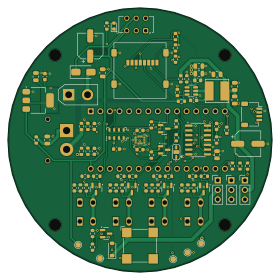
About the Self landing rocket PCB
Self landing rocket is an open source ESP32 PCB design by npsggehlot-cmyk, published on GitHub. It is a 4-layer board measuring 70 × 70 mm, with 94 components from 41 distinct parts.
Its main chip is the 2x 1x15 2.54mm female header (socket), from the ESP32 family. Other key parts include the AMS1117-3.3, TI TPS563200DDCR, LSM6DSO32, MS5607-02BA03 and 74LVC125A. By type, the board carries 40 resistors, 24 capacitors, 11 connectors, 7 transistors, 5 ICs and 3 diodes.
It belongs with the robotics & motion designs in this gallery.
From the project
Self-landing TVC model rocket: RocketFC flight computer PCB, avionics bay, servo chute ejector, Arduino firmware, 3D MATLAB flight simulator
Open rocketfc.kicadpro in KiCad 7 or newer.
- fabrication/ holds exactly what was sent to JLCPCB: the Gerbers plus the full-assembly BOM and CPL files. - scripts/ has the Python scripts used to generate the schematic and board. design.py is the single source of truth for every part and net. - lib/ contains a local footprint for the WAGO 2601 lever terminals.
JLCPCB settings used: 4 layers, 1.6 mm, ENIG, Standard PCBA, assembly on both sides, parts placement confirmation, and depaneling.
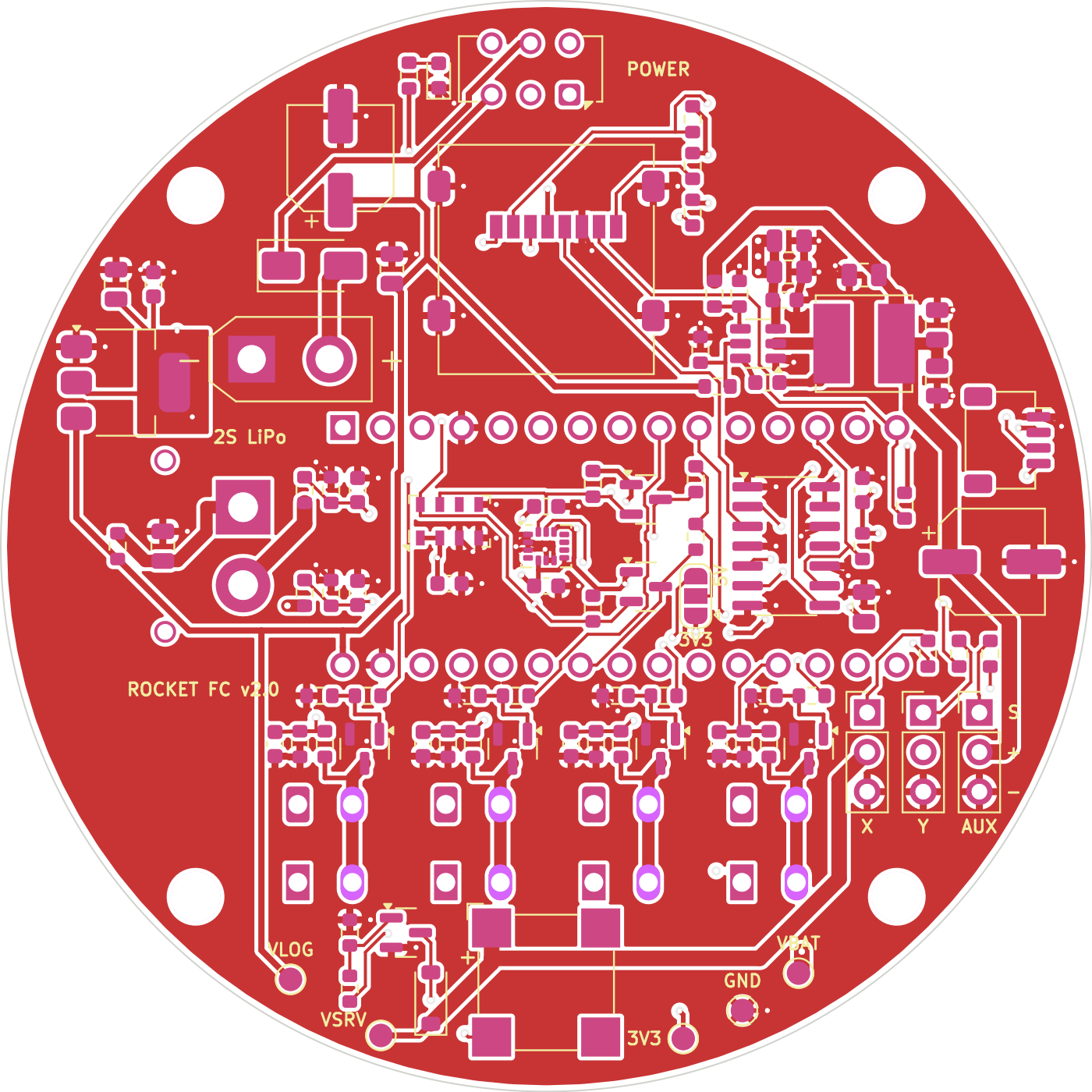
Main components on the Self landing rocket
Self landing rocket bill of materials (BOM)
94 components, 41 distinct parts — part numbers from the project's BOM.
| Qty | Part | Footprint | Refs |
|---|---|---|---|
| 1 | AMS1117-3.3 | SOT-223-3_TabPin2 | U1 |
| 1 | TI TPS563200DDCR TPS563200 | SOT-23-6 | U2 |
| 1 | ST LSM6DSO32TR (+/-32g, 2000dps; pin-compatible with LSM6DSL) LSM6DSO32 | LGA-14_3x2.5mm_P0.5mm_LayoutBorder3x4y | U3 |
| 1 | TE MS5607-02BA03 (pin-compatible MS5611 family, I2C addr 0x77) MS5607-02BA03 | LGA-8_3x5mm_P1.25mm | U4 |
| 1 | TI SN74LVC125ADR (5V-tolerant inputs, run at 3.3V) 74LVC125A | SOIC-14_3.9x8.7mm_P1.27mm | U5 |
| 1 | 2x 1x15 2.54mm female header (socket) Arduino Nano / Nano ESP32 (socketed) | Arduino_Nano | A1 |
| 5 | AO3400A | SOT-23 | Q1, Q2, Q3, Q4, Q5 |
| 2 | Diodes BSS138-7-F BSS138 | SOT-23 | Q6, Q7 |
| 1 | AMASS XT30UPB-M BATTERY 2S (XT30 male, vertical) | AMASS_XT30UPB-M_1x02_P5.0mm_Vertical | J1 |
| 1 | 2.54mm 1x3 male header SERVO X (TVC) | PinHeader_1x03_P2.54mm_Vertical | J2 |
| 1 | 2.54mm 1x3 male header SERVO Y (TVC) | PinHeader_1x03_P2.54mm_Vertical | J3 |
| 1 | 2.54mm 1x3 male header SERVO AUX | PinHeader_1x03_P2.54mm_Vertical | J4 |
| 1 | AMASS XT30PW-F ARM PLUG (XT30 female) | AMASS_XT30PW-F_1x02_P2.50mm_Horizontal | J5 |
| 1 | WAGO 2601-3102 (lever) P1 ASCENT MOTOR | TerminalBlock_WAGO_2601-3102_1x02_P3.50mm_Vertical | J6 |
| 1 | WAGO 2601-3102 (lever) P2 LANDING MOTOR | TerminalBlock_WAGO_2601-3102_1x02_P3.50mm_Vertical | J7 |
| 1 | WAGO 2601-3102 (lever) P3 LEG BURN WIRE | TerminalBlock_WAGO_2601-3102_1x02_P3.50mm_Vertical | J8 |
| 1 | WAGO 2601-3102 (lever) P4 PARACHUTE | TerminalBlock_WAGO_2601-3102_1x02_P3.50mm_Vertical | J9 |
| 1 | Molex 47219-2001 (hinge lid - will not eject on landing) microSD (hinged lid) | microSD_HC_Molex_47219-2001 | J10 |
| 1 | JST SM04B-SRSS-TB QWIIC (GPS / rangefinder) | JST_SH_SM04B-SRSS-TB_1x04-1MP_P1.00mm_Horizontal | J11 |
| 1 | Same Sky (CUI) CMT-8504-100-SMT-TR magnetic transducer: drive with tone(D9, 4000) CMT-8504 5V 100dB | MagneticBuzzer_CUI_CMT-8504-100-SMT | BZ1 |
Show 21 more
| Qty | Part | Footprint | Refs |
|---|---|---|---|
| 1 | C&K JS202011AQN POWER | SW_CK_JS202011AQN_DPDT_Angled | SW1 |
| 1 | SS34 (40V 3A Schottky) SS34 | D_SMA | D1 |
| 1 | KT-0603R red LED RED | LED_0603_1608Metric | D2 |
| 1 | 1N4148W | D_SOD-123 | D3 |
| 1 | Bourns SRN6045TA-2R2Y (2.2uH, 6A) 2.2uH | L_Bourns_SRN6045TA | L1 |
| 1 | Panasonic EEE-FK1C221P 220uF 16V (brown-out hold-up) 220uF 16V | CP_Elec_6.3x7.7 | C1 |
| 4 | 10uF 25V | C_0805_2012Metric | C2, C6, C7, C15 |
| 6 | 10nF | C_0603_1608Metric | C3, C14, C16, C17, C18, C19 |
| 4 | 22uF 10V 22uF 25V | C_0805_2012Metric | C4, C10, C11, C12 |
| 7 | 100nF | C_0603_1608Metric | C5, C8, C9, C20, C21, C22, C23 |
| 1 | Panasonic EEE-FK1C221P 220uF 16V (servo bulk) 220uF 16V | CP_Elec_6.3x7.7 | C13 |
| 1 | 10uF 10V 10uF 25V | C_0805_2012Metric | C24 |
| 14 | 0603 1% 100k 100k | R_0603_1608Metric | R1, R4, R6, R7, R12, R15, R16, R19 +6 |
| 6 | 0603 1% 33k 33k | R_0603_1608Metric | R2, R13, R17, R21, R25, R29 |
| 1 | 0603 1% 1k 1k | R_0603_1608Metric | R3 |
| 1 | 0603 1% 18k 18k | R_0603_1608Metric | R5 |
| 3 | 0603 1% 220 220 | R_0603_1608Metric | R8, R9, R10 |
| 1 | 0603 1% 47k 47k | R_0603_1608Metric | R11 |
| 5 | 0603 1% 100 100 | R_0603_1608Metric | R14, R18, R22, R26, R30 |
| 4 | 0603 1% 4.7k 4.7k | R_0603_1608Metric | R32, R33, R34, R35 |
| 5 | 0603 1% 10k 10k | R_0603_1608Metric | R36, R37, R38, R39, R40 |
Self landing rocket design files
The KiCad project lives in the npsggehlot-cmyk/self-landing-rocket repository on GitHub; these links point at the commit this page was built from.
Self landing rocket: common questions
What microcontroller does the Self landing rocket use?
The Self landing rocket is built around the 2x 1x15 2.54mm female header (socket), from the ESP32 family.
How big is the Self landing rocket PCB?
The Self landing rocket measures 70 × 70 mm, has 4 copper layers and is 1.6 mm thick.
How many components are on the Self landing rocket?
94 components, from 41 distinct parts, with part numbers taken from the project's own BOM. The full bill of materials is listed on this page.
Where can I download the Self landing rocket design files?
From the npsggehlot-cmyk/self-landing-rocket repository on GitHub, which has the KiCad layout, the schematic and the BOM; the links under Design files point to each one.
Can I use the Self landing rocket design in my own project?
The repository has no license, so all rights stay with npsggehlot-cmyk. Use it as a reference, and ask the author before reusing the design.
Can I test firmware for the Self landing rocket without the hardware?
Yes. HardLabs builds a simulation of the board from its netlist and BOM, so you can run and debug ESP32 firmware against it before you order a PCB.
Similar boards
 ESP32
ESP32Open Book Abridged Edition
joeycastillo
85 × 115 mm65 parts2LCC-BY-SA-4.08.1k ESP32
ESP32Powertrain
byrantech
64 × 45.4 mm171 parts4LMIT4.3k ESP32
ESP32Badge
atopile
56.3 × 39 mm239 parts4LMIT4.0k ESP32
ESP32Esp32 minimal
36.2 × 26.8 mm20 parts2LMIT4.0k ESP32
ESP32Controller
StuckAtPrototype
29 × 74 mm58 parts4LApache-2.03.8k ESP32
ESP32Racer
36 × 50.2 mm70 parts4LApache-2.03.8k