
Octoprobe Tentacle

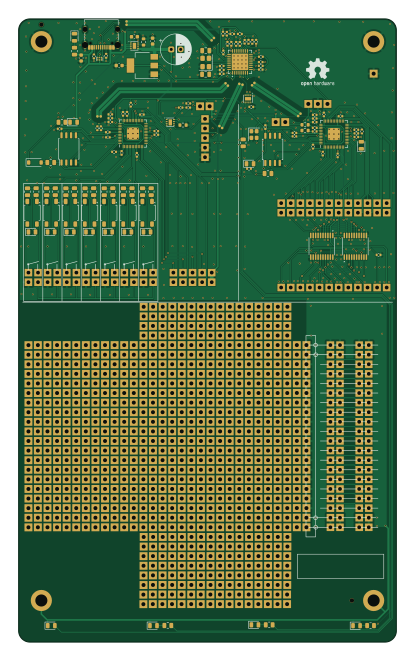
About the Octoprobe Tentacle PCB
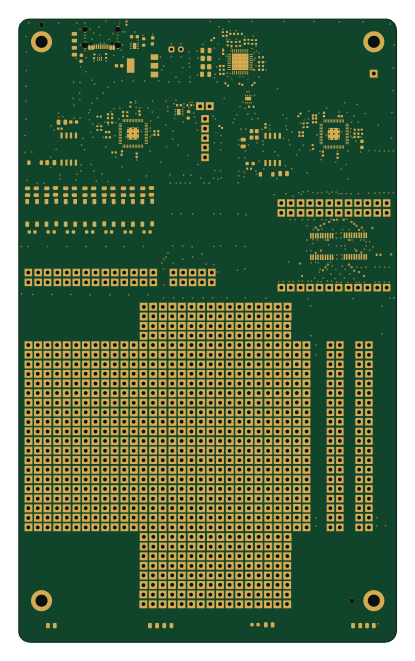
Octoprobe Tentacle is an open source RP2040/RP2350 PCB design by octoprobe, published on GitHub under the MIT license. It is a 2-layer board measuring 100 × 165 mm, with 130 components from 34 distinct parts.
Its main chip is the RP2040, from the RP2040/RP2350 family. Other key parts include the AMS1117-3.3, W25Q32JVS, TPS2595XX, USB2514B_BI and GAQY221S. By type, the board carries 54 resistors, 40 capacitors, 17 diodes, 16 ICs, 2 crystals and 1 connector.
From the project
Open source hardware as part of octoprobe
Remove silkscreen: R301, U302, R1401, R1505 Breadbord pads: Only one ground line to leave more space for DUT-boards Breadbord: Enlarged for big boards buffering capacitor on HUB+5V GPIO Pads equal to Tentacle v3 LEDS less bright (Green LEDs 2k2 -> 4k7) Power DUT via PICO-Infra? + DUT is not powerered when Tentacle is plugged in. Power PICO-Probe via PICO-Infra? + PICO-Probe is by default off. + PICO-Probe Boot pin would be controlled by PICO-Infra. DUT may be powerered via a jumper RP2INFRABOOT via USB Port 2 RP2PROBEBOOT via GPIO RP2PROBE_RUN via GPIO
Main components on the Octoprobe Tentacle
Octoprobe Tentacle bill of materials (BOM)
130 components, 34 distinct parts — part numbers from the project's BOM.
| Qty | Part | Footprint | Refs |
|---|---|---|---|
| 2 | RP2040 | RP2040-QFN-56 | U201, U1501 |
| 1 | AMS1117-3.3 | SOT-223-3_TabPin2 | U202 |
| 2 | W25Q32JVS | SOIC-8_5.23x5.23mm_P1.27mm | U203, U1502 |
| 3 | TPS2595XX TPS2595xx | WSON-8-1EP_2x2mm_P0.5mm_EP0.9x1.6mm | U204, U205, U207 |
| 1 | USB2514B_BI USB2514B_Bi | Texas_RHH0036C_VQFN-36-1EP_6x6mm_P0.5mm_EP4.4x4.4mm_ThermalVias | U302 |
| 7 | GAQY221S | SOP-4_4.4x4.3mm_P2.54mm | U601, U701, U801, U901, U1001, U1101, U1201 |
| 1 | OSCILLATOR-12MHZ Oscillator-12MHz | Crystal_SMD_2520-4Pin_2.5x2.0mm | X201 |
| 1 | 24MHZ 24MHz | Crystal_SMD_3225-4Pin_3.2x2.5mm | Y301 |
| 1 | USB_C_RECEPTACLE_USB2.0 USB_C_Receptacle_USB2.0 | USB_C_Receptacle_Palconn_UTC16-G | J301 |
| 10 | C34499 white | LED_0805_2012Metric | D101, D601, D701, D801, D901, D1001, D1101, D1201 +2 |
| 3 | C2297 green | LED_0805_2012Metric | D103, D104, D301 |
| 1 | C2293 blue | LED_0805_2012Metric | D201 |
| 1 | C8598 B5819W SL | D_SOD-123 | D202 |
| 1 | C2295 red | LED_0805_2012Metric | D203 |
| 1 | PRTR5V0U2X | Texas_USON-6_1x1.45mm_P0.5mm_SMD | D302 |
| 4 | 10U 10u | C_0603_1608Metric | C201, C202, C215, C401 |
| 29 | 100N 100n | C_0402_1005Metric | C203, C204, C207, C208, C209, C210, C211, C212 +21 |
| 5 | 1u | C_0402_1005Metric | C205, C206, C217, C1503, C1504 |
| 2 | 18P 18p | C_0805_2012Metric | C307, C308 |
| 8 | 2K2 2k2 | R_0805_2012Metric | R101, R601, R701, R801, R901, R1001, R1101, R1201 |
Show 14 more
| Qty | Part | Footprint | Refs |
|---|---|---|---|
| 3 | 4K7 | R_0805_2012Metric | R103, R104, R301 |
| 3 | 1k | R_0805_2012Metric | R201, R204, R1503 |
| 4 | 33R | R_0402_1005Metric | R202, R203, R1501, R1502 |
| 1 | 0R | R_0805_2012Metric | R205 |
| 9 | 10K 10k | R_0402_1005Metric | R207, R210, R213, R312, R313, R314, R315, R1504 +1 |
| 1 | 2K7 | R_0603_1608Metric | R208 |
| 1 | 3K6 | R_0603_1608Metric | R209 |
| 9 | 100K | R_0402_1005Metric | R211, R304, R305, R306, R307, R308, R310, R311 +1 |
| 1 | 33K | R_0402_1005Metric | R212 |
| 2 | 0R | R_0603_1608Metric | R220, R221 |
| 2 | 5.1K | R_0402_1005Metric | R302, R303 |
| 1 | 12K 12k | R_0402_1005Metric | R309 |
| 7 | 390 | R_0805_2012Metric | R602, R702, R802, R902, R1002, R1102, R1202 |
| 2 | 2K2 2k2 | R_0402_1005Metric | R1506, R1507 |
Octoprobe Tentacle design files
The KiCad project lives in the octoprobe/tentacle repository on GitHub; these links point at the commit this page was built from.
Octoprobe Tentacle: common questions
What microcontroller does the Octoprobe Tentacle use?
The Octoprobe Tentacle is built around the RP2040, from the RP2040/RP2350 family.
How big is the Octoprobe Tentacle PCB?
The Octoprobe Tentacle measures 100 × 165 mm, has 2 copper layers and is 1.6 mm thick.
How many components are on the Octoprobe Tentacle?
130 components, from 34 distinct parts, with part numbers taken from the project's own BOM. The full bill of materials is listed on this page.
Where can I download the Octoprobe Tentacle design files?
From the octoprobe/tentacle repository on GitHub, which has the KiCad layout, the schematic and the BOM; the links under Design files point to each one.
Can I use the Octoprobe Tentacle design in my own project?
Yes, under the terms of its MIT license, which octoprobe chose for the repository.
Can I test firmware for the Octoprobe Tentacle without the hardware?
Yes. HardLabs builds a simulation of the board from its netlist and BOM, so you can run and debug RP2040/RP2350 firmware against it before you order a PCB.
More boards in tentacle
Similar boards
 RP2040/RP2350
Open Book Abridged Edition
joeycastillo
85 × 115 mm29 parts2LCC-BY-SA-4.08.1k RP2040/RP2350
Corne
foostan
277.2 × 107.5 mm164 parts2LCC-BY-4.07.7k RP2040/RP2350
Corne
277.2 × 107.5 mm164 parts2LCC-BY-4.07.7k RP2040/RP2350
Hid remapper
jfedor2
100 × 100 mm124 parts2LMIT1.7k RP2040/RP2350
Msa
Mentra-Community
47.8 × 9.4 mm53 parts2LMIT1.2k RP2040/RP2350
Open Source Smart Glasses
93 × 10.5 mm80 parts4LMIT1.2k