
Privasee

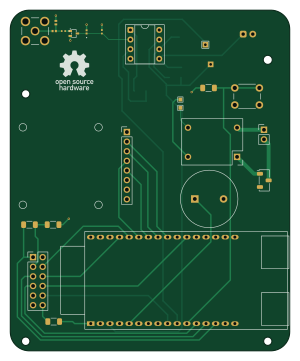
About the Privasee PCB
Privasee is an open source ESP32 PCB design by OSHE-Github, published on GitHub under the GPL-3.0 license. It is a 4-layer board measuring 73.9 × 90 mm, with 29 components from 27 distinct parts.
Its main chip is the ESP32-C5-DevKitC-1, from the ESP32 family. Other key parts include the LM358, 254 and DFR0568. By type, the board carries 11 resistors, 5 connectors, 4 ICs, 3 capacitors, 2 switches and 2 diodes.
It belongs with the rf & radio and iot & wireless designs in this gallery, and the repository also holds 1 earlier revision of it.
From the project
There are multiple different types of cameras. Detecting with them can be done in a combination of different ways. Some of these way include, but are not limited too detecting the infrared light pulses, reading the Radio Frequency and a handful of other waysPrivasee is a two seme
There are multiple different types of cameras. Detecting with them can be done in a combination of different ways. Some of these way include, but are not limited too detecting the infrared light pulses, reading the Radio Frequency and a handful of other waysPrivasee is a two semester project intended to locate and detect cameras. Additionally, the device itself aims to be low-cost, mobile, and efficient for detection. In other words, the device should be able to scan an area such as a hotel room and indicate to the user if there is a hidden camera. The basis of what to detect for hidden…
Main components on the Privasee
Privasee bill of materials (BOM)
29 components, 27 distinct parts.
| Qty | Part | Footprint | Refs |
|---|---|---|---|
| 1 | LM358 | DIP-8_W7.62mm_Socket | U2 |
| 1 | 254 | PinHeader_1x08_P2.54mm_Vertical | U3 |
| 1 | DFR0568 | PinSocket_2x02_P2.54mm_Vertical | U4 |
| 1 | ESP32-C5-DevKitC-1 | ESP32-C5-DevKitC-1 | U6 |
| 1 | RFPC-SMA27-F | GRADCONN_RFPC-SMA27-F | J1 |
| 1 | Batt_Solder_Point | PinHeader_1x02_P2.54mm_Vertical | J2 |
| 1 | Conn_02x06_Odd_Even | PinHeader_2x06_P2.54mm_Vertical | J3 |
| 1 | IR_TEST | TestPoint_THTPad_1.5x1.5mm_Drill0.7mm | J6 |
| 1 | RF_TEST | TestPoint_THTPad_1.5x1.5mm_Drill0.7mm | J7 |
| 1 | Buzzer | Buzzer_15x7.5RM7.6 | BZ1 |
| 1 | Switch | Nidec_Copal_CAS-120A | SW1 |
| 1 | SW_Push | SW_PUSH_6mm_H4.3mm | SW2 |
| 1 | BAT1504WH6327XTSA1 Infineon Technologies | BAT1504WH6327XTSA1 | D1 |
| 1 | Photodiode | D_A-405_P2.54mm_Vertical_AnodeUp | D3 |
| 1 | LQW15AN9N1H00D | INDC1006X60N | L1 |
| 1 | GJM1555C1HR22BB01D | CAPC1005X55N | C1 |
| 1 | GJM1555C1H4R7CB01D | G-155_MUR-L | C2 |
| 1 | GJM1555C1H220FB01D | CAP_GJM1555C1H220FB01D_MUR-L | C3 |
| 1 | 200 | R_1206_3216Metric_Pad1.30x1.75mm_HandSolder | R1 |
| 1 | 470 Ohm | R_1206_3216Metric_Pad1.30x1.75mm_HandSolder | R2 |
Show 7 more
| Qty | Part | Footprint | Refs |
|---|---|---|---|
| 1 | 25 Ohms | R_1206_3216Metric_Pad1.30x1.75mm_HandSolder | R3 |
| 1 | 100 Ohms | R_1206_3216Metric_Pad1.30x1.75mm_HandSolder | R4 |
| 1 | 1 MOhm | R_1206_3216Metric_Pad1.30x1.75mm_HandSolder | R5 |
| 1 | RT0402BRE07100KL | RC0402N_YAG-L | R6 |
| 1 | 10 | R_1206_3216Metric_Pad1.30x1.75mm_HandSolder | R7 |
| 1 | 100 ohm | R_1206_3216Metric_Pad1.30x1.75mm_HandSolder | R8 |
| 3 | 10k | R_1206_3216Metric_Pad1.30x1.75mm_HandSolder | R9, R10, R12 |
Privasee design files
The KiCad project lives in the OSHE-Github/Privasee repository on GitHub; these links point at the commit this page was built from.
Privasee: common questions
What microcontroller does the Privasee use?
The Privasee is built around the ESP32-C5-DevKitC-1, from the ESP32 family.
How big is the Privasee PCB?
The Privasee measures 73.9 × 90 mm, has 4 copper layers and is 1.6 mm thick.
How many components are on the Privasee?
29 components, from 27 distinct parts. The full bill of materials is listed on this page.
Where can I download the Privasee design files?
From the OSHE-Github/Privasee repository on GitHub, which has the KiCad layout and the schematic; the links under Design files point to each one.
Can I use the Privasee design in my own project?
Yes, under the terms of its GPL-3.0 license, which OSHE-Github chose for the repository.
Can I test firmware for the Privasee without the hardware?
Yes. HardLabs builds a simulation of the board from its netlist and BOM, so you can run and debug ESP32 firmware against it before you order a PCB.
Earlier revisions in the repo: Privasee
Similar boards
 ESP32
ESP32Open Book Abridged Edition
joeycastillo
85 × 115 mm65 parts2LCC-BY-SA-4.08.1k ESP32
ESP32Badge
atopile
56.3 × 39 mm239 parts4LMIT4.0k ESP32
ESP32Esp32 minimal
36.2 × 26.8 mm20 parts2LMIT4.0k ESP32
ESP32Racer
StuckAtPrototype
36 × 50.2 mm70 parts4LApache-2.03.8k ESP32
ESP32Controller
29 × 74 mm58 parts4LApache-2.03.8k ESP32
ESP32Bitaxe
skot
56.5 × 99.8 mm86 parts4LCERN-OHL-S-2.01.4k