
Pursuit drone

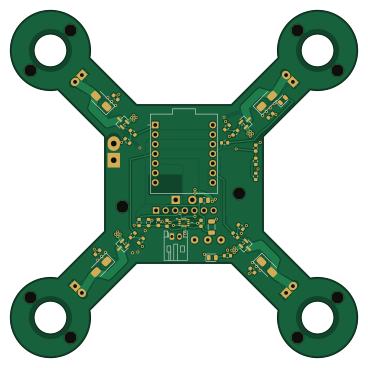
About the Pursuit drone PCB
Pursuit drone is an open source ESP32 PCB design by Pai-88, published on GitHub under the MIT license. It is a 4-layer board measuring 91.9 × 91.9 mm, with 58 components from 30 distinct parts.
Its main chip is the XIAO-ESP32S3-Sense, from the ESP32 family. Other key parts include the ICM-42688-P. By type, the board carries 14 resistors, 11 capacitors, 4 transistors, 4 connectors, 4 diodes and 3 test points.
It belongs with the robotics & motion and iot & wireless designs in this gallery.
From the project
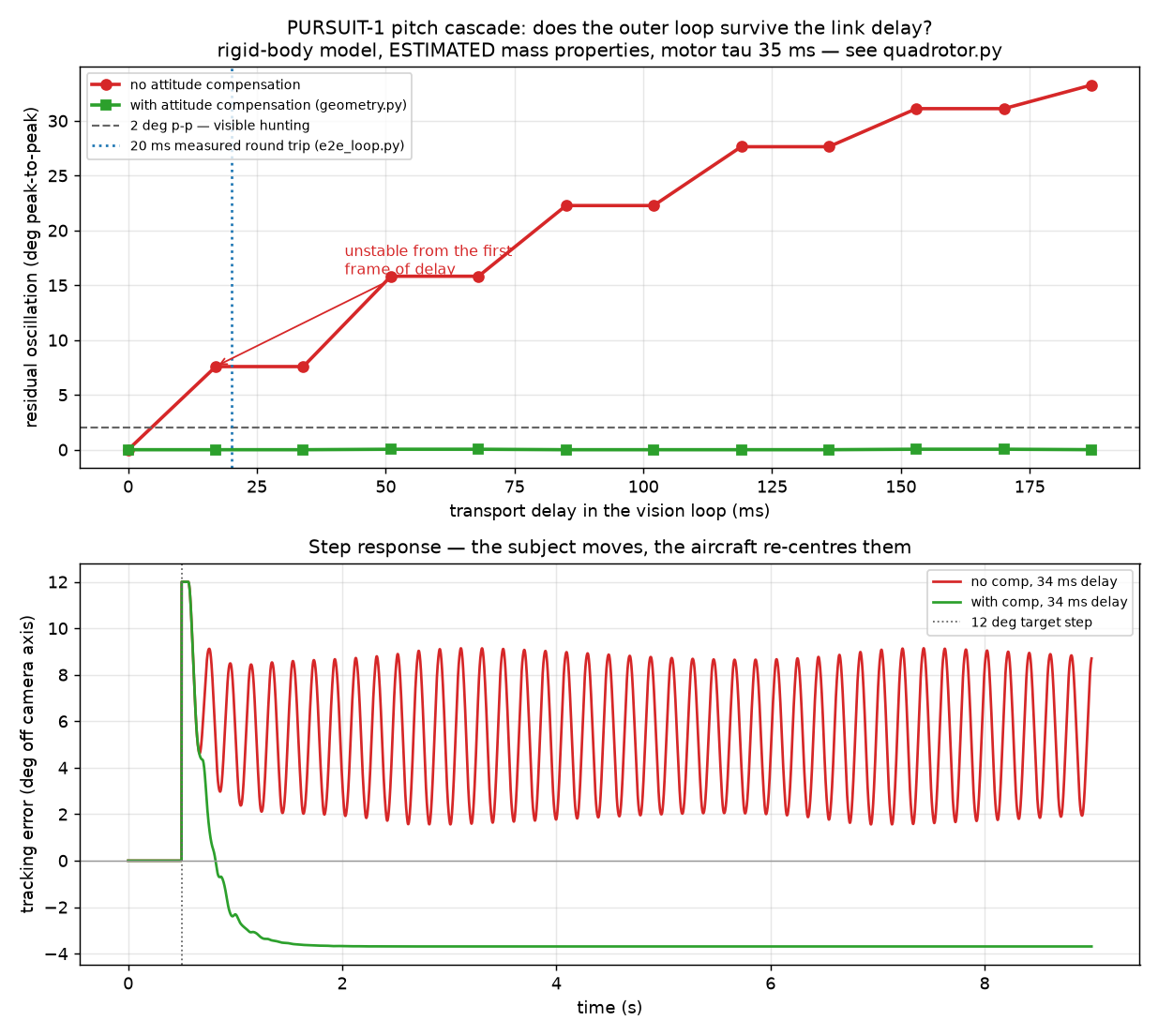
92 mm person-following quadcopter whose 4-layer PCB is its own airframe: ESP32-S3 flight firmware, off-board face and body re-identification, generated wire protocol. Bench-tested, not yet flown.
A 92 mm quadcopter whose circuit board is its own airframe, built to follow one enrolled person using face and body re-identification.
There is no separate frame. The 4-layer FR4 board is the structure, and the motors clamp into rings at the ends of its arms. The board is generated from a Python netlist rather than drawn by hand. The ESP32-S3 flight firmware is written from the IMU registers up. Person detection and identity run off-board on a laptop (ONNX Runtime), which sends attitude and throttle setpoints to the aircraft over WiFi using a wire protocol generated from a single source file.
Main components on the Pursuit drone
Pursuit drone bill of materials (BOM)
58 components, 30 distinct parts — part numbers from the project's BOM.
| Qty | Part | Footprint | Refs |
|---|---|---|---|
| 1 | XIAO-ESP32S3-Sense | XIAO_ESP32S3_Carrier | U1 |
| 1 | ICM-42688-P | ICM42688P_LGA14 | U2 |
| 4 | AO3400A | SOT-23 | Q1, Q2, Q3, Q4 |
| 1 | JST-PH-2 BATT | JST_PH_S2B-PH-K_1x02_P2.00mm_Horizontal | J1 |
| 1 | VL53L1X-Pololu | PinHeader_1x07_P2.54mm_Vertical | J2 |
| 1 | XIAO-BAT-wires | Wire_Pads_2x | J4 |
| 1 | BATT-pigtail | Wire_Pads_2x_HD | J5 |
| 10 | — | Strap_Hole_3.2 | H1, H2, H3, H4, H5, H6, H7, H8 +2 |
| 1 | 8520-M1 | Motor_Pads_2x | MT1 |
| 1 | 8520-M2 | Motor_Pads_2x | MT2 |
| 1 | 8520-M3 | Motor_Pads_2x | MT3 |
| 1 | 8520-M4 | Motor_Pads_2x | MT4 |
| 1 | VBAT | TestPoint_1mm | TP1 |
| 1 | 3V3 | TestPoint_1mm | TP2 |
| 1 | GND | TestPoint_1mm | TP3 |
| 1 | LED-Yellow-Front-Vf2.6max | LED_0805_2012Metric | LED1 |
| 1 | LED-Red-Rear | LED_0805_2012Metric | LED2 |
| 4 | SS34 | D_SMA | D1, D2, D3, D4 |
| 1 | 220uF/6.3V polymer ESR<=30m | CP_EIA-7343-31_Kemet-D | C1 |
| 1 | 10nF | C_0603_1608Metric | C2 |
Show 10 more
| Qty | Part | Footprint | Refs |
|---|---|---|---|
| 5 | 100nF | C_0603_1608Metric | C3, C10, C11, C12, C13 |
| 1 | 2.2uF | C_0603_1608Metric | C4 |
| 1 | 22uF | C_0805_2012Metric | C6 |
| 1 | 100uF/6.3V | C_1206_3216Metric | C7 |
| 1 | 100NF 100nF | C_0603_1608Metric | C8 |
| 4 | 100R | R_0603_1608Metric | R1, R2, R3, R4 |
| 4 | 1k | R_0603_1608Metric | R5, R6, R7, R8 |
| 2 | 4.7K 4.7k | R_0603_1608Metric | R9, R10 |
| 2 | 10K 10k | R_0603_1608Metric | R11, R12 |
| 2 | 150R | R_0603_1608Metric | R13, R14 |
Pursuit drone design files
The KiCad project lives in the Pai-88/pursuit-drone repository on GitHub; these links point at the commit this page was built from.
- Layouthardware/pursuit.kicad_pcb
- Schematichardware/pursuit.kicad_sch
- BOMgerbers/BOM.csv
Pursuit drone: common questions
What microcontroller does the Pursuit drone use?
The Pursuit drone is built around the XIAO-ESP32S3-Sense, from the ESP32 family.
How big is the Pursuit drone PCB?
The Pursuit drone measures 91.9 × 91.9 mm, has 4 copper layers and is 1.6 mm thick.
How many components are on the Pursuit drone?
58 components, from 30 distinct parts, with part numbers taken from the project's own BOM. The full bill of materials is listed on this page.
Where can I download the Pursuit drone design files?
From the Pai-88/pursuit-drone repository on GitHub, which has the KiCad layout, the schematic and the BOM; the links under Design files point to each one.
Can I use the Pursuit drone design in my own project?
Yes, under the terms of its MIT license, which Pai-88 chose for the repository.
Can I test firmware for the Pursuit drone without the hardware?
Yes. HardLabs builds a simulation of the board from its netlist and BOM, so you can run and debug ESP32 firmware against it before you order a PCB.
Similar boards
 ESP32
ESP32Open Book Abridged Edition
joeycastillo
85 × 115 mm65 parts2LCC-BY-SA-4.08.1k ESP32
ESP32Badge
atopile
56.3 × 39 mm239 parts4LMIT4.0k ESP32
ESP32Esp32 minimal
36.2 × 26.8 mm20 parts2LMIT4.0k ESP32
ESP32Racer
StuckAtPrototype
36 × 50.2 mm70 parts4LApache-2.03.8k ESP32
ESP32Controller
29 × 74 mm58 parts4LApache-2.03.8k ESP32
ESP32Bitaxe
skot
56.5 × 99.8 mm86 parts4LCERN-OHL-S-2.01.4k