
PyTrainer

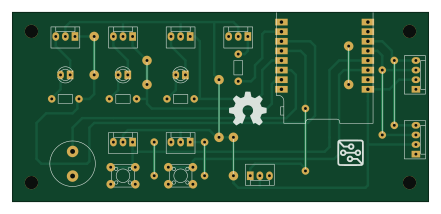
About the PyTrainer PCB
PyTrainer is an open source ESP8266 PCB design by profetolocka, published on GitHub under the MIT license. It is a 2-layer board measuring 110 × 50 mm, with 44 components from 34 distinct parts.
Its main chip is the WEMOS D1 MINI, from the ESP8266 family. Other key parts include the Header-Female-2.54_1x3. By type, the board carries 5 switches, 4 resistors, 3 LEDs, 1 IC and 1 module.
It belongs with the iot & wireless and displays & leds designs in this gallery.
From the project
Kit educativo para aprender a programar en Micropython
pyTrainer es un completo kit educativo diseñado para aquellos que desean introducirse en el apasionante mundo del aprendizaje de Micropython.
Ha sido creado teniendo como objetivo la sencillez y la economía, ya que puede ser replicado y construido por estudiantes o aficionados empleando técnicas caseras.
Está formado por una placa principal llamada pyTrainer BASIC, módulos de sensores y actuadores para interactuar con el mundo real y piezas impresas en 3D para montar las placas y crear distintas estructuras.
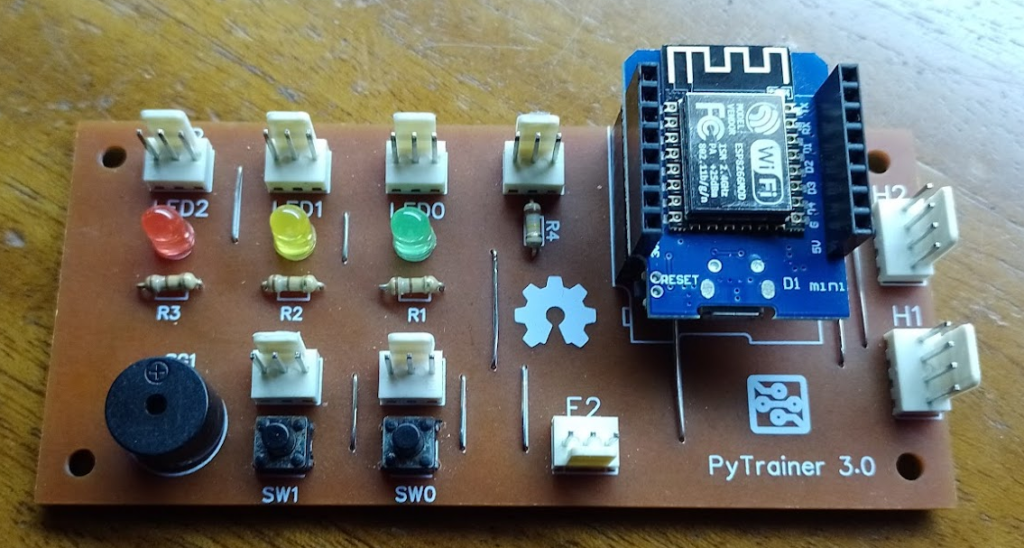
Main components on the PyTrainer
PyTrainer bill of materials (BOM)
44 components, 34 distinct parts.
| Qty | Part | Footprint | Refs |
|---|---|---|---|
| 1 | WEMOS D1 MINI | WEMOS D1 MINI | U1 |
| 1 | Header-Female-2.54_1x3 Boom Precision Elec | MOLEX-1X3 | A0 |
| 3 | Header-Female-2.54_1x3 Boom Precision Elec | MOLEX-1X3 | E0, E1, E2 |
| 2 | Header-Male-2.54_1x4_C124378 Ckmtw | MOLEX-1X4 | H1, H2 |
| 1 | Hole_gge2783 | Hole_gge2783 | Hole_gge2783 |
| 1 | Hole_gge2788 | Hole_gge2788 | Hole_gge2788 |
| 1 | Hole_gge3649 | Hole_gge3649 | Hole_gge3649 |
| 1 | Hole_gge3664 | Hole_gge3664 | Hole_gge3664 |
| 1 | Pad_gge6454 | Pad_gge6454 | Pad_gge6454 |
| 1 | Pad_gge6466 | Pad_gge6466 | Pad_gge6466 |
| 1 | Pad_gge6478 | Pad_gge6478 | Pad_gge6478 |
| 1 | Pad_gge6490 | Pad_gge6490 | Pad_gge6490 |
| 1 | Pad_gge6502 | Pad_gge6502 | Pad_gge6502 |
| 1 | Pad_gge6514 | Pad_gge6514 | Pad_gge6514 |
| 1 | Pad_gge6526 | Pad_gge6526 | Pad_gge6526 |
| 1 | Pad_gge6538 | Pad_gge6538 | Pad_gge6538 |
| 1 | Pad_gge6550 | Pad_gge6550 | Pad_gge6550 |
| 1 | Pad_gge6562 | Pad_gge6562 | Pad_gge6562 |
| 1 | Pad_gge6574 | Pad_gge6574 | Pad_gge6574 |
| 1 | Pad_gge6586 | Pad_gge6586 | Pad_gge6586 |
Show 14 more
| Qty | Part | Footprint | Refs |
|---|---|---|---|
| 1 | Pad_gge6598 | Pad_gge6598 | Pad_gge6598 |
| 1 | Pad_gge6610 | Pad_gge6610 | Pad_gge6610 |
| 1 | Pad_gge6622 | Pad_gge6622 | Pad_gge6622 |
| 1 | Pad_gge6634 | Pad_gge6634 | Pad_gge6634 |
| 1 | Pad_gge6655 | Pad_gge6655 | Pad_gge6655 |
| 1 | Pad_gge6667 | Pad_gge6667 | Pad_gge6667 |
| 1 | Pad_gge6679 | Pad_gge6679 | Pad_gge6679 |
| 1 | Pad_gge6691 | Pad_gge6691 | Pad_gge6691 |
| 3 | Header-Female-2.54_1x3 Boom Precision Elec | MOLEX-1X3 | S0, S1, S2 |
| 1 | BUZZER | BUZZER-12MM-NS | SG1 |
| 2 | Switch-6x6x7.3-square-head BBJ | SW-TH_4P-L6.0-W6.0-P4.50-LS6.5 | SW0, SW1 |
| 3 | LED-0603_R EVERLIGHT(台湾亿光) | LED-TH_BD3.0-P2.54-FD | LED0, LED1, LED2 |
| 3 | 220 | RD-3.2X1.8-1/8W | R1, R2, R3 |
| 1 | 180K | RD-3.2X1.8-1/8W | R4 |
PyTrainer design files
The KiCad project lives in the profetolocka/pyTrainer repository on GitHub; these links point at the commit this page was built from.
- Layouthardware/PyTrainer.kicad_pcb
- Schematichardware/PyTrainer.kicad_sch
PyTrainer: common questions
What microcontroller does the PyTrainer use?
The PyTrainer is built around the WEMOS D1 MINI, from the ESP8266 family.
How big is the PyTrainer PCB?
The PyTrainer measures 110 × 50 mm, has 2 copper layers and is 1.6 mm thick.
How many components are on the PyTrainer?
44 components, from 34 distinct parts. The full bill of materials is listed on this page.
Where can I download the PyTrainer design files?
From the profetolocka/pyTrainer repository on GitHub, which has the KiCad layout and the schematic; the links under Design files point to each one.
Can I use the PyTrainer design in my own project?
Yes, under the terms of its MIT license, which profetolocka chose for the repository.
Can I test firmware for the PyTrainer without the hardware?
Yes. HardLabs builds a simulation of the board from its netlist and BOM, so you can run and debug ESP8266 firmware against it before you order a PCB.
Similar boards
 ESP8266
ESP8266ControllerCircuit
stuartpittaway
75 × 30 mm20 parts2LCC-BY-NC-4.01.1k ESP8266
HASwitchPlate
aderusha
60 × 40 mm8 parts2LMIT738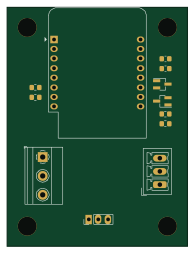 ESP8266
RatGDO-OpenSource-D1Mini-ESP8266
Kaldek
47.8 × 63.3 mm12 parts2LMIT506 ESP8266
Goatgdo
32.9 × 53.3 mm23 parts2LMIT506 ESP8266
RatGDO-OpenSource-Bare-ESP8266
55 × 82.7 mm20 parts2LMIT506 ESP8266
Iaq board
nkitanov
70.1 × 43.2 mm17 parts2LNo license398