
NTP-Server

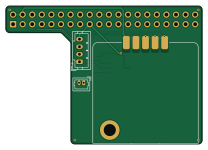
About the NTP-Server PCB
NTP-Server is an open source Raspberry Pi PCB design by Qeteshpony, published on GitHub under the BSD-2-Clause license. It is a 2-layer board measuring 52 × 36.5 mm, with 8 components from 7 distinct parts.
Its main chip is the Raspberry_Pi_2_3, from the Raspberry Pi family. Other key parts include the GT-U7 and DS3231MZ. By type, the board carries 2 ICs, 2 connectors, 2 resistors, 1 battery holder and 1 capacitor.
It belongs with the rf & radio and dev boards & breakouts designs in this gallery.
From the project
Raspberry Pi Hat for a GPS driven NTP-Server
Raspberry Pi Hat to connect a GT-U7 GPS Module and a DS3231 RTC in an orderly fashion

Main components on the NTP-Server
NTP-Server bill of materials (BOM)
8 components, 7 distinct parts.
| Qty | Part | Footprint | Refs |
|---|---|---|---|
| 1 | GT-U7 | GT-U7_SMT | U1 |
| 1 | DS3231MZ | SOIC-8_3.9x4.9mm_P1.27mm | U2 |
| 1 | Raspberry_Pi_2_3 | PinSocket_2x20_P2.54mm_Vertical | J4 |
| 1 | I2C | JST_PH_B4B-PH-K_1x04_P2.00mm_Vertical | J6 |
| 1 | CR2032 | Molex_PicoBlade_53047-0210_1x02_P1.25mm_Vertical | BT1 |
| 1 | 100n | C_0603_1608Metric_Pad1.08x0.95mm_HandSolder | C2 |
| 2 | 2k2 | R_0603_1608Metric_Pad0.98x0.95mm_HandSolder | R6, R7 |
NTP-Server design files
The KiCad project lives in the Qeteshpony/NTP-Server repository on GitHub; these links point at the commit this page was built from.
- Layoutpcb/NTP-Server.kicad_pcb
- Schematicpcb/NTP-Server.kicad_sch
NTP-Server: common questions
What microcontroller does the NTP-Server use?
The NTP-Server is built around the Raspberry_Pi_2_3, from the Raspberry Pi family.
How big is the NTP-Server PCB?
The NTP-Server measures 52 × 36.5 mm, has 2 copper layers and is 1.6 mm thick.
How many components are on the NTP-Server?
8 components, from 7 distinct parts. The full bill of materials is listed on this page.
Where can I download the NTP-Server design files?
From the Qeteshpony/NTP-Server repository on GitHub, which has the KiCad layout and the schematic; the links under Design files point to each one.
Can I use the NTP-Server design in my own project?
Yes, under the terms of its BSD-2-Clause license, which Qeteshpony chose for the repository.
Can I test firmware for the NTP-Server without the hardware?
Yes. HardLabs builds a simulation of the board from its netlist and BOM, so you can run and debug Raspberry Pi firmware against it before you order a PCB.
Similar boards
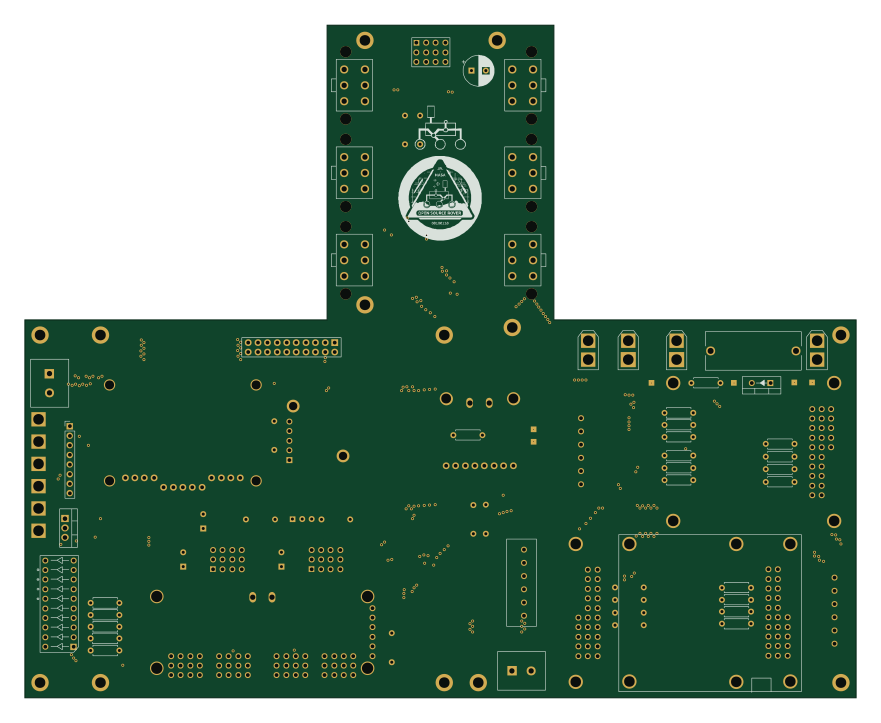 Raspberry Pi
Open source rover
nasa-jpl
220 × 178 mm144 parts2LApache-2.09.7k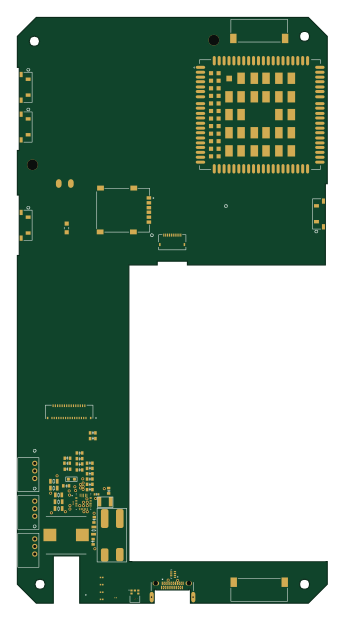 Raspberry Pi
SPIRIT
SPIRIT-org
82 × 155 mm130 parts6LCERN-OHL-S-2.01.3k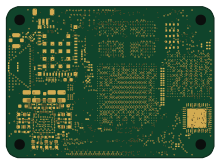 Raspberry Pi
CM5RevEng
schlae
55 × 40 mm417 parts10LNo license1.0k Raspberry Pi
Haxo hw
cardonabits
102.4 × 211.3 mm38 parts2LCustom license672 Raspberry Pi
PowerBook
BlueSCSI
74.5 × 56.3 mm78 parts2LGPL-3.0449 Raspberry Pi
Desktop 50 Pin TopConn
89.2 × 82.6 mm103 parts2LGPL-3.0449