
QRPTransceiver

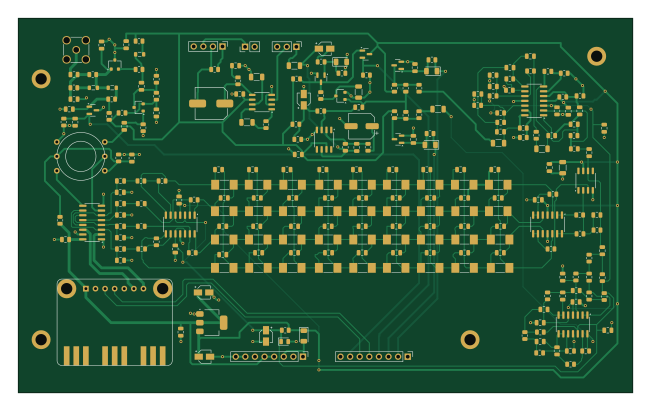
About the QRPTransceiver PCB
QRPTransceiver is an open source PCB design by richardhosking, published on GitHub under the CERN-OHL-S-2.0 license. It is a 2-layer board measuring 162.5 × 99 mm, with 255 components from 73 distinct parts.
Other key parts include the AP1117-50, Si5351Module, FST3253, TS924 and OPA1641. By type, the board carries 113 resistors, 109 capacitors, 10 ICs, 8 transistors, 6 connectors and 5 diodes.
It belongs with the rf & radio and audio designs in this gallery.
From the project
SSB HF transceiver using Phasing techniques and SM components KICAD files for receiver board initially
QRPTransceiver is an HF transceiver project using phasing techniques, surface-mount components, KiCad hardware design files, and Raspberry Pi Pico firmware for control and user interface.
- hardware design in KiCad - firmware for Raspberry Pi Pico using PlatformIO/Arduino - local oscillator control using an SI5351 - front-panel UI using a rotary encoder, push buttons, and an ILI9341 TFT display
Main components on the QRPTransceiver
QRPTransceiver bill of materials (BOM)
255 components, 73 distinct parts.
| Qty | Part | Footprint | Refs |
|---|---|---|---|
| 1 | AP1117-50 | SOT-223-3_TabPin2 | U1 |
| 1 | Si5351Module | Si5351Module | U2 |
| 1 | FST3253 | SOIC-16_3.9x9.9mm_P1.27mm | U3 |
| 4 | TS924 | SO-14_3.9x8.65mm_P1.27mm | U4, U5, U7, U8 |
| 2 | OPA1641 | SO-8_3.9x4.9mm_P1.27mm | U6, U9 |
| 1 | LM386 | SO-8_3.9x4.9mm_P1.27mm | U10 |
| 1 | VN10N | SOT-23 | Q1 |
| 2 | 2SK2394 | SC-59 | Q2, Q3 |
| 1 | J177 | SC-59 | Q4 |
| 2 | 2N3904 | SOT-23 | Q5, Q6 |
| 2 | VN10LF | SOT-23 | Q7, Q8 |
| 1 | Data | PinHeader_1x08_P2.54mm_Vertical | J1 |
| 1 | Power | PinHeader_1x08_P2.54mm_Vertical | J2 |
| 1 | Input | SMA_Amphenol_901-144_Vertical | J3 |
| 1 | Audio Gain | PinHeader_1x03_P2.54mm_Vertical | J5 |
| 1 | Audio Out | PinHeader_1x04_P2.54mm_Vertical | J6 |
| 1 | Speaker | PinHeader_1x02_P2.54mm_Vertical | J7 |
| 1 | Input | T50-2TrifilarTransformer | T1 |
| 1 | IN4001 | D_1206_3216Metric | D1 |
| 1 | 6V2 | D_0805_2012Metric | D2 |
Show 53 more
| Qty | Part | Footprint | Refs |
|---|---|---|---|
| 1 | 1N4142 | D_1206_3216Metric | D3 |
| 2 | 1N914 | D_1206_3216Metric | D4, D5 |
| 1 | 100n | L_0805_2012Metric | L1 |
| 1 | 1n | L_0805_2012Metric | L2 |
| 1 | 500u | L_0805_2012Metric | L3 |
| 42 | 10n | C_0805_2012Metric | C1, C28, C29, C30, C31, C32, C33, C34 +34 |
| 3 | 1n | C_0805_2012Metric | C2, C4, C12 |
| 4 | 10u | CP_Elec_3x5.3 | C3, C6, C87, C95 |
| 30 | 100n | C_0805_2012Metric | C5, C7, C8, C9, C10, C11, C13, C14 +22 |
| 4 | 470n | C_0805_2012Metric | C15, C16, C17, C18 |
| 4 | 220n | C_0805_2012Metric | C20, C21, C22, C23 |
| 2 | 220p | C_0805_2012Metric | C64, C79 |
| 1 | 47u | CP_Elec_3x5.3 | C71 |
| 3 | 10u | C_1206_3216Metric | C72, C102, C103 |
| 4 | 47n | C_0805_2012Metric | C75, C82, C91, C104 |
| 5 | 1u | C_1206_3216Metric | C84, C85, C97, C105, C109 |
| 2 | 33n | C_0805_2012Metric | C86, C94 |
| 2 | 470p | C_0805_2012Metric | C88, C99 |
| 1 | 47u | CP_Elec_6.3x4.9 | C92 |
| 1 | 33p | C_0805_2012Metric | C93 |
| 1 | 220u | C_Elec_8x10.2 | C106 |
| 2 | 47 | R_0805_2012Metric | R1, R3 |
| 1 | 100 | R_0805_2012Metric | R2 |
| 23 | 10K | R_0805_2012Metric | R4, R5, R10, R13, R18, R19, R20, R21 +15 |
| 9 | 1K | R_0805_2012Metric | R6, R7, R14, R15, R16, R17, R82, R111 +1 |
| 7 | 1M | R_0805_2012Metric | R8, R9, R65, R74, R78, R83, R87 |
| 1 | 10 | R_0805_2012Metric | R11 |
| 1 | 6K8 | R_0805_2012Metric | R12 |
| 4 | 3K3 | R_MELF_MMB-0207 | R22, R23, R24, R25 |
| 4 | 4K7 | R_MELF_MMB-0207 | R26, R27, R28, R29 |
| 4 | 6K8 | R_MELF_MMB-0207 | R30, R31, R32, R33 |
| 4 | 10K | R_MELF_MMB-0207 | R34, R35, R36, R37 |
| 4 | 15K | R_MELF_MMB-0207 | R38, R39, R40, R41 |
| 4 | 22K | R_MELF_MMB-0207 | R42, R43, R44, R45 |
| 4 | 33K | R_MELF_MMB-0207 | R46, R47, R48, R49 |
| 4 | 47K | R_MELF_MMB-0207 | R50, R51, R52, R53 |
| 4 | 68K | R_MELF_MMB-0207 | R54, R55, R56, R57 |
| 2 | 220K | R_0805_2012Metric | R62, R91 |
| 1 | 22K | R_0805_2012Metric | R63 |
| 3 | 47K | R_0805_2012Metric | R64, R95, R102 |
| 3 | 4K7 | R_0805_2012Metric | R66, R79, R84 |
| 3 | 33K | R_0805_2012Metric | R67, R68, R72 |
| 2 | 18K | R_0805_2012Metric | R70, R92 |
| 4 | 56K | R_0805_2012Metric | R76, R77, R90, R93 |
| 4 | 100K | R_0805_2012Metric | R80, R81, R109, R110 |
| 2 | 470K | R_0805_2012Metric | R86, R99 |
| 2 | 39K | R_0805_2012Metric | R88, R100 |
| 2 | 3K3 | R_0805_2012Metric | R89, R96 |
| 1 | 390K | R_0805_2012Metric | R97 |
| 1 | 1K2 | R_0805_2012Metric | R103 |
| 1 | 27K | R_0805_2012Metric | R104 |
| 1 | 10R | R_0805_2012Metric | R105 |
| 1 | 470R | R_0805_2012Metric | R108 |
QRPTransceiver design files
The KiCad project lives in the richardhosking/QRPTransceiver repository on GitHub; these links point at the commit this page was built from.
QRPTransceiver: common questions
How big is the QRPTransceiver PCB?
The QRPTransceiver measures 162.5 × 99 mm, has 2 copper layers and is 1.6 mm thick.
How many components are on the QRPTransceiver?
255 components, from 73 distinct parts. The full bill of materials is listed on this page.
Where can I download the QRPTransceiver design files?
From the richardhosking/QRPTransceiver repository on GitHub, which has the KiCad layout and the schematic; the links under Design files point to each one.
Can I use the QRPTransceiver design in my own project?
Yes, under the terms of its CERN-OHL-S-2.0 license, which richardhosking chose for the repository.
Similar boards
KLOR
GEIGEIGEIST
160.2 × 118.3 mm79 parts2LGPL-3.01.2k
ButtonsLEDs
shanteacontrols
390 × 37 mm82 parts2LApache-2.0956
USB
52 × 12.6 mm6 parts2LApache-2.0956
Pots
390 × 93 mm75 parts2LApache-2.0956
PicoGUS Hand386
polpo
29.2 × 75.2 mm43 parts4LGPL-2.0800
Snark barker
schlae
231.1 × 106.7 mm193 parts2LNo license687