
AwesomeStudioPedal

About the AwesomeStudioPedal PCB
AwesomeStudioPedal is an open source ESP32 PCB design by tgd1975, published on GitHub under the MIT license. It is a board, with 21 components from 8 distinct parts.
Its main chip is the ESP32-S3-DevKitC-1, from the ESP32 family. Other key parts include the ULN2803A and LTV-846. By type, the board carries 9 resistors, 5 ICs, 4 relays, 2 capacitors and 1 connector.
It belongs with the iot & wireless, keyboards and audio designs in this gallery.
From the project
Open-source Bluetooth foot controller for musicians, streamers, and studio workers. Programmable ESP32-based pedal that sends keypresses, media commands, or typed strings to any Bluetooth device. No drivers needed - works with iPad, iPhone, Android, Windows, Mac, and Linux.
Ideas are lightweight, qualitative proposals. Each lives in open/ until it is converted into a task or moved to archived/ for history.
The separator between NNN and the slug carries the meaning:
- Hyphen (idea-027-circuit-skill.md) → main file. Renders in OVERVIEW.md as one row. - Dot (idea-027.erc-engine.md) → sub-note. Never renders in the index. Linked from the main file's body.
Main components on the AwesomeStudioPedal
AwesomeStudioPedal bill of materials (BOM)
21 components, 8 distinct parts.
| Qty | Part | Footprint | Refs |
|---|---|---|---|
| 1 | ESP32-S3-DevKitC-1 | ESP32-S3-DevKitC-1 | U1 |
| 1 | ULN2803A | DIP-18_W7.62mm | U2 |
| 3 | LTV-846 | DIP-16_W7.62mm | U3, U4, U5 |
| 1 | DUT_NodeMCU-30 | PinSocket_1x15_P2.54mm_Vertical_x2_0.9in | J1 |
| 4 | Reed-SPST-NO-5V | Relay_DPDT_Omron_G5V-2 | K1, K2, K3, K4 |
| 1 | 100uF | CP_Radial_D5.0mm_P2.00mm | C1 |
| 1 | 100nF | C_Disc_D5.0mm_W2.5mm_P5.00mm | C2 |
| 9 | 10k | R_Axial_DIN0207_L6.3mm_D2.5mm_P2.54mm_Horizontal | R1, R2, R3, R4, R5, R6, R7, R8 +1 |
AwesomeStudioPedal design files
The KiCad project lives in the tgd1975/AwesomeStudioPedal repository on GitHub; these links point at the commit this page was built from.
AwesomeStudioPedal: common questions
What microcontroller does the AwesomeStudioPedal use?
The AwesomeStudioPedal is built around the ESP32-S3-DevKitC-1, from the ESP32 family.
How many components are on the AwesomeStudioPedal?
21 components, from 8 distinct parts. The full bill of materials is listed on this page.
Where can I download the AwesomeStudioPedal design files?
From the tgd1975/AwesomeStudioPedal repository on GitHub, which has a netlist; the links under Design files point to each one.
Can I use the AwesomeStudioPedal design in my own project?
Yes, under the terms of its MIT license, which tgd1975 chose for the repository.
Can I test firmware for the AwesomeStudioPedal without the hardware?
Yes. HardLabs builds a simulation of the board from its netlist and BOM, so you can run and debug ESP32 firmware against it before you order a PCB.
Similar boards
 ESP32
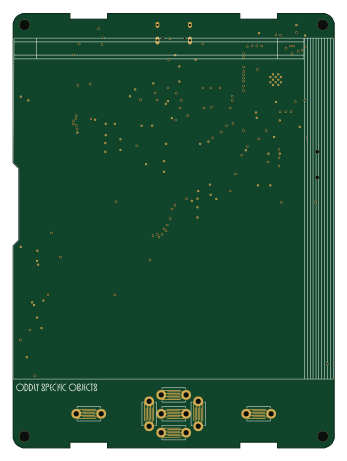
ESP32Open Book Abridged Edition
joeycastillo
85 × 115 mm65 parts2LCC-BY-SA-4.08.1k ESP32
ESP32Esp32 minimal
atopile
36.2 × 26.8 mm20 parts2LMIT4.0k ESP32
ESP32Badge
56.3 × 39 mm239 parts4LMIT4.0k ESP32
ESP32Controller
StuckAtPrototype
29 × 74 mm58 parts4LApache-2.03.8k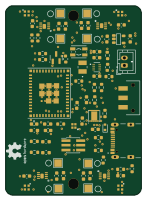 ESP32
ESP32Racer
36 × 50.2 mm70 parts4LApache-2.03.8k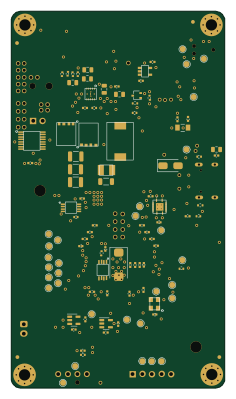 ESP32
ESP32Bitaxe
skot
56.5 × 99.8 mm86 parts4LCERN-OHL-S-2.01.4k