
Magic-8-badge

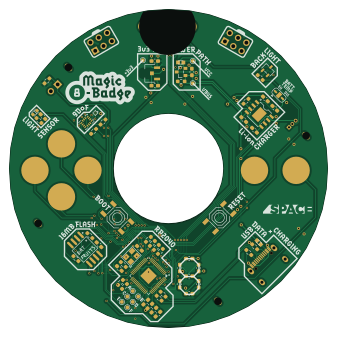
About the Magic-8-badge PCB
Magic-8-badge is an open source RP2040/RP2350 PCB design by tylercrumpton, published on GitHub. It is a 2-layer board measuring 84 × 84 mm, with 63 components from 34 distinct parts.
Its main chip is the RP2040, from the RP2040/RP2350 family. Other key parts include the TC4056A, W25Q128JVSIQTR, GC9A01 LCD, QMI8658C and QMC6308. By type, the board carries 23 resistors, 20 capacitors, 7 ICs, 3 connectors, 2 transistors and 2 switches.
It belongs with the wearables and sensors designs in this gallery.
From the project
An Open Source CircuitPython-compatible PCB badge that can (maybe) tell the future!
Hardware, software, and other resouces for a fun little CircuitPython-compatible PCB badge!
Note: Lots of information and improvements to be added soon!
All of the hardware design files are included in the hardware/ directory. The board was designed with KiCad 7, using mostly components from JLCPCB's Assembly Parts Library.
The Magic 8-Badge was created to utilize Adafruit's CircuitPython 🐍, and will hopefully have a board definition available on the CircuitPython website soon. The v1 version of the Magic 8-Badge distrbuted at PhreakNIC 24 in Nov 2023 are runnings a slightly-modified…
Main components on the Magic-8-badge
Magic-8-badge bill of materials (BOM)
63 components, 34 distinct parts — part numbers from the project's BOM.
| Qty | Part | Footprint | Refs |
|---|---|---|---|
| 1 | TC4056A FM(富满) | ESOP-8_L4.9-W3.9-P1.27-LS6.0-BR-EP3.3 | U1 |
| 1 | W25Q128JVSIQTR | SOIC-8_L5.3-W5.3-P1.27-LS8.0-BL | U2 |
| 1 | RP2040 | LQFN-56_L7.0-W7.0-P0.4-EP | U3 |
| 1 | GC9A01 LCD | GC9A01 | U4 |
| 1 | QMI8658C QST(上海矽睿) | LGA-14_L3.0-W2.5-P0.50-BR | U7 |
| 1 | QMC6308 QST(上海矽睿) | WLCSP-4_L0.8-W0.8-R2-C2-P0.40-BL | U9 |
| 1 | ME6210A33PG MICRONE(南京微盟) | SOT-89_L4.5-W2.5-P1.50-LS4.2-BR | U10 |
| 1 | AO3401A Alpha & Omega Semicon | SOT-23_L2.9-W1.3-P1.90-LS2.4-BR | Q1 |
| 1 | S8050 | SOT-23-3_L3.0-W1.7-P0.95-LS2.9-BR | Q2 |
| 1 | X322512MSB4SI | OSC-SMD_4P-L3.2-W2.5-BL | X1 |
| 1 | BattConn | CONN-TH_3P-P1.25_HDGC_HDGC1251WR-3P | J1 |
| 1 | SAO Header 1 | Badgelife-SAOv169-BADGE-2x3 | J2 |
| 1 | SAO Header 2 | Badgelife-SAOv169-BADGE-2x3 | J3 |
| 1 | TS-1187A-B-A-B | SW-SMD_4P-L5.1-W5.1-P3.70-LS6.5-TL-2 | BOOT_SEL1 |
| 1 | BATT_TEMP_EN | SolderJumper-3_P1.3mm_Open_RoundedPad1.0x1.5mm | JP1 |
| 1 | SW_Push | PinHeader_1x02_P2.54mm_Horizontal | SW1 |
| 1 | TS-1187A-B-A-B | SW-SMD_4P-L5.1-W5.1-P3.70-LS6.5-TL-2 | SW2 |
| 1 | USB-TYPE-C-018 | USB-C_SMD-TYPE-C-31-M-12 | USB1 |
| 2 | MSK4005 SHIKUES(时科) | SOD-523F_L1.2-W0.8-LS1.7-RD | D1, D2 |
| 10 | 100NF 100nF | C_0603_1608Metric_Pad1.08x0.95mm_HandSolder | C1, C7, C8, C10, C11, C12, C13, C14 +2 |
Show 14 more
| Qty | Part | Footprint | Refs |
|---|---|---|---|
| 5 | 10UF 10uF | C_0603_1608Metric_Pad1.08x0.95mm_HandSolder | C2, C3, C4, C5, C6 |
| 1 | 22UF 22uF | C_0603_1608Metric_Pad1.08x0.95mm_HandSolder | C9 |
| 2 | 1UF 1uF | C_0603_1608Metric_Pad1.08x0.95mm_HandSolder | C15, C18 |
| 2 | 27PF 27pF | C_0603_1608Metric_Pad1.08x0.95mm_HandSolder | C19, C20 |
| 1 | ALS-PT19-315C/L177/TR8 EVERLIGHT(亿光) | SENSORS-SMD_ALS-PT19 | R1 |
| 3 | 1K | R_0603_1608Metric_Pad0.98x0.95mm_HandSolder | R2, R11, R18 |
| 3 | 2.4K | R_0603_1608Metric_Pad0.98x0.95mm_HandSolder | R3, R22, R23 |
| 2 | 100K | R_0603_1608Metric_Pad0.98x0.95mm_HandSolder | R4, R19 |
| 1 | 24K | R_0603_1608Metric_Pad0.98x0.95mm_HandSolder | R5 |
| 1 | DNF | R_0603_1608Metric_Pad0.98x0.95mm_HandSolder | R6 |
| 2 | 27.4 | R_0603_1608Metric_Pad0.98x0.95mm_HandSolder | R7, R8 |
| 2 | 5.1K | R_0603_1608Metric_Pad0.98x0.95mm_HandSolder | R9, R10 |
| 6 | 1M | R_0603_1608Metric_Pad0.98x0.95mm_HandSolder | R12, R13, R14, R15, R16, R17 |
| 2 | DNF | C_0603_1608Metric_Pad1.08x0.95mm_HandSolder | R20, R21 |
Magic-8-badge design files
The KiCad project lives in the tylercrumpton/magic-8-badge repository on GitHub; these links point at the commit this page was built from.
Magic-8-badge: common questions
What microcontroller does the Magic-8-badge use?
The Magic-8-badge is built around the RP2040, from the RP2040/RP2350 family.
How big is the Magic-8-badge PCB?
The Magic-8-badge measures 84 × 84 mm, has 2 copper layers and is 1.6 mm thick.
How many components are on the Magic-8-badge?
63 components, from 34 distinct parts, with part numbers taken from the project's own BOM. The full bill of materials is listed on this page.
Where can I download the Magic-8-badge design files?
From the tylercrumpton/magic-8-badge repository on GitHub, which has the KiCad layout, the schematic and the BOM; the links under Design files point to each one.
Can I use the Magic-8-badge design in my own project?
The repository has no license, so all rights stay with tylercrumpton. Use it as a reference, and ask the author before reusing the design.
Can I test firmware for the Magic-8-badge without the hardware?
Yes. HardLabs builds a simulation of the board from its netlist and BOM, so you can run and debug RP2040/RP2350 firmware against it before you order a PCB.
Similar boards
 RP2040/RP2350
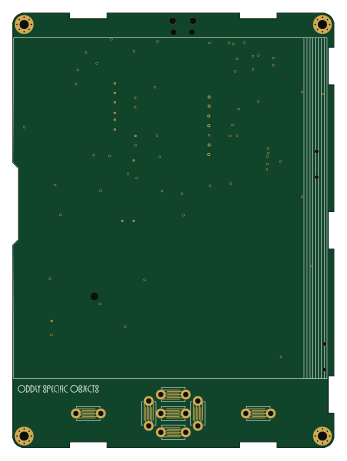
Open Book Abridged Edition
joeycastillo
85 × 115 mm29 parts2LCC-BY-SA-4.08.1k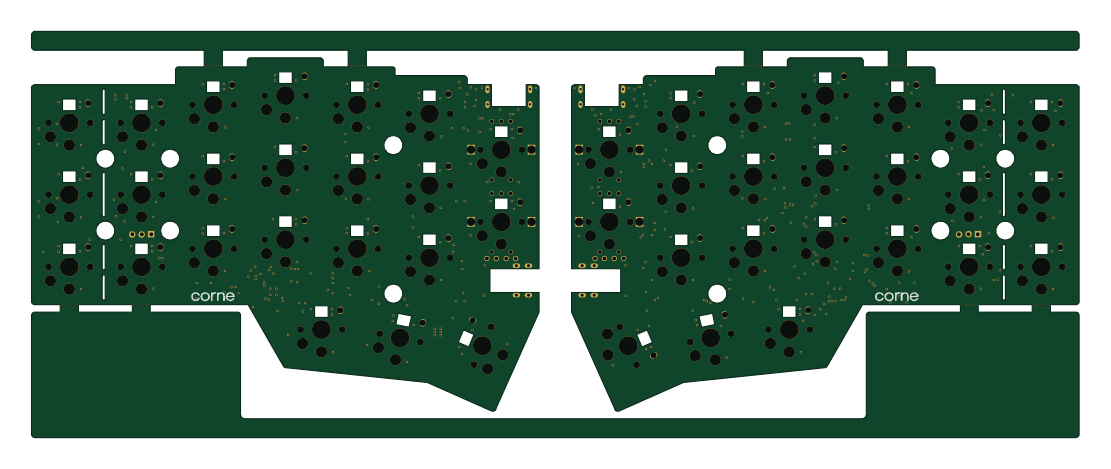 RP2040/RP2350
Corne
foostan
277.2 × 107.5 mm164 parts2LCC-BY-4.07.7k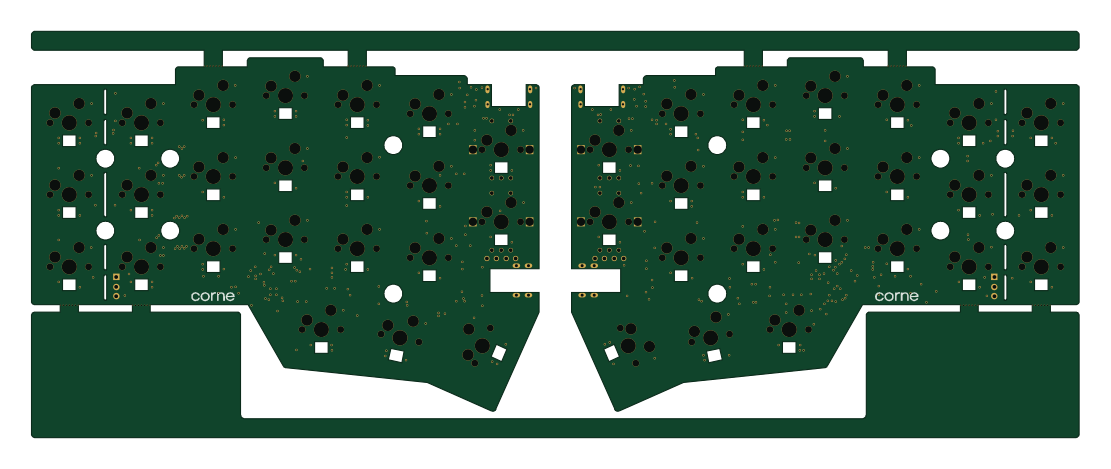 RP2040/RP2350
Corne
277.2 × 107.5 mm164 parts2LCC-BY-4.07.7k RP2040/RP2350
MSA
Mentra-Community
30.5 × 138 mm61 parts2LMIT1.2k RP2040/RP2350
Open Source Smart Glasses
93 × 10.5 mm80 parts4LMIT1.2k RP2040/RP2350
Msa
47.8 × 9.4 mm53 parts2LMIT1.2k