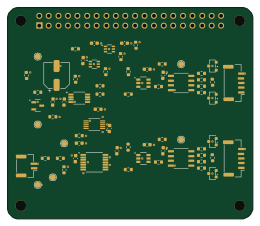
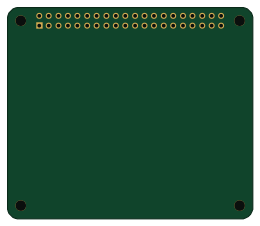
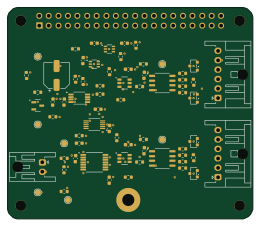
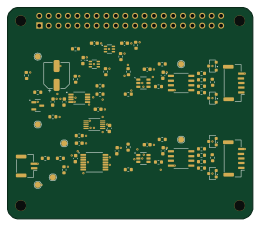
Assembly source

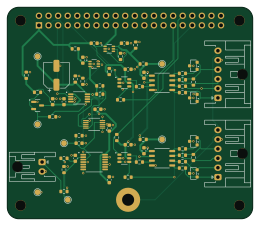
About the Assembly source PCB
Assembly source is an open source PCB design by zcrawling, published on GitHub. It is a 4-layer board measuring 65 × 56 mm, with 65 components from 27 distinct parts.
Other key parts include the LM66100DCKR, TLV803ED29DBZR, SN74LVC2G17DBVR, THVD1451DR and TMUX1511PWR. By type, the board carries 32 resistors, 15 capacitors, 10 ICs, 4 connectors and 4 diodes.
From the project
2026 LOONAR Rover project
J2·J3은 수평형 JST XA 6핀, J4는 수평형 JST XA 2핀으로 변경했다. J1 Raspberry Pi 40핀 소켓은 유지한다. J2/J3의 6번은 CHASSIS 전용이며 SH1 M3 도금 체결점으로 연결되고 보드 GND와 분리되어 있다. R107/R207 120Ω은 기본 실장이다.
회로도 4장, 회로 항목 73개, 핀 연결 243개를 검증했다. ERC 오류/경고 0, PCB DRC 위반 0, 미연결 0, 회로도–PCB 불일치 0. 실제 실장 부품은 SMT 61개와 PTH 커넥터 4개이다. 7개 테스트포인트와 SH1은 PCB 형상이다.
제조 자료는 manufacturing 폴더에 있으며, 발주 전 FABRICATION_NOTES.md의 완성 홀 치수·XA 고정 슬롯·조립 방향을 업체와 확인해야 한다. 19mm 적층 및 공식 Active Cooler 조건을 유지한다. XA 플러그와 케이블은 보드 바깥 공간이 필요하다. SH1 링터미널 및 M3 하드웨어는 별도 조립한다.
Main components on the Assembly source
Assembly source bill of materials (BOM)
65 components, 27 distinct parts — part numbers from the project's BOM.
| Qty | Part | Footprint | Refs |
|---|---|---|---|
| 2 | LM66100DCKR | TI_DCK0006A | U1, U2 |
| 1 | TLV803ED29DBZR | TI_DBZ0003A | U3 |
| 2 | SN74LVC2G17DBVR | TI_DBV0006A | U100, U200 |
| 2 | THVD1451DR | TI_D0008A | U101, U201 |
| 1 | TMUX1511PWR | TI_PW0014A | U300 |
| 1 | ADS1115IDGSR | TI_DGS0010A | U301 |
| 1 | TCA9517ADGKR | TI_DGK0008A | U302 |
| 1 | PRT-16763 Pi 5 / H16 / gap19 | GPIO_2x20_H16_Drill1.02 | J1 |
| 2 | S06B-XASK-1(LF)(SN) S06B-XASK-1 | XA_S06B_Horizontal | J2, J3 |
| 1 | S02B-XASS-1(LF)(SN) S02B-XASS-1 | XA_S02B_Horizontal | J4 |
| 4 | CDSOT23-SM712 | Bourns_CDSOT23_SM712 | D100, D101, D200, D201 |
| 3 | GRM188R71E105KA12D 1u / 25V / X7R | Capacitor_SMD_C_0603_1608Metric | C1, C5, C300 |
| 1 | GRM188R61A475KE15D 4.7u / 10V / X5R | Capacitor_SMD_C_0603_1608Metric | C2 |
| 1 | EEEFK1C101P 100u / 16V / 20% | Panasonic_FK_D_6.3x5.8 | C3 |
| 9 | GRM188R71C104KA01D 100n / 16V / X7R | Capacitor_SMD_C_0603_1608Metric | C4, C100, C101, C200, C201, C302, C303, C304 +1 |
| 1 | GRM1885C1H102JA01D 1n / 50V / C0G | Capacitor_SMD_C_0603_1608Metric | C301 |
| 1 | CRCW060322R0FKEAHP 22R pulse | Resistor_SMD_R_0603_1608Metric | R1 |
| 7 | CRCW060310K0FKEA 10k | Resistor_SMD_R_0603_1608Metric | R2, R3, R4, R7, R8, R100, R200 |
| 1 | CRCW0603100KFKEA 100k | Resistor_SMD_R_0603_1608Metric | R5 |
| 1 | CRCW06031K00FKEA 1k | Resistor_SMD_R_0603_1608Metric | R6 |
Show 7 more
| Qty | Part | Footprint | Refs |
|---|---|---|---|
| 4 | CRCW060347R0FKEA 47R | Resistor_SMD_R_0603_1608Metric | R101, R102, R201, R202 |
| 8 | CRCW0603010RJNEAHP 10R pulse | Resistor_SMD_R_0603_1608Metric | R103, R104, R105, R106, R203, R204, R205, R206 |
| 2 | CRCW0603120RFKEA 120R / fitted | Resistor_SMD_R_0603_1608Metric | R107, R207 |
| 2 | CRCW06030000Z0EA 0R / rail link | Resistor_SMD_R_0603_1608Metric | R108, R208 |
| 3 | TNPW060347K0BEEA 47k / 0.1% | Resistor_SMD_R_0603_1608Metric | R300, R301, R303 |
| 1 | TNPW060318K0BEEA 18k / 0.1% | Resistor_SMD_R_0603_1608Metric | R302 |
| 2 | CRCW06034K70FKEA 4.7k | Resistor_SMD_R_0603_1608Metric | R304, R305 |
Assembly source design files
The KiCad project lives in the zcrawling/LOONARover repository on GitHub; these links point at the commit this page was built from.
Assembly source: common questions
How big is the Assembly source PCB?
The Assembly source measures 65 × 56 mm, has 4 copper layers and is 1.6 mm thick.
How many components are on the Assembly source?
65 components, from 27 distinct parts, with part numbers taken from the project's own BOM. The full bill of materials is listed on this page.
Where can I download the Assembly source design files?
From the zcrawling/LOONARover repository on GitHub, which has the KiCad layout and the BOM; the links under Design files point to each one.
Can I use the Assembly source design in my own project?
The repository has no license, so all rights stay with zcrawling. Use it as a reference, and ask the author before reusing the design.