
BIOCHEST-ECG-EMG

About the BIOCHEST-ECG-EMG PCB
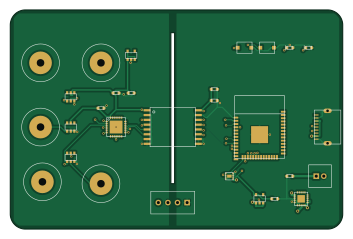
BIOCHEST-ECG-EMG is an open source ESP32 PCB design by 8aChristian, published on GitHub. It is a 4-layer board measuring 88 × 58 mm, with 29 components from 27 distinct parts.
Its main chip is the ESP32-S3-MINI-1-N8, from the ESP32 family. Other key parts include the ADS1293CZXER, ISO7741UDWR, TPS7A2033PDBVR, AP2112K-3.3TRG1 and BQ24075RGTR. By type, the board carries 8 ICs, 7 capacitors, 6 connectors, 5 diodes, 2 switches and 1 battery holder.
It belongs with the iot & wireless and wearables designs in this gallery.
From the project
BIOCHEST-ECG/EMG is an ultra-compact, medical-grade, 4-layer wearable biosignal acquisition platform engineered for continuous, high-fidelity Electrocardiography (ECG) and Surface Electromyography (sEMG) telemetry. Designed strictly around IEC 60601-1 (2x MOPP) and IPC-2221 Class
BIOCHEST-ECG/EMG is an ultra-compact, medical-grade, 4-layer wearable biosignal acquisition platform engineered for continuous, high-fidelity Electrocardiography (ECG) and Surface Electromyography (sEMG) telemetry. Designed strictly around IEC 60601-1 (2x MOPP) and IPC-2221 Class 2 medical standards, the device combines a 24-bit bio-potential analog front-end (AFE) with galvanic barrier isolation and an ESP32-S3 dual-core microcontroller featuring native Wi-Fi, BLE 5.0, and USB-C power-path management.
Main components on the BIOCHEST-ECG-EMG
BIOCHEST-ECG-EMG bill of materials (BOM)
29 components, 27 distinct parts — part numbers from the project's BOM.
| Qty | Part | Footprint | Refs |
|---|---|---|---|
| 1 | ADS1293CZXER ADS1293 Texas Instruments | ADS1293_WQFN-28_5x5mm | U1 |
| 1 | ISO7741UDWR ISO7741U Texas Instruments | ISO7741U_SOIC-16W_DWW | U2 |
| 1 | ESP32-S3-MINI-1-N8 ESP32-S3-MINI-1 Espressif Systems | ESP32-S3-MINI-1 | U3 |
| 1 | TPS7A2033PDBVR TPS7A2033 Texas Instruments | SOT-23-5 | U7 |
| 1 | AP2112K-3.3TRG1 AP2112K-3.3 Diodes Incorporated | SOT-23-5 | U8 |
| 1 | BQ24075RGTR BQ24075 Texas Instruments | BQ24075_QFN-20_3.5x3.5mm | U9 |
| 1 | B0503S-1WR3 Mornsun | B0503S_1WR3_SIP-4 | U10 |
| 1 | MAX17048G+T10 MAX17048 Analog Devices / Maxim | MAX17048_DFN-8_2x2mm | U11 |
| 1 | ECG-SNAP-10MM ECG+ Generic / Keystone | Snap_Button_Male_10mm | J1 |
| 1 | ECG-SNAP-10MM ECG- Generic / Keystone | Snap_Button_Male_10mm | J2 |
| 1 | ECG-SNAP-10MM RLD Generic / Keystone | Snap_Button_Male_10mm | J3 |
| 1 | ECG-SNAP-10MM EMG+ Generic / Keystone | Snap_Button_Male_10mm | J4 |
| 1 | ECG-SNAP-10MM EMG- Generic / Keystone | Snap_Button_Male_10mm | J5 |
| 1 | TYPE-C-31-M-12 USB_C Korean Hroparts / GCT | USB_C_Receptacle_16P_SurfaceMount | J6 |
| 1 | S2B-PH-K-S VBAT_JST JST | JST_PH_S2B-PH-K-S_1x02_P2.00mm_Horizontal | BT1 |
| 1 | KMR221GLFS RESET C&K / Panasonic | SW_Push_SPST_NO_3x4mm | SW1 |
| 1 | KMR221GLFS BOOT C&K / Panasonic | SW_Push_SPST_NO_3x4mm | SW2 |
| 3 | TPD2E001DRLR TPD2E001 Texas Instruments | TPD2E001_SOT-23 | D1, D2, D3 |
| 1 | 19-217/GHC-YR1S2/3T STATUS_GRN Everlight / Lite-On | LED_0603_1608Metric | D4 |
| 1 | 19-217/R6C-AL1M2VY/3T ALERT_RED Everlight / Lite-On | LED_0603_1608Metric | D5 |
Show 7 more
| Qty | Part | Footprint | Refs |
|---|---|---|---|
| 1 | CL10B104KB8NNNC 100nF_AVDD Samsung / Murata | C_0603_1608Metric | C1 |
| 1 | CL10B104KB8NNNC 100nF_DVDD Samsung / Murata | C_0603_1608Metric | C2 |
| 1 | CL10B104KB8NNNC 100nF_VDD Samsung / Murata | C_0603_1608Metric | C3 |
| 1 | CL10B104KB8NNNC 100nF_ISO2 Samsung / Murata | C_0603_1608Metric | C4 |
| 1 | CL10A106KO8NNNC 10uF_3V3 Samsung / Murata | C_0603_1608Metric | C5 |
| 1 | CL10A475KO8NNNC 4.7uF_3V3 Samsung / Murata | C_0603_1608Metric | C6 |
| 1 | CL10A106KO8NNNC 10uF_VBAT Samsung / Murata | C_0603_1608Metric | C7 |
BIOCHEST-ECG-EMG design files
The KiCad project lives in the 8aChristian/BIOCHEST-ECG-EMG repository on GitHub; these links point at the commit this page was built from.
BIOCHEST-ECG-EMG: common questions
What microcontroller does the BIOCHEST-ECG-EMG use?
The BIOCHEST-ECG-EMG is built around the ESP32-S3-MINI-1-N8, from the ESP32 family.
How big is the BIOCHEST-ECG-EMG PCB?
The BIOCHEST-ECG-EMG measures 88 × 58 mm, has 4 copper layers and is 1.6 mm thick.
How many components are on the BIOCHEST-ECG-EMG?
29 components, from 27 distinct parts, with part numbers taken from the project's own BOM. The full bill of materials is listed on this page.
Where can I download the BIOCHEST-ECG-EMG design files?
From the 8aChristian/BIOCHEST-ECG-EMG repository on GitHub, which has the KiCad layout, the schematic and the BOM; the links under Design files point to each one.
Can I use the BIOCHEST-ECG-EMG design in my own project?
The repository has no license, so all rights stay with 8aChristian. Use it as a reference, and ask the author before reusing the design.
Can I test firmware for the BIOCHEST-ECG-EMG without the hardware?
Yes. HardLabs builds a simulation of the board from its netlist and BOM, so you can run and debug ESP32 firmware against it before you order a PCB.
Similar boards
 ESP32
ESP32Open Book Abridged Edition
joeycastillo
85 × 115 mm65 parts2LCC-BY-SA-4.08.1k ESP32
ESP32Badge
atopile
56.3 × 39 mm239 parts4LMIT4.0k ESP32
ESP32Esp32 minimal
36.2 × 26.8 mm20 parts2LMIT4.0k ESP32
ESP32Racer
StuckAtPrototype
36 × 50.2 mm70 parts4LApache-2.03.8k ESP32
ESP32Controller
29 × 74 mm58 parts4LApache-2.03.8k ESP32
ESP32Bitaxe
skot
56.5 × 99.8 mm86 parts4LCERN-OHL-S-2.01.4k