
MicroMETER

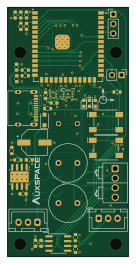
About the MicroMETER PCB
MicroMETER is an open source ESP32 PCB design by AUXSPACEeV, published on GitHub under the CERN-OHL-P-2.0 license. It is a 4-layer board measuring 32 × 66 mm, with 82 components from 34 distinct parts.
Its main chip is the ESP32-S3-WROOM-1, from the ESP32 family. Other key parts include the TCAN334, TPS7B8601QDDARQ1, LSM6DSO32XTR and BMP581. By type, the board carries 32 resistors, 23 capacitors, 8 transistors, 6 connectors, 5 ICs and 5 diodes.
It belongs with the power & battery designs in this gallery.
From the project
Minimal Flightcomputer
Barometer BMP581 for altitude computation IMU STM LSM6DS032x for acceloration and rotation data Buzzer for easier commissioning and recovery 2-channel Pyro ignition for recovery CAN Bus for communication with posible expansion PCBs µSD-Card for logging remove before flight jumper GPIO38 is pulled HIGH when the jumper is removed battery voltage measurement
µMETER provides two separated Pyro Channels. To prevent voltage drops from the ignition the battery is decoupled via two 680µF capacitors. The capacitors are charging/discharging when the ARM-Signal is enabled/disabled for about 2.8 sec. To…
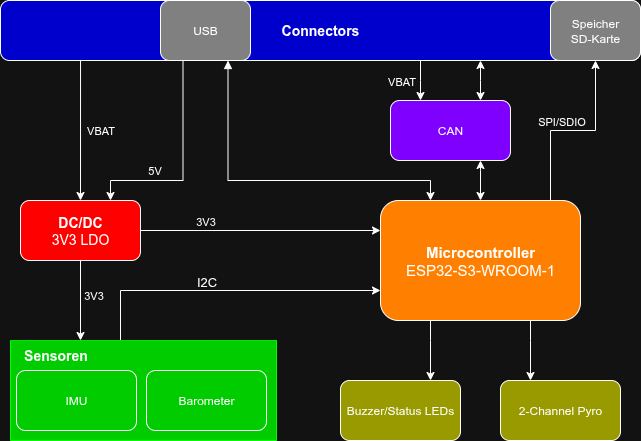
Main components on the MicroMETER
MicroMETER bill of materials (BOM)
82 components, 34 distinct parts — part numbers from the project's BOM.
| Qty | Part | Footprint | Refs |
|---|---|---|---|
| 1 | TCAN334 | SOIC-8_3.9x4.9mm_P1.27mm | U1 |
| 1 | TPS7B8601QDDARQ1 | Texas_R-PDSO-G8_EP2.95x4.9mm_Mask2.4x3.1mm_ThermalVias | U2 |
| 1 | LSM6DSO32XTR | LGA_O32XTR_STM | U3 |
| 1 | ESP32-S3-WROOM-1 | ESP32-S3-WROOM-1 | U4 |
| 1 | BMP581 | ST_HLGA-10_2x2mm_P0.5mm_LayoutBorder3x2y | U8 |
| 5 | 2N7002K | SOT-23 | Q1, Q4, Q5, Q6, Q8 |
| 3 | DMP3099L | SOT-23 | Q2, Q3, Q7 |
| 1 | 693072010801 Wurth Elektronik | microSD_HC_Wuerth_693072010801 | J1 |
| 1 | 61300311121 PinHeader 2,54mm 3p | PinHeader_1x03_P2.54mm_Vertical | J2 |
| 2 | JST XH 3p | JST_XH_B3B-XH-A_1x03_P2.50mm_Vertical | J3, J4 |
| 1 | 691210910004 Wurth Elektronik | 691210910004 | J5 |
| 1 | 629722000214 USB_C_Plug_USB2.0 Wurth Elektronik | J_Wurth_WR-USB_629722000214 | P1 |
| 1 | 61300211121 PinHeader 2,54mm 2p | PinHeader_1x02_P2.54mm_Vertical | JP1 |
| 2 | 430481025816 Wurth Elektronik | SW_Wurth_WS-TASV_430481025816 | SW2, SW3 |
| 3 | 865060143005 grün | LED_0603_1608Metric | D1, D2, D3 |
| 1 | SS24FL | D_SOD-123F | D4 |
| 1 | SS24FL | D_SOD-123F | D5 |
| 13 | 885012206071 100nF | C_0603_1608Metric | C1, C3, C4, C5, C6, C8, C9, C11 +5 |
| 1 | 865060243005 150 µF Wurth Elektronik | CP_Wurth_WCAP-ASLL-D6.3L5.5 | C2 |
| 3 | 885012106031 10µF | C_0603_1608Metric | C7, C15, C26 |
Show 14 more
| Qty | Part | Footprint | Refs |
|---|---|---|---|
| 2 | 885012206076 1µF | C_0603_1608Metric | C10, C17 |
| 2 | 885012206065 10nF | C_0603_1608Metric | C19, C20 |
| 2 | 870025375009 680µF | C_Radial_D10.0mm_H12.5mm_P5.00mm | C23, C24 |
| 2 | 62R | R_0603_1608Metric | R1, R17 |
| 15 | 4,7k | R_0603_1608Metric | R2, R7, R8, R9, R10, R11, R16, R19 +7 |
| 1 | 30K 8,2k | R_0603_1608Metric | R3 |
| 2 | 11K 11k | R_0603_1608Metric | R4, R15 |
| 1 | 51K 4,7k | R_0603_1608Metric | R5 |
| 1 | 2,7k | R_0603_1608Metric | R6 |
| 2 | 330R | L_1206_3216Metric | R12, R18 |
| 3 | 390R | R_0603_1608Metric | R13, R14, R23 |
| 2 | 22R | R_0603_1608Metric | R27, R28 |
| 2 | 5,1k | R_0603_1608Metric | R29, R30 |
| 1 | 8,2k | R_0603_1608Metric | R31 |
MicroMETER design files
The KiCad project lives in the AUXSPACEeV/microMETER repository on GitHub; these links point at the commit this page was built from.
MicroMETER: common questions
What microcontroller does the MicroMETER use?
The MicroMETER is built around the ESP32-S3-WROOM-1, from the ESP32 family.
How big is the MicroMETER PCB?
The MicroMETER measures 32 × 66 mm, has 4 copper layers and is 1.579 mm thick.
How many components are on the MicroMETER?
82 components, from 34 distinct parts, with part numbers taken from the project's own BOM. The full bill of materials is listed on this page.
Where can I download the MicroMETER design files?
From the AUXSPACEeV/microMETER repository on GitHub, which has the KiCad layout, the schematic and the BOM; the links under Design files point to each one.
Can I use the MicroMETER design in my own project?
Yes, under the terms of its CERN-OHL-P-2.0 license, which AUXSPACEeV chose for the repository.
Can I test firmware for the MicroMETER without the hardware?
Yes. HardLabs builds a simulation of the board from its netlist and BOM, so you can run and debug ESP32 firmware against it before you order a PCB.
Similar boards
 ESP32
ESP32Open Book Abridged Edition
joeycastillo
85 × 115 mm65 parts2LCC-BY-SA-4.08.1k ESP32
ESP32Badge
atopile
56.3 × 39 mm239 parts4LMIT4.0k ESP32
ESP32Esp32 minimal
36.2 × 26.8 mm20 parts2LMIT4.0k ESP32
ESP32Racer
StuckAtPrototype
36 × 50.2 mm70 parts4LApache-2.03.8k ESP32
ESP32Controller
29 × 74 mm58 parts4LApache-2.03.8k ESP32
ESP32Bitaxe
skot
56.5 × 99.8 mm86 parts4LCERN-OHL-S-2.01.4k