
Phoniesp32

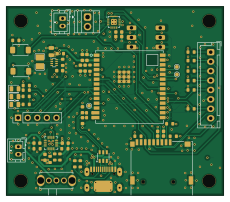
About the Phoniesp32 PCB
Phoniesp32 is an open source ESP32 PCB design by butzist, published on GitHub under the MIT license. It is a 4-layer board measuring 57.4 × 50 mm, with 55 components from 32 distinct parts.
Its main chip is the ESP32-C6-WROOM-1U-N4, from the ESP32 family. Other key parts include the TPS631000DRLR, MAX98357AETE+T and BQ24073RGTR. By type, the board carries 26 resistors, 15 capacitors, 4 ICs, 4 diodes, 3 switches and 1 connector.
It belongs with the audio, iot & wireless and power & battery designs in this gallery.
From the project
A kid-friendly jukebox powered by the ESP32
A kid-friendly jukebox powered by the ESP32, inspired by Phoniebox. Unlike the original Raspberry Pi–based version, phoniesp32 is designed to be battery-operated, low-power, and ultra-portable.
Download Firmware (download the firmware artifact from the latest run on main)
- ESP32-based jukebox: replaces the Raspberry Pi with an ESP32-C6. - Low-power & battery-ready: runs on a Li-ion cell with charging and buck-boost converter. - Bare-metal Rust firmware: built on the embassy async embedded framework. - Rust-powered Web UI: implemented with Dioxus and served directly from the ESP32. - Audio…
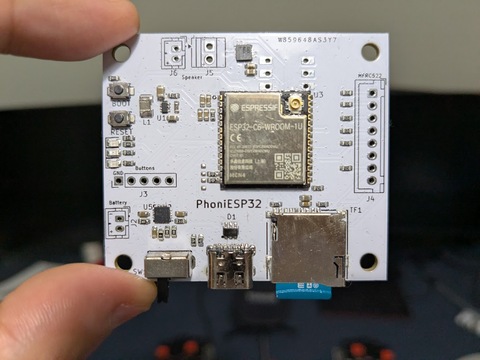
Main components on the Phoniesp32
Phoniesp32 bill of materials (BOM)
55 components, 32 distinct parts.
| Qty | Part | Footprint | Refs |
|---|---|---|---|
| 1 | TPS631000DRLR | SOT-583-8_L2.1-W1.2-P0.50-LS1.6-BL | U1 |
| 1 | MAX98357AETE+T | TQFN-16_L3.0-W3.0-P0.50-BL-EP1.5 | U2 |
| 1 | ESP32-C6-WROOM-1U-N4 | WIFIM-SMD_28P-L19.2-W18.0-P1.27-TL | U3 |
| 1 | BQ24073RGTR | QFN-16_L3.0-W3.0-P0.50-TL-EP1.7 | U5 |
| 1 | USB-TYPE-C-019 Connector, USB-TYPE-C-16P | TYPE-C-SMD_HX-TYPE-C-16PIN | J1 |
| 2 | TS-1088-AR02016 Tactile Button, 160gf XUNPU | SW_TS-1088-AR02016 | S1, S2 |
| 1 | SK12D07VG5 | SW-TH_SK12D07VG5-1 | SW1 |
| 1 | TF-CARD H1.8 | TF-SMD_TF-CARD-H1.8 | TF1 |
| 1 | USBLC6-2SC6 | SOT-23-6_L2.9-W1.6-P0.95-LS2.8-BL | D1 |
| 1 | NCD0805R1 Red Foshan NationStar Optoelectronics | D_0805 | D2 |
| 1 | KT-0805Y Yellow Hubei KENTO Elec | D_0805 | D3 |
| 1 | KT-0805G Green Hubei KENTO Elec | D_0805 | D4 |
| 1 | DFE252012P-1R0M=P2 | L1008 | L1 |
| 4 | 1uF Samsung Electro-Mechanics | C_0603_Label | C1, C11, C16, C17 |
| 2 | 4.7uF Samsung Electro-Mechanics | C_0603_Label | C2, C3 |
| 3 | 22uF Samsung Electro-Mechanics | C_0603_Label | C4, C6, C8 |
| 1 | 47uF Samsung Electro-Mechanics | C_0805 | C5 |
| 4 | 100nF YAGEO | C_0603_Label | C7, C9, C10, C13 |
| 1 | 10uF Samsung Electro-Mechanics | C_0603_Label | C12 |
| 1 | 2x5.1kΩ UNI-ROYAL(Uniroyal Elec) | R_0603_Label | R1 |
Show 12 more
| Qty | Part | Footprint | Refs |
|---|---|---|---|
| 1 | 5.1kΩ UNI-ROYAL(Uniroyal Elec) | R_0603_Label | R2 |
| 5 | 10kΩ UNI-ROYAL(Uniroyal Elec) | R_0603_Label | R3, R14, R15, R17, R18 |
| 1 | 2x1.5kΩ UNI-ROYAL(Uniroyal Elec) | R_0603_Label | R4 |
| 2 | 1.5kΩ UNI-ROYAL(Uniroyal Elec) | R_0603_Label | R5, R12 |
| 2 | 470Ω UNI-ROYAL(Uniroyal Elec) | R_0603_Label | R6, R7 |
| 1 | 510kΩ UNI-ROYAL(Uniroyal Elec) | R_0603_Label | R8 |
| 1 | 91kΩ UNI-ROYAL(Uniroyal Elec) | R_0603_Label | R9 |
| 2 | 22Ω UNI-ROYAL(Uniroyal Elec) | R_0603_Label | R10, R11 |
| 1 | 200Ω UNI-ROYAL(Uniroyal Elec) | R_0603_Label | R13 |
| 1 | 150Ω UNI-ROYAL(Uniroyal Elec) | R_0603_Label | R16 |
| 1 | 0Ω UNI-ROYAL(Uniroyal Elec) | R_0603_Label | R20 |
| 7 | 47kΩ UNI-ROYAL(Uniroyal Elec) | R_0603_Label | R23, R24, R25, R26, R27, R28, R29 |
Phoniesp32 design files
The KiCad project lives in the butzist/phoniesp32 repository on GitHub; these links point at the commit this page was built from.
Phoniesp32: common questions
What microcontroller does the Phoniesp32 use?
The Phoniesp32 is built around the ESP32-C6-WROOM-1U-N4, from the ESP32 family.
How big is the Phoniesp32 PCB?
The Phoniesp32 measures 57.4 × 50 mm, has 4 copper layers and is 1.6 mm thick.
How many components are on the Phoniesp32?
55 components, from 32 distinct parts. The full bill of materials is listed on this page.
Where can I download the Phoniesp32 design files?
From the butzist/phoniesp32 repository on GitHub, which has the KiCad layout and the schematic; the links under Design files point to each one.
Can I use the Phoniesp32 design in my own project?
Yes, under the terms of its MIT license, which butzist chose for the repository.
Can I test firmware for the Phoniesp32 without the hardware?
Yes. HardLabs builds a simulation of the board from its netlist and BOM, so you can run and debug ESP32 firmware against it before you order a PCB.
Similar boards
 ESP32
Open Book Abridged Edition
joeycastillo
85 × 115 mm65 parts2LCC-BY-SA-4.08.1k ESP32
Powertrain
byrantech
64 × 45.4 mm171 parts4LMIT4.3k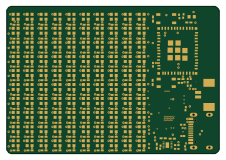 ESP32
Badge
atopile
56.3 × 39 mm239 parts4LMIT4.0k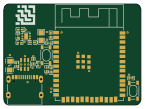 ESP32
Esp32 minimal
36.2 × 26.8 mm20 parts2LMIT4.0k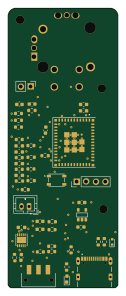 ESP32
Controller
StuckAtPrototype
29 × 74 mm58 parts4LApache-2.03.8k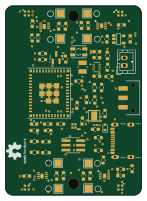 ESP32
Racer
36 × 50.2 mm70 parts4LApache-2.03.8k