
CT800

About the CT800 PCB
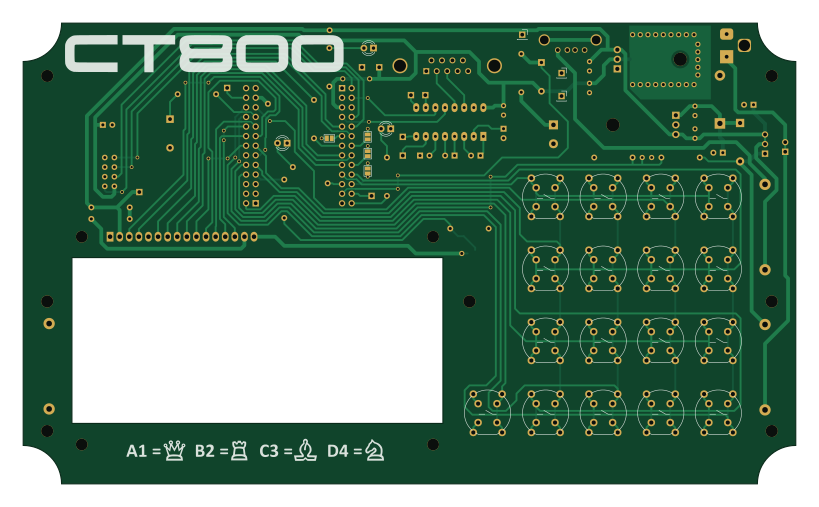
CT800 is an open source ESP8266 PCB design by d3rvita, published on GitHub under the MIT license. It is a 2-layer board measuring 204.5 × 121.9 mm, with 79 components from 61 distinct parts.
Its main chip is the ESP-01, from the ESP8266 family. Other key parts include the STM32H405, 7805/S9V11F5, LM1117-3.3, DISP_4x20 and MAX3232. By type, the board carries 17 switches, 15 connectors, 14 capacitors, 13 resistors, 6 ICs and 6 diodes.
It belongs with the power & battery and iot & wireless designs in this gallery.
From the project
PCB for the CT800 chess computer
In order to become familiar with KiCAD and making something useful at the same time I started this project. The goal was to develop a PCB for the CT800 to ease the build-up. The CT800 is a dedicated chess computer made by Rasmus Althoff. It is very well documented, take a look at its homepage www.ct800.net for detailed info.
The developed PCB consists entirely of THT components except one SMD transistor, due to better availability of 3.3V logic level devices. Soldering SMD parts isn’t easy especially packages like LQFP64 with 0.5mm pitch, therefore the Olimex board was kept in this design.…
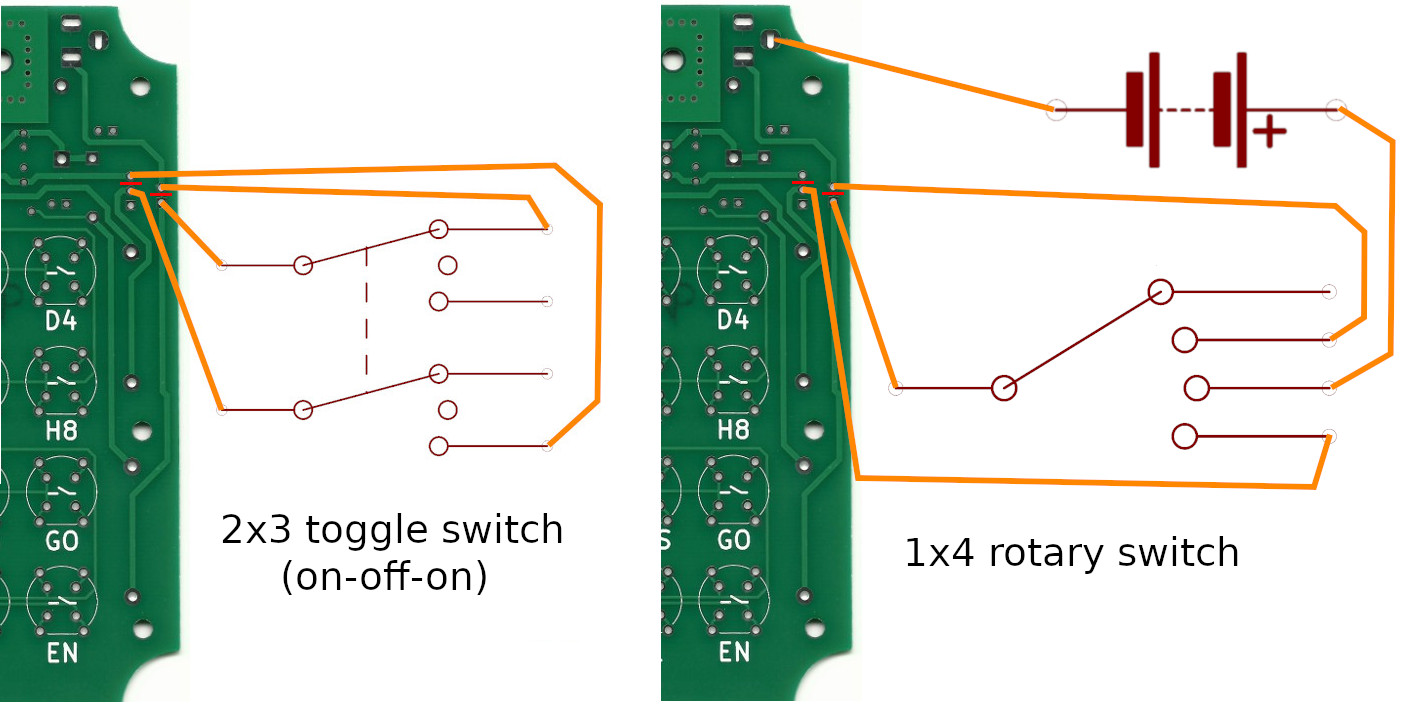
Main components on the CT800
CT800 bill of materials (BOM)
79 components, 61 distinct parts.
| Qty | Part | Footprint | Refs |
|---|---|---|---|
| 1 | STM32H405 | Olimex_STM32H405 | U1 |
| 1 | 7805/S9V11F5 | TO-220-3_Horizontal_TabDown | U2 |
| 1 | LM1117-3.3 | TO-220-3_Horizontal_TabDown | U3 |
| 1 | ESP-01 | ESP-01 | U4 |
| 1 | DISP_4x20 | LCD04x20BL | U5 |
| 1 | MAX3232 | DIP-16_W7.62mm_LongPads | U6 |
| 1 | IRLML6244 | SOT-23 | Q1 |
| 1 | 4-12V= | BarrelJack_Horizontal | J1 |
| 1 | PWR | Pin_Header_Straight_1x02_Pitch2.54mm | J2 |
| 1 | PC13 | PinSocket_1x01_P2.54mm_Vertical | J3 |
| 1 | PC9 | PinSocket_1x01_P2.54mm_Vertical | J4 |
| 2 | 5V | PinSocket_1x01_P2.54mm_Vertical | J6, J7 |
| 2 | 3.3V | PinSocket_1x01_P2.54mm_Vertical | J8, J9 |
| 2 | GND | PinSocket_1x01_P2.54mm_Vertical | J10, J11 |
| 1 | tx3.3 | PinSocket_1x01_P2.54mm_Vertical | J12 |
| 1 | rx3.3 | PinSocket_1x01_P2.54mm_Vertical | J13 |
| 1 | Tx | PinSocket_1x01_P2.54mm_Vertical | J14 |
| 1 | Rx | PinSocket_1x01_P2.54mm_Vertical | J15 |
| 1 | USB_PWR | USB_A | J16 |
| 1 | Buzzer | Buzzer_12x9.5RM7.6 | BZ1 |
Show 41 more
| Qty | Part | Footprint | Refs |
|---|---|---|---|
| 2 | 1A | Fuseholder_Cylinder-5x20mm_Stelvio-Kontek_PTF78_Horizontal_Open | F1, F3 |
| 1 | aux | Fuseholder_Cylinder-5x20mm_Stelvio-Kontek_PTF78_Horizontal_Open | F2 |
| 1 | USB_SEL | PinSocket_1x03_P2.54mm_Vertical | JP5 |
| 1 | LIGHT | D6_3FTH | SW1 |
| 1 | A1 | D6_3FTH | SW2 |
| 1 | E5 | D6_3FTH | SW3 |
| 1 | MENU | D6_3FTH | SW4 |
| 1 | < | D6_3FTH | SW5 |
| 1 | B2 | D6_3FTH | SW6 |
| 1 | F6 | D6_3FTH | SW7 |
| 1 | INFO | D6_3FTH | SW8 |
| 1 | > | D6_3FTH | SW9 |
| 1 | C3 | D6_3FTH | SW10 |
| 1 | G7 | D6_3FTH | SW11 |
| 1 | POS | D6_3FTH | SW12 |
| 1 | CL | D6_3FTH | SW13 |
| 1 | D4 | D6_3FTH | SW14 |
| 1 | H8 | D6_3FTH | SW15 |
| 1 | GO | D6_3FTH | SW16 |
| 1 | EN | D6_3FTH | SW17 |
| 1 | CT800 Logo | ct800 | SYM1 |
| 1 | Promotion | promotion | SYM2 |
| 1 | ok | LED_D3.0mm | D1 |
| 1 | error | LED_D3.0mm | D2 |
| 1 | 1N4007 | D_DO-41_SOD81_P10.16mm_Horizontal | D3 |
| 1 | 15V/5W | D_5W_P12.70mm_Horizontal | D4 |
| 1 | BAT43 | D_A-405_P7.62mm_Horizontal | D5 |
| 1 | power | LED_D3.0mm | D6 |
| 6 | 100n | C_Rect_L4.6mm_W3.0mm_P2.50mm_MKS02_FKP02 | C1, C4, C5, C7, C8, C11 |
| 2 | 100µ | CP_Radial_D6.3mm_P2.50mm | C2, C9 |
| 1 | 1F | CP_Radial_D14.0mm_P5.00mm | C3 |
| 1 | 10µ | CP_Radial_D6.3mm_P2.50mm | C6 |
| 4 | 100n | CP_Radial_Tantal_D4.5mm_P2.50mm | C10, C12, C13, C14 |
| 3 | 470 | R_Axial_DIN0207_L6.3mm_D2.5mm_P10.16mm_Horizontal | R1, R4, R12 |
| 1 | 47k/0.1% | R_Axial_DIN0207_L6.3mm_D2.5mm_P10.16mm_Horizontal | R2 |
| 1 | 10k/0.1% | R_Axial_DIN0207_L6.3mm_D2.5mm_P10.16mm_Horizontal | R3 |
| 1 | 39 | R_Axial_DIN0207_L6.3mm_D2.5mm_P10.16mm_Horizontal | R5 |
| 3 | 100 | R_Axial_DIN0207_L6.3mm_D2.5mm_P10.16mm_Horizontal | R6, R7, R11 |
| 2 | 47 | R_Axial_DIN0207_L6.3mm_D2.5mm_P10.16mm_Horizontal | R8, R9 |
| 1 | 10k | R_Axial_DIN0207_L6.3mm_D2.5mm_P10.16mm_Horizontal | R10 |
| 1 | 0 | R_Axial_DIN0309_L9.0mm_D3.2mm_P25.40mm_Horizontal | R13 |
CT800 design files
The KiCad project lives in the d3rvita/ct800-pcb repository on GitHub; these links point at the commit this page was built from.
CT800: common questions
What microcontroller does the CT800 use?
The CT800 is built around the ESP-01, from the ESP8266 family.
How big is the CT800 PCB?
The CT800 measures 204.5 × 121.9 mm, has 2 copper layers and is 1.6 mm thick.
How many components are on the CT800?
79 components, from 61 distinct parts. The full bill of materials is listed on this page.
Where can I download the CT800 design files?
From the d3rvita/ct800-pcb repository on GitHub, which has the KiCad layout; the links under Design files point to each one.
Can I use the CT800 design in my own project?
Yes, under the terms of its MIT license, which d3rvita chose for the repository.
Can I test firmware for the CT800 without the hardware?
Yes. HardLabs builds a simulation of the board from its netlist and BOM, so you can run and debug ESP8266 firmware against it before you order a PCB.
Similar boards
 ESP8266
ESP8266ControllerCircuit
stuartpittaway
75 × 30 mm20 parts2LCC-BY-NC-4.01.1k ESP8266
HASwitchPlate
aderusha
60 × 40 mm8 parts2LMIT738 ESP8266
RatGDO-OpenSource-D1Mini-ESP8266
Kaldek
47.8 × 63.3 mm12 parts2LMIT506 ESP8266
RatGDO-OpenSource-Bare-ESP8266
55 × 82.7 mm20 parts2LMIT506 ESP8266
Goatgdo
32.9 × 53.3 mm23 parts2LMIT506 ESP8266
Iaq board
nkitanov
70.1 × 43.2 mm17 parts2LNo license398