
Microgrid-Home-Energy-Monitor

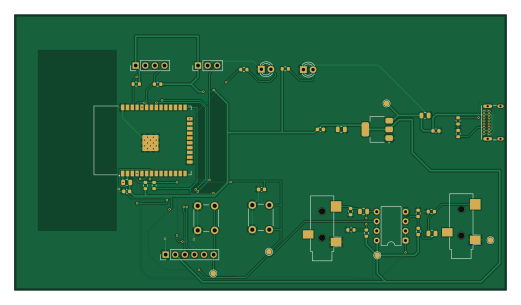
About the Microgrid-Home-Energy-Monitor PCB
Microgrid-Home-Energy-Monitor is an open source ESP32 PCB design by dish-glitch, published on GitHub under the MIT license. It is a 2-layer board measuring 130.2 × 72.9 mm, with 36 components from 19 distinct parts.
Its main chip is the ESP32-WROOM-32E-N4, from the ESP32 family. Other key parts include the MCP6002-I/P and AMS1117-3.3. By type, the board carries 14 resistors, 9 capacitors, 6 connectors, 3 ICs, 2 switches and 2 diodes.
It belongs with the sensors and iot & wireless designs in this gallery.
From the project
I want to understand how power is measured, how the grid sees demand so I will try to build a custom PCB that clips non-invasive current transformer sensors around wires and measure real-time power usage I would like it to measure Watts. Apparent power (VA) and Power factor.
Custom 2-layer PCB designed in KiCad 9. Measures real-time household power consumption using non-invasive current transformer sensors.
CC1 and CC2 resistors (5.1kΩ to GND) identify the board as a USB device to the host charger, enabling 5V/500mA delivery per USB-C spec.
1. Burden resistor (33Ω): The SCT-013 outputs a small currecnt but the ESP32 measures the voltage. The 33 ohm burden resisotr converts that currecnt into a voltage using Ohm's law. At the senors's max rated current, this produeces 1.65 V RMS 2.33 V peak.
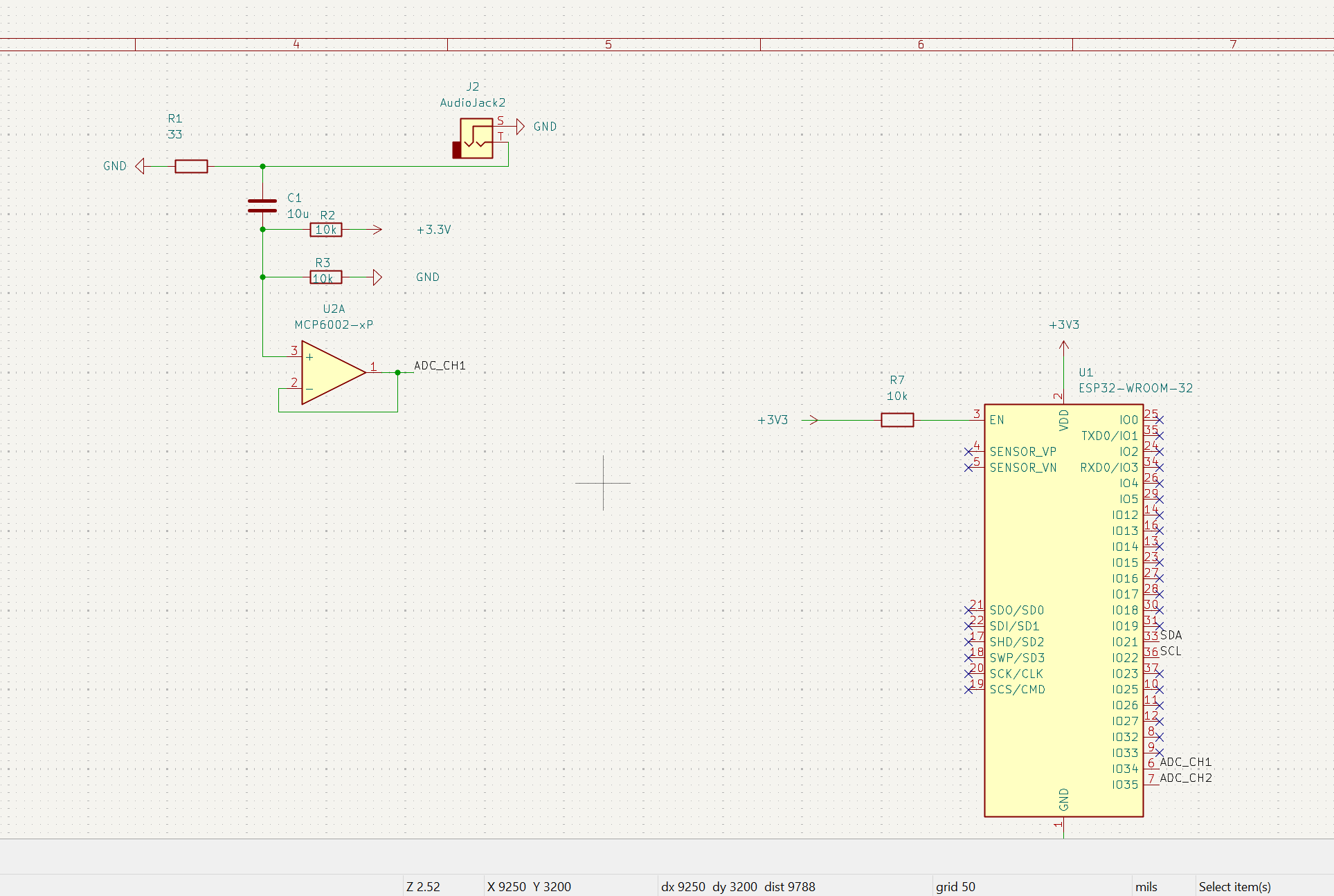
Main components on the Microgrid-Home-Energy-Monitor
Microgrid-Home-Energy-Monitor bill of materials (BOM)
36 components, 19 distinct parts — part numbers from the project's BOM.
| Qty | Part | Footprint | Refs |
|---|---|---|---|
| 1 | ESP32-WROOM-32E-N4 ESP32-WROOM-32 | ESP32-WROOM-32 | U1 |
| 1 | MCP6002-I/P MCP6002-xP | DIP-8_W7.62mm | U2 |
| 1 | AMS1117-3.3 | SOT-223-3_TabPin2 | U3 |
| 2 | SJ-3523-SMT AudioJack2 | Jack_3.5mm_CUI_SJ-3523-SMT_Horizontal | J1, J2 |
| 1 | Conn_01x04 | PinHeader_1x04_P2.54mm_Vertical | J3 |
| 1 | USB_C_Receptacle_USB2.0_16P | USB_C_Receptacle_GCT_USB4085 | J4 |
| 1 | Conn_01x06 | PinHeader_1x06_P2.54mm_Vertical | J5 |
| 1 | Conn_01x03 | PinHeader_1x03_P2.54mm_Vertical | J6 |
| 2 | 6MM SW_Push | SW_PUSH_6mm_H4.3mm | SW1, SW2 |
| 2 | LED | LED_D3.0mm | D1, D2 |
| 3 | 10u | C_0805_2012Metric | C1, C2, C8 |
| 2 | 10uF | C_0805_2012Metric | C3, C6 |
| 3 | 100NF 100nF | C_0603_1608Metric | C4, C5, C9 |
| 1 | 100NF 0.1u | C_0603_1608Metric | C7 |
| 2 | 33 | R_0603_1608Metric | R1, R4 |
| 6 | 10k | R_0603_1608Metric | R2, R3, R5, R6, R7, R10 |
| 2 | 4.7k | R_0603_1608Metric | R8, R9 |
| 2 | 5.1k | R_0603_1608Metric | R11, R12 |
| 2 | 150 | R_0603_1608Metric | R13, R14 |
Microgrid-Home-Energy-Monitor design files
The KiCad project lives in the dish-glitch/Microgrid-Home-Energy-Monitor repository on GitHub; these links point at the commit this page was built from.
Microgrid-Home-Energy-Monitor: common questions
What microcontroller does the Microgrid-Home-Energy-Monitor use?
The Microgrid-Home-Energy-Monitor is built around the ESP32-WROOM-32E-N4, from the ESP32 family.
How big is the Microgrid-Home-Energy-Monitor PCB?
The Microgrid-Home-Energy-Monitor measures 130.2 × 72.9 mm, has 2 copper layers and is 1.6 mm thick.
How many components are on the Microgrid-Home-Energy-Monitor?
36 components, from 19 distinct parts, with part numbers taken from the project's own BOM. The full bill of materials is listed on this page.
Where can I download the Microgrid-Home-Energy-Monitor design files?
From the dish-glitch/Microgrid-Home-Energy-Monitor repository on GitHub, which has the KiCad layout, the schematic and the BOM; the links under Design files point to each one.
Can I use the Microgrid-Home-Energy-Monitor design in my own project?
Yes, under the terms of its MIT license, which dish-glitch chose for the repository.
Can I test firmware for the Microgrid-Home-Energy-Monitor without the hardware?
Yes. HardLabs builds a simulation of the board from its netlist and BOM, so you can run and debug ESP32 firmware against it before you order a PCB.
Similar boards
 ESP32
ESP32Open Book Abridged Edition
joeycastillo
85 × 115 mm65 parts2LCC-BY-SA-4.08.1k ESP32
ESP32Badge
atopile
56.3 × 39 mm239 parts4LMIT4.0k ESP32
ESP32Esp32 minimal
36.2 × 26.8 mm20 parts2LMIT4.0k ESP32
ESP32Racer
StuckAtPrototype
36 × 50.2 mm70 parts4LApache-2.03.8k ESP32
ESP32Controller
29 × 74 mm58 parts4LApache-2.03.8k ESP32
ESP32Bitaxe
skot
56.5 × 99.8 mm86 parts4LCERN-OHL-S-2.01.4k