
CANSAT-M2-2026

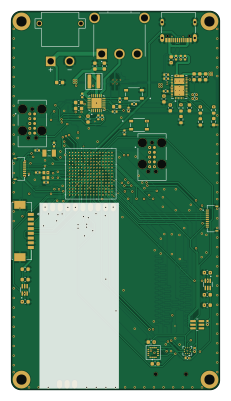
About the CANSAT-M2-2026 PCB
CANSAT-M2-2026 is an open source STM32 PCB design by Engineer162, published on GitHub under the CERN-OHL-S-2.0 license. It is a 4-layer board measuring 55 × 100 mm, with 156 components from 47 distinct parts.
Its main chip is the STM32H7S3L8H6, from the STM32 family. Other key parts include the TPS63060DSCT, ICM-42688-P, MMC5983MA, TMP121AIDBVR and TPS22919DCKR. By type, the board carries 93 capacitors, 32 resistors, 12 ICs, 11 connectors, 3 crystals and 3 inductors.
It belongs with the power & battery and sensors designs in this gallery.
From the project
This repository contains all the sources for a highly advanced CANSAT based on an STM32 MCU and featuring a rechargeable lithium polymer battery.
This repository contains all the sources for a highly advanced CANSAT based on an STM32 MCU and featuring a rechargeable lithium polymer battery.
Additionally, it features numerous different sensors for logging, as listed below:
And debugging/programming is done via a TAG-CONNECT TC2050-IDC "Plug-Of-Nails™" connector.
Main components on the CANSAT-M2-2026
CANSAT-M2-2026 bill of materials (BOM)
156 components, 47 distinct parts.
| Qty | Part | Footprint | Refs |
|---|---|---|---|
| 1 | TPS63060DSCT | CONV_TPS63060DSCT | U1 |
| 1 | ICM-42688-P | LGA14_2P5X3X0P91_TDK | U2 |
| 1 | MMC5983MA | MMC5983MA_MEM | U3 |
| 1 | TMP121AIDBVR | DBV6 | U4 |
| 3 | TPS22919DCKR | SOT65P210X110-6N | U5, U12, U13 |
| 1 | BMP581 | QFN10_BMP581_BOS | U6 |
| 1 | STM32H7S3L8H6 | TFBGA225_13X13_STM | U7 |
| 1 | BQ25895RTWT | QFN50P400X400X80-25N | U9 |
| 1 | TPS25730DREFR | REF0038A-MFG | U10 |
| 1 | STM32L031G6U6 | UFQFPN28-4x4mm | U11 |
| 2 | ABS07-32.768KHZ-T | XTAL_ABS07-32.768KHZ-T | Y1, Y3 |
| 1 | 25MHz | XTAL_ECS-160-9-37-CKM-TR | Y2 |
| 1 | 12402012E212A | AMPHENOL_USB-C_12402012E212A | J1 |
| 1 | 1-2328702-0 | TE_1-2328702-0 | J2 |
| 1 | MSD-4-A | CUI_MSD-4-A | J3 |
| 1 | STM32H7_SWD | TAG-CONNECT_TC2050-IDC | J4 |
| 1 | STM32L0_SWD | TAG-CONNECT_TC2050-IDC | J5 |
| 2 | SKRPACE010 | SW_SKRPACE010_AAL | J6, J7 |
| 1 | Power | SW_SKRPACE010_AAL | J8 |
| 1 | XT30 Battery | AMASS_XT30PW-M | J9 |
Show 27 more
| Qty | Part | Footprint | Refs |
|---|---|---|---|
| 1 | 2328702-8 | TE_2328702-8 | J10 |
| 1 | 532610871 | MOLEX_532610871 | J11 |
| 1 | ~ | SI4463-MODULE | RF1 |
| 1 | Main Switch | SW_500SSP1S1M6QEA | S1 |
| 1 | FerriteBead | L_0603_1608Metric | FB1 |
| 1 | 1uH | L_1008_2520Metric | L1 |
| 1 | 2.2uH | L_Wuerth_MAPI-4020 | L2 |
| 15 | 10uF | C_0603_1608Metric | C1, C11, C18, C21, C23, C29, C92, C94 +7 |
| 16 | 1uF | C_0603_1608Metric | C2, C10, C24, C30, C64, C77, C80, C82 +8 |
| 33 | 100nF | C_0402_1005Metric | C3, C4, C5, C6, C7, C8, C9, C27 +25 |
| 3 | 10nF | C_0402_1005Metric | C12, C13, C14 |
| 8 | 4.7uF | C_0603_1608Metric | C15, C22, C62, C70, C78, C91, C95, C100 |
| 2 | 330pF | C_0402_1005Metric | C16, C17 |
| 4 | 22uF | C_0603_1608Metric | C19, C20, C90, C93 |
| 5 | 10pF | C_0402_1005Metric | C25, C26, C83, C84, C98 |
| 4 | 2.2uF | C_0603_1608Metric | C66, C67, C68, C69 |
| 2 | 18pF | C_0402_1005Metric | C85, C86 |
| 1 | 47nF | C_0402_1005Metric | C99 |
| 5 | 22Ω | R_0402_1005Metric | R1, R2, R3, R4, R5 |
| 16 | 10kΩ | R_0402_1005Metric | R6, R7, R8, R9, R11, R12, R18, R19 +8 |
| 3 | 200kΩ | R_0603_1608Metric | R10, R14, R16 |
| 2 | 100kΩ | R_0603_1608Metric | R13, R15 |
| 1 | 27kΩ | R_0603_1608Metric | R17 |
| 2 | 3.3kΩ | R_0402_1005Metric | R21, R22 |
| 1 | 150Ω | R_0603_1608Metric | R25 |
| 1 | 560kΩ | R_0402_1005Metric | R31 |
| 1 | 100kΩ | R_0402_1005Metric | R32 |
CANSAT-M2-2026 design files
The KiCad project lives in the Engineer162/CANSAT-M2-2026 repository on GitHub; these links point at the commit this page was built from.
CANSAT-M2-2026: common questions
What microcontroller does the CANSAT-M2-2026 use?
The CANSAT-M2-2026 is built around the STM32H7S3L8H6, from the STM32 family.
How big is the CANSAT-M2-2026 PCB?
The CANSAT-M2-2026 measures 55 × 100 mm, has 4 copper layers and is 1.6 mm thick.
How many components are on the CANSAT-M2-2026?
156 components, from 47 distinct parts. The full bill of materials is listed on this page.
Where can I download the CANSAT-M2-2026 design files?
From the Engineer162/CANSAT-M2-2026 repository on GitHub, which has the KiCad layout and the schematic; the links under Design files point to each one.
Can I use the CANSAT-M2-2026 design in my own project?
Yes, under the terms of its CERN-OHL-S-2.0 license, which Engineer162 chose for the repository.
Can I test firmware for the CANSAT-M2-2026 without the hardware?
Yes. HardLabs builds a simulation of the board from its netlist and BOM, so you can run and debug STM32 firmware against it before you order a PCB.
More boards in CANSAT-M2-2026

Similar boards
 STM32
STM32LumenPnP Motherboard
opulo-inc
149 × 95 mm296 parts4LCC-BY-SA-4.03.7k STM32
STM32AxxSolder
AxxAxx
39 × 82.5 mm122 parts2LGPL-3.01.7k STM32
STM32LibreVNA
jankae
122 × 98 mm592 parts6LGPL-3.01.6k STM32
STM32AIOC
skuep
21 × 31.5 mm47 parts2LMIT1.4k STM32
STM32Ferris
pierrechevalier83
208.8 × 86.8 mm102 parts2LSHL-2.11.3k STM32
STM32176 pin board
rusefi
61.8 × 73.2 mm76 parts2LGPL-3.01.2k