
TRS-IO-M1

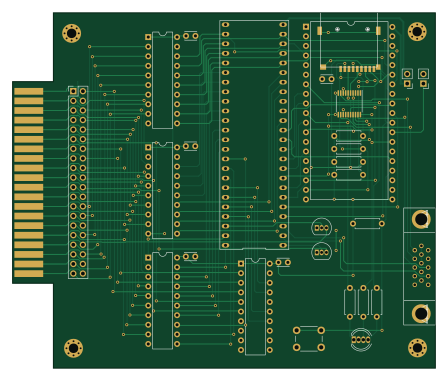
About the TRS-IO-M1 PCB
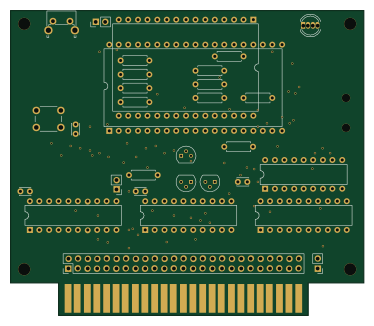
TRS-IO-M1 is an open source FPGA PCB design by ESP-WORKS, published on GitHub. It is a 2-layer board measuring 111.9 × 94 mm, with 30 components from 25 distinct parts.
Its main chip is the MCP23S17T-E/SS, from the FPGA family. Other key parts include the 1904-1034-1, MCP23S08T-E/SS, LM1117MPX-3.3/NOPB, MCP4361-502E/ST and 74LVC245. By type, the board carries 8 resistors, 7 ICs, 6 connectors, 5 capacitors, 2 transistors and 1 switch.
It belongs with the power & battery designs in this gallery.
From the project
TRS-IO gives a TRS-80 Model 1/III online capabilities and provides access to a variety of services. TRS-IO currently features the following capabilities:
TRS-IO gives a TRS-80 Model 1/III online capabilities and provides access to a variety of services. TRS-IO currently features the following capabilities:
1. Access to the RetroStore 2. FreHD emulation 3. Access to files mounted on a SMB share or located on a micro-SD card 4. Access to remote servers via TCP 5. Virtual printer support
The TRS-IO versions for the Model 1 have some additional features that are explained below. The following sections give an overview of TRS-IO as well as setup instructions. This Github repository contains the complete source code as well as the KiCad schematics…
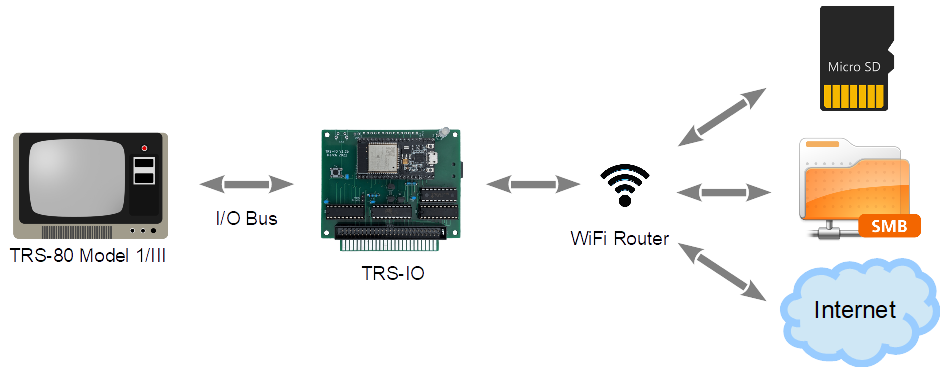
Main components on the TRS-IO-M1
TRS-IO-M1 bill of materials (BOM)
30 components, 25 distinct parts — part numbers from the project's BOM.
| Qty | Part | Footprint | Refs |
|---|---|---|---|
| 1 | 1904-1034-1 HiLetgo-ESP-32S | DIP-38_W22.9mm | U1 |
| 1 | MCP23S17T-E/SS Artix-7-15T | DIP-48_600_ELL | U2 |
| 1 | MCP23S08T-E/SS 74LVC245 | DIP-20_W7.62mm | U3 |
| 1 | LM1117MPX-3.3/NOPB 74LVC245 | DIP-20_W7.62mm | U4 |
| 1 | MCP4361-502E/ST 74LVC245 | DIP-20_W7.62mm | U5 |
| 1 | 74LVC245 | DIP-20_W7.62mm | U6 |
| 1 | MCP43x1 | TSSOP-20_4.4x6.5mm_P0.65mm | U7 |
| 1 | BSS138 2N7000 | TO-92_Inline | Q1 |
| 1 | MMBT3904-7-F 2N7000 | TO-92_Inline | Q2 |
| 1 | 302-S501 Conn_02x20_Odd_Even | PinHeader_2x20_P2.54mm_Vertical | J1 |
| 1 | SJ1-3535NG-BE Conn_02x20_Odd_Even | TRSEDGE | J2 |
| 1 | 5749180-1 SD_Card | TFP09-2-12B | J3 |
| 1 | ICD15S13E4GV00LF Conn_01x02_Male | PinHeader_1x02_P2.54mm_Vertical | J4 |
| 1 | 961136-6404-AR Conn_01x02_Male | PinHeader_1x02_P2.54mm_Vertical | J5 |
| 1 | 10118193-0001LF DB15_Female_HighDensity | DB_15F-VGA | J6 |
| 1 | 1825910-6 SW_Push | SW_PUSH_6mm_H9.5mm | SW1 |
| 1 | LED_RCBG | LED_D5.0mm-4_RGB | D1 |
| 2 | CL31F106ZPHNNNE 0.1uF | C_Disc_D3.0mm_W2.0mm_P2.50mm | C1, C2 |
| 1 | C0805C104Z3VACTU 0.1uF | C_Disc_D3.0mm_W2.0mm_P2.50mm | C3 |
| 2 | F930J107KAA 0.1uF | C_Disc_D3.0mm_W2.0mm_P2.50mm | C4, C5 |
Show 5 more
| Qty | Part | Footprint | Refs |
|---|---|---|---|
| 3 | 100 | R_Axial_DIN0207_L6.3mm_D2.5mm_P7.62mm_Horizontal | R1, R2, R3 |
| 1 | RC0805FR-072KL 4K7 | R_Axial_DIN0207_L6.3mm_D2.5mm_P7.62mm_Horizontal | R4 |
| 1 | RC0805FR-072KL 10K | R_Axial_DIN0207_L6.3mm_D2.5mm_P7.62mm_Horizontal | R5 |
| 2 | RC0805FR-074K7L 10K | R_Axial_DIN0207_L6.3mm_D2.5mm_P7.62mm_Horizontal | R6, R7 |
| 1 | ESR10EZPJ271 10K | R_Axial_DIN0207_L6.3mm_D2.5mm_P7.62mm_Horizontal | R8 |
TRS-IO-M1 design files
The KiCad project lives in the ESP-WORKS/TTGO-POCKET-TRS repository on GitHub; these links point at the commit this page was built from.
TRS-IO-M1: common questions
What microcontroller does the TRS-IO-M1 use?
The TRS-IO-M1 is built around the MCP23S17T-E/SS, from the FPGA family.
How big is the TRS-IO-M1 PCB?
The TRS-IO-M1 measures 111.9 × 94 mm, has 2 copper layers and is 1.6 mm thick.
How many components are on the TRS-IO-M1?
30 components, from 25 distinct parts, with part numbers taken from the project's own BOM. The full bill of materials is listed on this page.
Where can I download the TRS-IO-M1 design files?
From the ESP-WORKS/TTGO-POCKET-TRS repository on GitHub, which has the KiCad layout, the schematic and the BOM; the links under Design files point to each one.
Can I use the TRS-IO-M1 design in my own project?
The repository has no license, so all rights stay with ESP-WORKS. Use it as a reference, and ask the author before reusing the design.
Can I test firmware for the TRS-IO-M1 without the hardware?
Yes. HardLabs builds a simulation of the board from its netlist and BOM, so you can run and debug FPGA firmware against it before you order a PCB.
More boards in TTGO-POCKET-TRS
Similar boards
 FPGA
Base board
GlasgowEmbedded
80 × 49 mm222 parts4L0BSD2.2k FPGA
Thunderscope Rev5.3
EEVengers
122.5 × 103.5 mm817 parts6LMIT1.3k FPGA
Usb sniffer
ataradov
58.2 × 38.1 mm86 parts2LBSD-3-Clause1.3k FPGA
Tomu, I'm
theacodes
13 × 9.4 mm40 parts4LMIT1.1k FPGA
Icepi zero
cheyao
65 × 30 mm143 parts4LSHL-2.1865 FPGA
Gcvideo
ikorb
49 × 30 mm44 parts4LNo license765