
PCBbot

About the PCBbot PCB
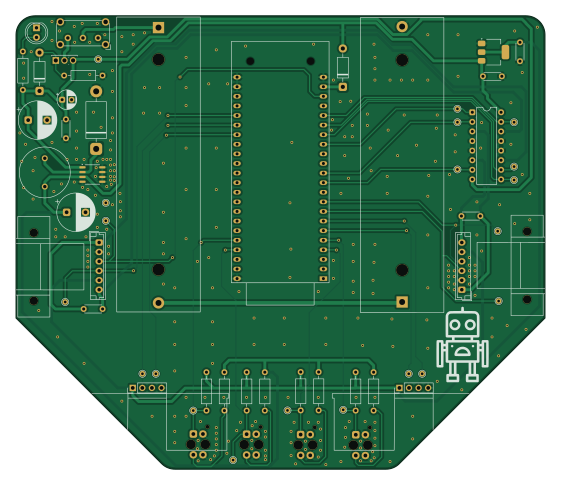
PCBbot is an open source ESP32 PCB design by halherta, published on GitHub under the MIT license. It is a 2-layer board measuring 140 × 120 mm, with 60 components from 46 distinct parts.
Its main chip is the ESP32-S3-DevKitC, from the ESP32 family. Other key parts include the LM1117MP-3.3, TCRT5000, SN754410NE, HC-SR04 and AP1509-50SG-13. By type, the board carries 20 test points, 10 ICs, 10 resistors, 8 capacitors, 4 diodes and 3 connectors.
From the project
The PCBBot leverages the PCB itself as the chassis. This reduces cost significantly. It also means that the two motors and the caster wheel would have to be mounted on the PCB itself, in addition to the batteries and all the other components...
The PCBBot leverages the PCB itself as the chassis. This reduces cost significantly. It also means that the two motors and the caster wheel would have to be mounted on the PCB itself, in addition to the batteries and all the other components...
For more info have a look at the write up on my blog entry
In this Github repo, you'll find my PCBBot KiCAD PCB design freely available (MIT License) along with a Digikey bill of materials (BOM) (caster wheel, motor brackets and motors not included) and MicroPython code. I’m also providing my custom symbol and footprint libraries in this repo. Feel…
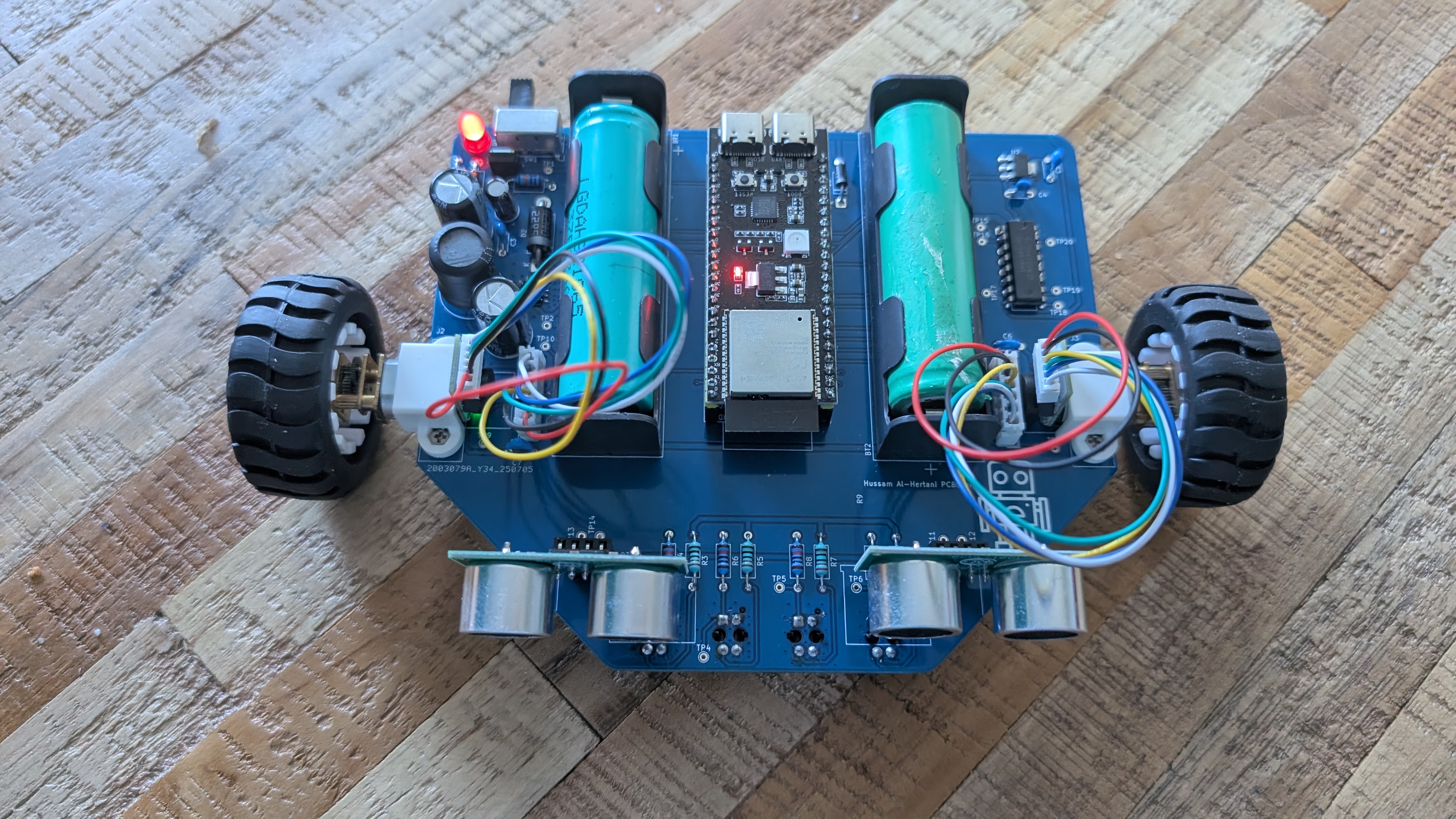
Main components on the PCBbot
PCBbot bill of materials (BOM)
60 components, 46 distinct parts.
| Qty | Part | Footprint | Refs |
|---|---|---|---|
| 1 | LM1117MP-3.3 | SOT-223-3_TabPin2 | U2 |
| 4 | TCRT5000 | Vishay_TCRT5000 | U3, U4, U5, U6 |
| 1 | SN754410NE | DIP-16_W7.62mm | U7 |
| 1 | ESP32-S3-DevKitC | ESP32-S3-DevKitC | U8 |
| 2 | HC-SR04 | HC-SR04 | U9, U10 |
| 1 | AP1509-50SG-13 | SOP-8_3.9x4.9mm_P1.27mm | U11 |
| 1 | TSM480P06 | TO-251-3_Vertical | Q1 |
| 2 | n20motorenc | n20motorencv2 | J2, J3 |
| 1 | Castor Wheel | N20CasterSteelBall-Mini | J4 |
| 2 | Battery_Cell | BatteryHolder_MPD_BK-18650-PC2 | BT1, BT2 |
| 1 | SW_Push_SPDT | SW_E-Switch_EG1224_SPDT_Angled | SW1 |
| 1 | VCC | TestPoint_THTPad_D1.5mm_Drill0.7mm | TP1 |
| 1 | GND | TestPoint_THTPad_D1.5mm_Drill0.7mm | TP2 |
| 1 | SENS_AN0 | TestPoint_THTPad_D1.5mm_Drill0.7mm | TP3 |
| 1 | SENS_AN1 | TestPoint_THTPad_D1.5mm_Drill0.7mm | TP4 |
| 1 | SENS_AN2 | TestPoint_THTPad_D1.5mm_Drill0.7mm | TP5 |
| 1 | SENS_AN3 | TestPoint_THTPad_D1.5mm_Drill0.7mm | TP6 |
| 1 | ENC1A | TestPoint_THTPad_D1.5mm_Drill0.7mm | TP7 |
| 1 | ENC1B | TestPoint_THTPad_D1.5mm_Drill0.7mm | TP8 |
| 1 | ENC2A | TestPoint_THTPad_D1.5mm_Drill0.7mm | TP9 |
Show 26 more
| Qty | Part | Footprint | Refs |
|---|---|---|---|
| 1 | ENC2B | TestPoint_THTPad_D1.5mm_Drill0.7mm | TP10 |
| 1 | TRIG1 | TestPoint_THTPad_D1.5mm_Drill0.7mm | TP11 |
| 1 | ECHO1 | TestPoint_THTPad_D1.5mm_Drill0.7mm | TP12 |
| 1 | TRIG2 | TestPoint_THTPad_D1.5mm_Drill0.7mm | TP13 |
| 1 | ECHO2 | TestPoint_THTPad_D1.5mm_Drill0.7mm | TP14 |
| 1 | MOT2_EN | TestPoint_THTPad_D1.5mm_Drill0.7mm | TP15 |
| 1 | MOT2_A | TestPoint_THTPad_D1.5mm_Drill0.7mm | TP16 |
| 1 | MOT2_B | TestPoint_THTPad_D1.5mm_Drill0.7mm | TP17 |
| 1 | MOT1_EN | TestPoint_THTPad_D1.5mm_Drill0.7mm | TP18 |
| 1 | MOT1_A | TestPoint_THTPad_D1.5mm_Drill0.7mm | TP19 |
| 1 | MOT1_B | TestPoint_THTPad_D1.5mm_Drill0.7mm | TP20 |
| 1 | LED | LED_D5.0mm | D1 |
| 1 | 1N5822 | D_DO-201AD_P15.24mm_Horizontal | D2 |
| 1 | 1N5817 | D_DO-41_SOD81_P10.16mm_Horizontal | D3 |
| 1 | 1N47xxA | D_DO-41_SOD81_P10.16mm_Horizontal | D4 |
| 1 | 47u | AIUR-06_ABRv2 | L1 |
| 1 | 470u | CP_Radial_D10.0mm_P5.00mm | C1 |
| 1 | 10u | CP_Radial_D5.0mm_P2.50mm | C2 |
| 3 | 1u | C_Disc_D4.3mm_W1.9mm_P5.00mm | C3, C4, C5 |
| 2 | 10n | C_Disc_D4.3mm_W1.9mm_P5.00mm | C6, C7 |
| 1 | 330u | CP_Radial_D10.0mm_P5.00mm | C10 |
| 1 | 100k | R_Axial_DIN0207_L6.3mm_D2.5mm_P10.16mm_Horizontal | R1 |
| 1 | 470 | R_Axial_DIN0207_L6.3mm_D2.5mm_P10.16mm_Horizontal | R2 |
| 3 | 150 | R_Axial_DIN0207_L6.3mm_D2.5mm_P10.16mm_Horizontal | R3, R7, R9 |
| 4 | 10k | R_Axial_DIN0207_L6.3mm_D2.5mm_P10.16mm_Horizontal | R4, R6, R8, R10 |
| 1 | 100 | R_Axial_DIN0207_L6.3mm_D2.5mm_P10.16mm_Horizontal | R5 |
PCBbot design files
The KiCad project lives in the halherta/PCBbot repository on GitHub; these links point at the commit this page was built from.
- LayoutPCBbot.kicad_pcb
- SchematicPCBbot.kicad_sch
PCBbot: common questions
What microcontroller does the PCBbot use?
The PCBbot is built around the ESP32-S3-DevKitC, from the ESP32 family.
How big is the PCBbot PCB?
The PCBbot measures 140 × 120 mm, has 2 copper layers and is 1.6 mm thick.
How many components are on the PCBbot?
60 components, from 46 distinct parts. The full bill of materials is listed on this page.
Where can I download the PCBbot design files?
From the halherta/PCBbot repository on GitHub, which has the KiCad layout and the schematic; the links under Design files point to each one.
Can I use the PCBbot design in my own project?
Yes, under the terms of its MIT license, which halherta chose for the repository.
Can I test firmware for the PCBbot without the hardware?
Yes. HardLabs builds a simulation of the board from its netlist and BOM, so you can run and debug ESP32 firmware against it before you order a PCB.
Similar boards
 ESP32
ESP32Open Book Abridged Edition
joeycastillo
85 × 115 mm65 parts2LCC-BY-SA-4.08.1k ESP32
ESP32Badge
atopile
56.3 × 39 mm239 parts4LMIT4.0k ESP32
ESP32Esp32 minimal
36.2 × 26.8 mm20 parts2LMIT4.0k ESP32
ESP32Racer
StuckAtPrototype
36 × 50.2 mm70 parts4LApache-2.03.8k ESP32
ESP32Controller
29 × 74 mm58 parts4LApache-2.03.8k ESP32
ESP32Bitaxe
skot
56.5 × 99.8 mm86 parts4LCERN-OHL-S-2.01.4k