
Potentiostat

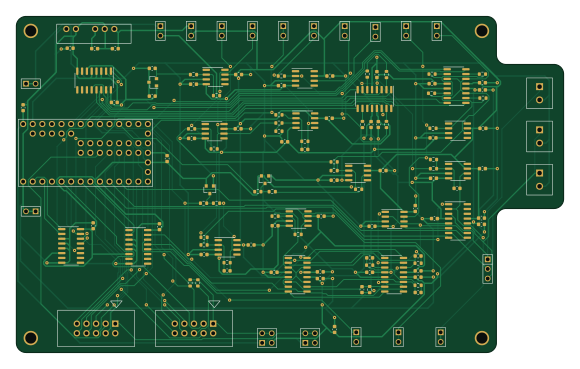
About the Potentiostat PCB
Potentiostat is an open source NXP PCB design by iorodeo, published on GitHub under the CC-BY-4.0 license. It is a 2-layer board measuring 144.8 × 88.9 mm, with 141 components from 65 distinct parts.
Its main chip is the WM17453, from the NXP family. Other key parts include the ZXRE060ET5DI, MAX6176AASA+, DG411xY, AD8250ARMZ-R7 and 811-2678-5. By type, the board carries 53 capacitors, 38 resistors, 22 connectors, 21 ICs, 2 diodes and 1 relay.
It belongs with the dev boards & breakouts designs in this gallery.
From the project
Rodeostat design files, software and firmware
Hardware design, firmware and software for IO Rodeo's Rodeostat Potentiostat.
* Project site: http://potentiostat.iorodeo.com
Designed as a shield for teensy 3.2 development board. 12-bit voltage output with four range settings: +/- 1, 2, 5, 10V 16-bit current measurement with four range settings: +/- 1, 10, 100, 1000 uA ranges Can be programmed over USB using the Arduino IDE (teensyduino). Expansion headers with DIO, analog inputs, UART, I2C, and SPI Schematic
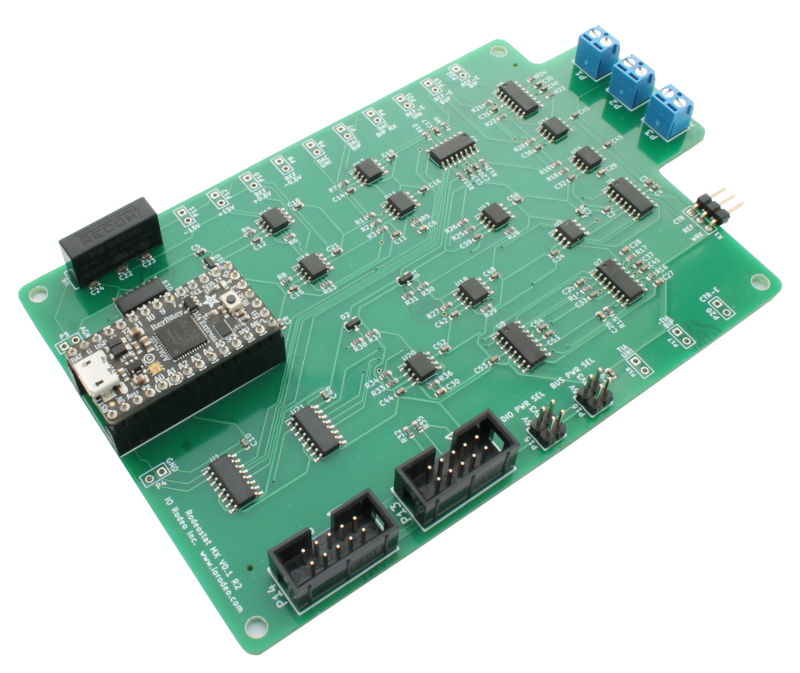
Main components on the Potentiostat
Potentiostat bill of materials (BOM)
141 components, 65 distinct parts — part numbers from the project's BOM.
| Qty | Part | Footprint | Refs |
|---|---|---|---|
| 1 | ZXRE060ET5DI 74HC138 Digikey | SOIC-16_3.9x9.9mm_P1.27mm | U1 |
| 1 | WM17453 TEENSY3.1 Digikey | TEENSY3X | U2 |
| 1 | MAX6176AASA+ DG411xY Digikey | SOIC-16_3.9x9.9mm_P1.27mm | U3 |
| 1 | DG411xY Digikey | SOIC-16_3.9x9.9mm_P1.27mm | U4 |
| 1 | AD8250ARMZ-R7 DG411xY Digikey | SOIC-16_3.9x9.9mm_P1.27mm | U5 |
| 1 | 811-2678-5 MEA1D05XXSC Digikey | MEA1 | U6 |
| 2 | OPA129U DG411xY Digikey | SOIC-16_3.9x9.9mm_P1.27mm | U7, U8 |
| 1 | ADG441BRZ-REEL TL072 Digikey | SOIC-8_3.9x4.9mm_P1.27mm | U9 |
| 1 | 296-26248-1 REF33XX Digikey | SOT-23 | U10 |
| 1 | 296-14626-1 OP07 Digikey | SOIC-8_3.9x4.9mm_P1.27mm | U11 |
| 7 | OP07 Digikey | SOIC-8_3.9x4.9mm_P1.27mm | U12, U14, U15, U16, U17, U18, U20 |
| 1 | ADG441BRZ-REEL OP07 Digikey | SOIC-8_3.9x4.9mm_P1.27mm | U13 |
| 2 | 74HC138 | SOIC-16_3.9x9.9mm_P1.27mm | U19, U21 |
| 3 | ED2635 Conn_01x02 Digikey | CONNBLOCK2 | P1, P2, P3 |
| 14 | 923345-01 Conn_01x02 Digikey | PIN_ARRAY_2X1 | P4, P5, P6, P7, P8, P9, P10, P11 +6 |
| 2 | S9169 Conn_02x05_Odd_Even Digikey | 5X2_SHRD_HEADER | P13, P14 |
| 2 | 609-3201 Conn_02x02_Odd_Even Digikey | PIN_ARRAY_2X2 | P15, P16 |
| 1 | Conn_01x02 | PIN_ARRAY_2X1 | P22 |
| 4 | VAL** | 4-40 | H1, H2, H3, H4 |
| 1 | S1111EC-03 Conn_01x03 Digikey | PIN_ARRAY_3X1 | K1 |
Show 45 more
| Qty | Part | Footprint | Refs |
|---|---|---|---|
| 2 | BAS70-04-E3-08 BAS07-04 Digikey | SOT-23 | D1, D2 |
| 2 | 311-1136-1 4.7uF Digikey | C_0603_1608Metric | C1, C5 |
| 12 | 311-1361-1 0.1uF Digkey | C_0603_1608Metric | C2, C10, C11, C12, C13, C14, C15, C17 +4 |
| 3 | 490-3335-1 0.1uF Digkey | C_0603_1608Metric | C3, C32, C38 |
| 5 | 490-5523-1 0.1uF Digikey | C_0603_1608Metric | C4, C16, C18, C31, C36 |
| 1 | 311-1361-1 3.3nF Digkey | C_0603_1608Metric | C6 |
| 1 | 490-3335-1 2.2uF Digkey | C_0603_1608Metric | C7 |
| 1 | 490-5523-1 2.2uF Digikey | C_0603_1608Metric | C8 |
| 1 | 1276-1066-1 2.2uF Digikey | C_0603_1608Metric | C9 |
| 3 | 478-1392-1 0.1uF Digikey | C_0603_1608Metric | C19, C20, C21 |
| 1 | 478-1392-1 1uF Digikey | C_0603_1608Metric | C22 |
| 1 | 311-1361-1 1uF Digkey | C_0603_1608Metric | C23 |
| 3 | 311-1361-1 68nF Digkey | C_0603_1608Metric | C25, C27, C28 |
| 1 | 490-5523-1 68nF Digikey | C_0603_1608Metric | C26 |
| 1 | 490-5523-1 10nF Digikey | C_0603_1608Metric | C29 |
| 1 | 311-1136-1 12nF Digikey | C_0603_1608Metric | C30 |
| 2 | 311-1136-1 0.1uF Digikey | C_0603_1608Metric | C37, C39 |
| 14 | 0.1uF | C_0603_1608Metric | C40, C41, C42, C43, C44, C45, C46, C47 +6 |
| 1 | 311-1.00KCR 12k Digikey | R_0603_1608Metric | R1 |
| 1 | P10KDA 12k Digikey | R_0603_1608Metric | R2 |
| 1 | P10KDA 20k Digikey | R_0603_1608Metric | R3 |
| 1 | P191DA 100k Digikey | R_0603_1608Metric | R4 |
| 1 | P604DA 20k Digikey | R_0603_1608Metric | R5 |
| 1 | A110618 20k Digikey | R_0603_1608Metric | R6 |
| 1 | P60.4KDA 10k Digikey | R_0603_1608Metric | R7 |
| 1 | P604KDA 20k Digikey | R_0603_1608Metric | R8 |
| 1 | P49.9KDA 10k Digikey | R_0603_1608Metric | R9 |
| 1 | P49.9KDA 20k Digikey | R_0603_1608Metric | R10 |
| 1 | P49.9KDA 50k Digikey | R_0603_1608Metric | R11 |
| 1 | P3.0KDA 100k Digikey | R_0603_1608Metric | R12 |
| 1 | P3.0KDA 20k Digikey | R_0603_1608Metric | R13 |
| 1 | 311-4.70KCR 300k Digikey | R_0603_1608Metric | R14 |
| 1 | 311-1.00KCR 30k Digikey | R_0603_1608Metric | R15 |
| 1 | 311-4.70KCR 3k Digikey | R_0603_1608Metric | R16 |
| 1 | 311-100CR 300 Digikey | R_0603_1608Metric | R17 |
| 1 | 311-1.00KCR 10k Digikey | R_0603_1608Metric | R18 |
| 1 | 311-100CR 10k Digikey | R_0603_1608Metric | R19 |
| 2 | 100k | R_0603_1608Metric | R20, R21 |
| 1 | 50k | R_0603_1608Metric | R22 |
| 3 | 20k | R_0603_1608Metric | R23, R25, R29 |
| 2 | 10k | R_0603_1608Metric | R24, R27 |
| 5 | 12k | R_0603_1608Metric | R26, R28, R33, R34, R36 |
| 2 | 1k | R_0603_1608Metric | R30, R37 |
| 2 | 100 | R_0603_1608Metric | R31, R38 |
| 2 | 4.7k | R_0603_1608Metric | R32, R35 |
Potentiostat design files
The KiCad project lives in the iorodeo/potentiostat repository on GitHub; these links point at the commit this page was built from.
Potentiostat: common questions
What microcontroller does the Potentiostat use?
The Potentiostat is built around the WM17453, from the NXP family.
How big is the Potentiostat PCB?
The Potentiostat measures 144.8 × 88.9 mm, has 2 copper layers and is 1.6 mm thick.
How many components are on the Potentiostat?
141 components, from 65 distinct parts, with part numbers taken from the project's own BOM. The full bill of materials is listed on this page.
Where can I download the Potentiostat design files?
From the iorodeo/potentiostat repository on GitHub, which has the KiCad layout and the BOM; the links under Design files point to each one.
Can I use the Potentiostat design in my own project?
Yes, under the terms of its CC-BY-4.0 license, which iorodeo chose for the repository.
Can I test firmware for the Potentiostat without the hardware?
Yes. HardLabs builds a simulation of the board from its netlist and BOM, so you can run and debug NXP firmware against it before you order a PCB.
More boards in potentiostat
Similar boards
 NXP
NXPMega-Cube-Board
MaltWhiskey
200 × 54 mm100 parts4LNo license763 NXP
NXP32Bit shift register
100 × 54 mm56 parts4LNo license763 NXP
NXPICED-L
kiibohd
175.4 × 145 mm163 partsCERN-OHL-1.2415 NXP
NXPK-Type
357.5 × 131.8 mm361 partsCERN-OHL-1.2415 NXP
NXPIC60
285 × 95 mm242 partsCERN-OHL-1.2415 NXP
NXPWhiteFox
304.8 × 101.1 mm296 partsCERN-OHL-1.2415