
Uq phone

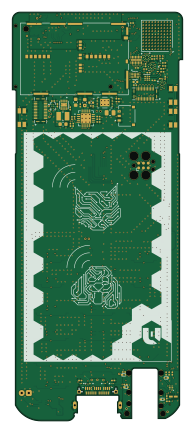
About the Uq phone PCB
Uq phone is an open source STM32 PCB design by JamesB-Wood, published on GitHub under the CERN-OHL-S-2.0 license. It is a 6-layer board measuring 45 × 108 mm, with 172 components from 53 distinct parts.
Its main chip is the STM32H723VGHx, from the STM32 family. Other key parts include the TPS62162DSGR, MCP73871-2CCI_ML, BQ27441DRZR-G1A, TCA9509MRVHR and TPD3F303DQDR. By type, the board carries 48 capacitors, 41 switches, 27 resistors, 17 ICs, 16 LEDs and 8 diodes.
It belongs with the audio designs in this gallery.
From the project
UniQHW
The hardware repository for UQ Phone (UniQ) The Corresponding software component can be found https://github.com/Benksur/UniQOS
Supervised by: Professor Pauline Pounds Institution: University of Queensland
Any Questions about the PCB and Schematics please direct them to james.brian.wood@outlook.com
The V0.2.0 PCB's must be made with the following specifications from JLCPCB
Main components on the Uq phone
Uq phone bill of materials (BOM)
172 components, 53 distinct parts.
| Qty | Part | Footprint | Refs |
|---|---|---|---|
| 1 | TPS62162DSGR | SON50P200X200X80-9N | U1 |
| 1 | MCP73871-2CCI_ML | QFN50P400X400X100-21N | U2 |
| 1 | BQ27441DRZR-G1A | IC_BQ27441DRZR-G1A | U3 |
| 1 | TCA9509MRVHR | RVH8_0P4X0P4 | U5 |
| 1 | STM32H723VGHx | TFBGA-100_8x8mm_Layout10x10_P0.8mm | U6 |
| 1 | TPD3F303DQDR | SON40P170X135X80-9N | U8 |
| 1 | AZV5001RA4-7 | DFN1210P6X_L1.2-W1.0-P0.40-BL | U9 |
| 1 | TPD8F003DQDR | SON40P135X330X80-17N | U10 |
| 1 | LSM6DSVTR | LGA14-L_2P59X3P1X0P5_STM | U11 |
| 1 | DRV2603RUNR | QFN50P200X200X80-10N | U12 |
| 1 | TS3A5018RSVR | QFN40P260X180X55-16N | U13 |
| 1 | NAU88C22YG | QFN50P500X500X80-33N | U14 |
| 1 | TPS22964CYZPR | IC_SN74LVC2G34YZPR | U15 |
| 1 | TXU0204DTRR | DTR0012A-MFG | U17 |
| 1 | TXU0304DTRR | DTR0012A-MFG | U18 |
| 2 | TXU0104DTRR | DTR0012A-MFG | U19, U20 |
| 2 | MMBT3904LP-7 | DFN101X61X53-3N | Q1, Q2 |
| 1 | S8050 | SOT-23 | Q3 |
| 1 | PJ-605-6A 韩国韩荣 | AUDIO-TH_PJ-605-6A | J1 |
| 1 | 124018312112A | AMPHENOL_124018312112A | J2 |
Show 33 more
| Qty | Part | Footprint | Refs |
|---|---|---|---|
| 1 | BM03B-ACHSS-GAN-TF_LF__SN_ | JST_BM03B-ACHSS-GAN-TF_LF__SN_ | J3 |
| 2 | 559092474 | CON_559092474 | J7, J9 |
| 1 | MCS-302S-C1 XUNPU(讯普) | SIM-SMD_MCS-302S-C1 | J8 |
| 1 | AMM-3738-B-R | MIC_AMM-3738-B-R | MK1 |
| 1 | OT7EL89CJI-111YLC-19.2M YXC(扬兴晶振) | OSC-SMD_4P-L2.0-W1.6-BL | OSC1 |
| 1 | MCABS-258-RC | MCABS-258-RC | SP1 |
| 38 | SKTAAAE010 | SKTAAAE010 | SW1, SW2, SW3, SW4, SW5, SW7, SW8, SW9 +30 |
| 3 | SKSCLCE010 | SKSCLCE010 | SW6, SW16, SW22 |
| 16 | XL-1010RGBC | XL-1010RGBC-WS2812B | LED1, LED3, LED4, LED5, LED6, LED7, LED8, LED9 +8 |
| 4 | ESD441DPLR | DIODFN60X30X32-2N | D4, D5, D6, D7 |
| 4 | ESD5451X WILLSEMI(韦尔) | WBFBP-02C_L1.0-W0.6-BI | D8, D9, D10, D11 |
| 2 | BLM18SG221TN1D | BEADC1608X65N | FB1, FB2 |
| 1 | 3.3uH | INDC2520X120N | L1 |
| 2 | 10uF | C_0603_1608Metric | C1, C3 |
| 1 | 22uF | C_0603_1608Metric | C2 |
| 10 | 4.7uF | C_0201_0603Metric | C4, C7, C14, C36, C39, C40, C41, C42 +2 |
| 1 | 470pF | C_0402_1005Metric | C5 |
| 7 | 1uF | C_0201_0603Metric | C6, C30, C37, C45, C47, C48, C49 |
| 23 | 100nF | C_0201_0603Metric | C15, C16, C17, C18, C19, C20, C21, C28 +15 |
| 2 | 2.2uF | C_0402_1005Metric | C25, C26 |
| 1 | 33pF | C_0402_1005Metric | C33 |
| 1 | 10nF | C_0402_1005Metric | C46 |
| 4 | 100k | R_0201_0603Metric | R1, R7, R11, R28 |
| 3 | 5.1k | R_0201_0603Metric | R2, R3, R6 |
| 4 | 4.7k | R_0201_0603Metric | R4, R16, R17, R22 |
| 1 | 270k | R_0201_0603Metric | R5 |
| 7 | 10k | R_0201_0603Metric | R8, R20, R21, R23, R24, R25, R33 |
| 1 | 10m | R_0805_2012Metric | R9 |
| 2 | 2.2k | R_0201_0603Metric | R10, R36 |
| 2 | 47k | R_0201_0603Metric | R18, R19 |
| 1 | 1k | R_0402_1005Metric | R26 |
| 1 | 5R | R_0402_1005Metric | R27 |
| 1 | 330R | R_0402_1005Metric | R42 |
Uq phone design files
The KiCad project lives in the JamesB-Wood/UniQHW repository on GitHub; these links point at the commit this page was built from.
Uq phone: common questions
What microcontroller does the Uq phone use?
The Uq phone is built around the STM32H723VGHx, from the STM32 family.
How big is the Uq phone PCB?
The Uq phone measures 45 × 108 mm, has 6 copper layers and is 0.8464 mm thick.
How many components are on the Uq phone?
172 components, from 53 distinct parts. The full bill of materials is listed on this page.
Where can I download the Uq phone design files?
From the JamesB-Wood/UniQHW repository on GitHub, which has the KiCad layout and the schematic; the links under Design files point to each one.
Can I use the Uq phone design in my own project?
Yes, under the terms of its CERN-OHL-S-2.0 license, which JamesB-Wood chose for the repository.
Can I test firmware for the Uq phone without the hardware?
Yes. HardLabs builds a simulation of the board from its netlist and BOM, so you can run and debug STM32 firmware against it before you order a PCB.
More boards in UniQHW
Similar boards
 STM32
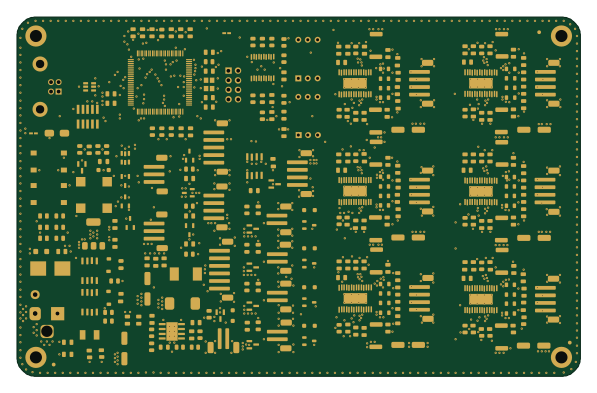
STM32LumenPnP Motherboard
opulo-inc
149 × 95 mm296 parts4LCC-BY-SA-4.03.7k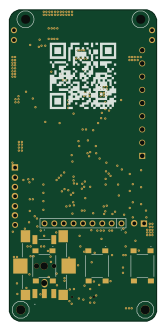 STM32
STM32AxxSolder
AxxAxx
39 × 82.5 mm122 parts2LGPL-3.01.7k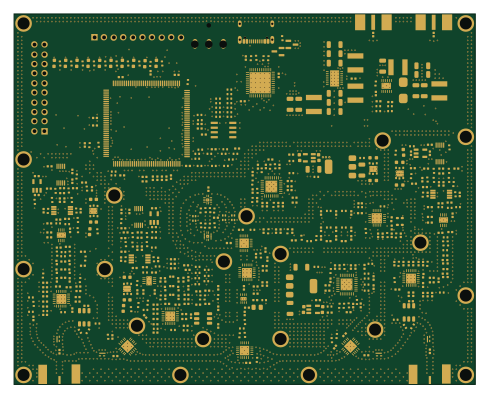 STM32
STM32LibreVNA
jankae
122 × 98 mm592 parts6LGPL-3.01.6k STM32
STM32AIOC
skuep
21 × 31.5 mm47 parts2LMIT1.4k STM32
STM32Ferris
pierrechevalier83
208.8 × 86.8 mm102 parts2LSHL-2.11.3k STM32
STM32176 pin board
rusefi
61.8 × 73.2 mm76 parts2LGPL-3.01.2k