
RF HAT

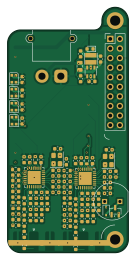
About the RF HAT
RF HAT is an open source RP2040/RP2350 PCB design by Just4Stan, published on GitHub. It is a 6-layer board measuring 32 × 65 mm, with 105 components from 46 distinct parts.
Its main chip is the RaspberryPi_Pico, from the RP2040/RP2350 family. Other key parts include the CC1200RHBR, XT30PW-M and LMR51420YFDDCR. By type, the board carries 59 capacitors, 17 inductors, 10 resistors, 6 diodes, 5 ICs and 5 connectors.
It belongs with the rf & radio, dev boards & breakouts and power & battery designs in this gallery.
From the project
RP2040-based AZ/EL rotator controller for SatNOGS-compatible satellite ground stations. Custom PCB, PID motor control, EasyComm/hamlib protocol over USB.
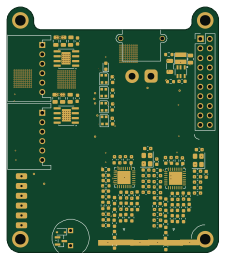
KiCad 9.0 project for a Raspberry Pi 3A+ HAT with two TI CC1200 transceivers (UHF 432 MHz + VHF 144 MHz), controlled by a Raspberry Pi Pico over SPI. Part of the SatNOGS Basestation project.
A rough estimate for 1 board, assembled by JLCPCB, for 10 units, is 20USD per board. This converges to 10USD in larger quantities.
Power: External buck converter provides 5V through a Schottky diode to the Pico's VSYS pin (USB can power simultaneously via internal Schottky OR-ing). Pico's onboard RT6150 regulator provides 3.3V for both CC1200s.
Main components on the RF HAT
RF HAT bill of materials (BOM)
105 components, 46 distinct parts — part numbers from the project's BOM.
| Qty | Part | Footprint | Refs |
|---|---|---|---|
| 2 | CC1200RHBR | QFN-32-1EP_5x5mm_P0.5mm_EP3.45x3.45mm | U1, U2 |
| 1 | RaspberryPi_Pico | RaspberryPi_Pico_SMD | U3 |
| 1 | XT30PW-M | AMASS_XT30PW-M_1x02_P2.50mm_Horizontal | U4 |
| 1 | LMR51420YFDDCR | SOT-23-6_L2.9-W1.6-P0.95-LS2.9-BL | U5 |
| 1 | BSS138 | SOT-23 | Q1 |
| 2 | 40MHZ 40MHz | Crystal_SMD_3225-4Pin_3.2x2.5mm | Y1, Y2 |
| 2 | SMA | SMA_Amphenol_132289_EdgeMount | J1, J2 |
| 1 | RASPBERRY_PI_2_3 Raspberry_Pi_2_3 | PinHeader_2x20_P2.54mm_Vertical | J3 |
| 2 | CONN_01X01 Conn_01x01 | PinHeader_1x01_P2.00mm_Vertical | J4, J5 |
| 1 | C3759853 D_Schottky | D_0603_1608Metric | D1 |
| 1 | 1N4148WS | D_SOD-323 | D2 |
| 4 | WS2812B-2020 | LED_WS2812B-2020_PLCC4_2.0x2.0mm | D3, D4, D5, D6 |
| 2 | 15NH 15nH | L_0603_1608Metric | L1, L5 |
| 1 | 43NH 43nH | L_0603_1608Metric | L2 |
| 2 | 22NH 22nH | L_0603_1608Metric | L3, L14 |
| 2 | 56NH 56nH | L_0603_1608Metric | L4, L7 |
| 2 | 27NH 27nH | L_0603_1608Metric | L6, L8 |
| 3 | 100NH 100nH | L_0603_1608Metric | L9, L10, L12 |
| 1 | 47NH 47nH | L_0603_1608Metric | L11 |
| 1 | 270NH 270nH | L_0603_1608Metric | L13 |
Show 26 more
| Qty | Part | Footprint | Refs |
|---|---|---|---|
| 1 | 120NH 120nH | L_0603_1608Metric | L15 |
| 1 | 82NH 82nH | L_0603_1608Metric | L16 |
| 1 | XRTC303020D4R7MBCA | IND-SMD_L3.0-W3.0_AFE303020S | L18 |
| 1 | 2.2PF 2.2pF | C_0603_1608Metric | C1 |
| 1 | 39PF 39pF | C_0603_1608Metric | C2 |
| 3 | 5.1PF 5.1pF | C_0603_1608Metric | C3, C8, C9 |
| 1 | 6.2PF 6.2pF | C_0603_1608Metric | C4 |
| 1 | 56PF 56pF | C_0603_1608Metric | C5 |
| 4 | 10NF 10nF | C_0603_1608Metric | C6, C16, C31, C41 |
| 5 | 100PF 100pF | C_0603_1608Metric | C7, C38, C39, C43, C47 |
| 1 | 1NF 1nF | C_0603_1608Metric | C10 |
| 8 | 15PF 15pF | C_0603_1608Metric | C11, C12, C13, C20, C27, C32, C45, C46 |
| 22 | 47NF 47nF | C_0603_1608Metric | C14, C15, C21, C25, C26, C28, C29, C30 +14 |
| 6 | 220NF 220nF | C_0603_1608Metric | C17, C34, C48, C49, C50, C51 |
| 1 | 1.5NF 1.5nF | C_0603_1608Metric | C18 |
| 1 | C98192 4.7uF 50v | C_0805_2012Metric | C19 |
| 1 | 100N 100n | C_0603_1608Metric | C22 |
| 1 | 1.8NF 1.8nF | C_0603_1608Metric | C23 |
| 1 | 22UF 22uF | C_0603_1608Metric | C24 |
| 1 | 1.5PF 1.5pF | C_0603_1608Metric | C44 |
| 4 | 10K 10k | R_0603_1608Metric | R1, R2, R4, R5 |
| 2 | 56K 56k | R_0603_1608Metric | R3, R7 |
| 1 | 18R | R_0603_1608Metric | R6 |
| 1 | 22R | R_0603_1608Metric | R8 |
| 1 | 100K 100k | C_0603_1608Metric | R16 |
| 1 | 13.7K 13.7k | C_0603_1608Metric | R17 |
RF HAT design files
The KiCad project lives in the Just4Stan/SatNOGS-Basestation repository on GitHub; these links point at the commit this page was built from.
RF HAT: common questions
What microcontroller does the RF HAT use?
The RF HAT is built around the RaspberryPi_Pico, from the RP2040/RP2350 family.
How big is the RF HAT?
The RF HAT measures 32 × 65 mm, has 6 copper layers and is 1.146 mm thick.
How many components are on the RF HAT?
105 components, from 46 distinct parts, with part numbers taken from the project's own BOM. The full bill of materials is listed on this page.
Where can I download the RF HAT design files?
From the Just4Stan/SatNOGS-Basestation repository on GitHub, which has the KiCad layout, the schematic and the BOM; the links under Design files point to each one.
Can I use the RF HAT design in my own project?
The repository has no license, so all rights stay with Just4Stan. Use it as a reference, and ask the author before reusing the design.
Can I test firmware for the RF HAT without the hardware?
Yes. HardLabs builds a simulation of the board from its netlist and BOM, so you can run and debug RP2040/RP2350 firmware against it before you order a PCB.
More boards in SatNOGS-Basestation
Similar boards
 RP2040/RP2350
Open Book Abridged Edition
joeycastillo
85 × 115 mm29 parts2LCC-BY-SA-4.08.1k RP2040/RP2350
Corne
foostan
277.2 × 107.5 mm164 parts2LCC-BY-4.07.7k RP2040/RP2350
Corne
277.2 × 107.5 mm164 parts2LCC-BY-4.07.7k RP2040/RP2350
MSA
Mentra-Community
30.5 × 138 mm61 parts2LMIT1.2k RP2040/RP2350
Open Source Smart Glasses
93 × 10.5 mm80 parts4LMIT1.2k RP2040/RP2350
Msa
47.8 × 9.4 mm53 parts2LMIT1.2k