
InSomnia

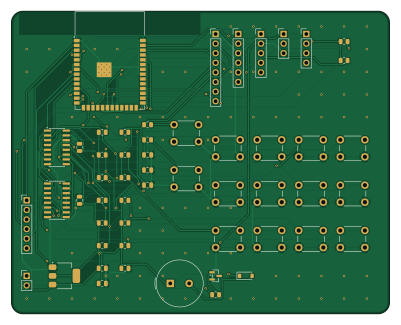
About the InSomnia PCB
InSomnia is an open source ESP32 PCB design by kaorii-ako, published on GitHub. It is a 2-layer board measuring 100 × 80 mm, with 53 components from 34 distinct parts.
Its main chip is the ESP32-S3-WROOM-1-N16R8, from the ESP32 family. Other key parts include the 74HC165 and AMS1117-3.3. By type, the board carries 17 resistors, 14 switches, 8 capacitors, 7 connectors, 4 ICs and 1 transistor.
It belongs with the iot & wireless designs in this gallery.
From the project
Adaptive, context-aware wake clock — wakes you while you're already stirring, stays quiet if you're already up. ESP32-S3 + thermal array.
An adaptive, context-aware wake clock. Instead of firing at a fixed timestamp, it wakes you inside a window at a moment you are already stirring — and if you got up before the window even opened, it stays quiet.
Built for Hack Club Forge. Firmware-first, fully offline after WiFi time sync, no cloud service, no audio leaves the device.
I hate being ripped out of deep sleep at 06:50 exactly when I was finally sleeping well, and I also hate my phone blaring when I’m already in the kitchen making coffee. Both are the same bug: a clock that knows time but not context. I wanted a clock that knows…
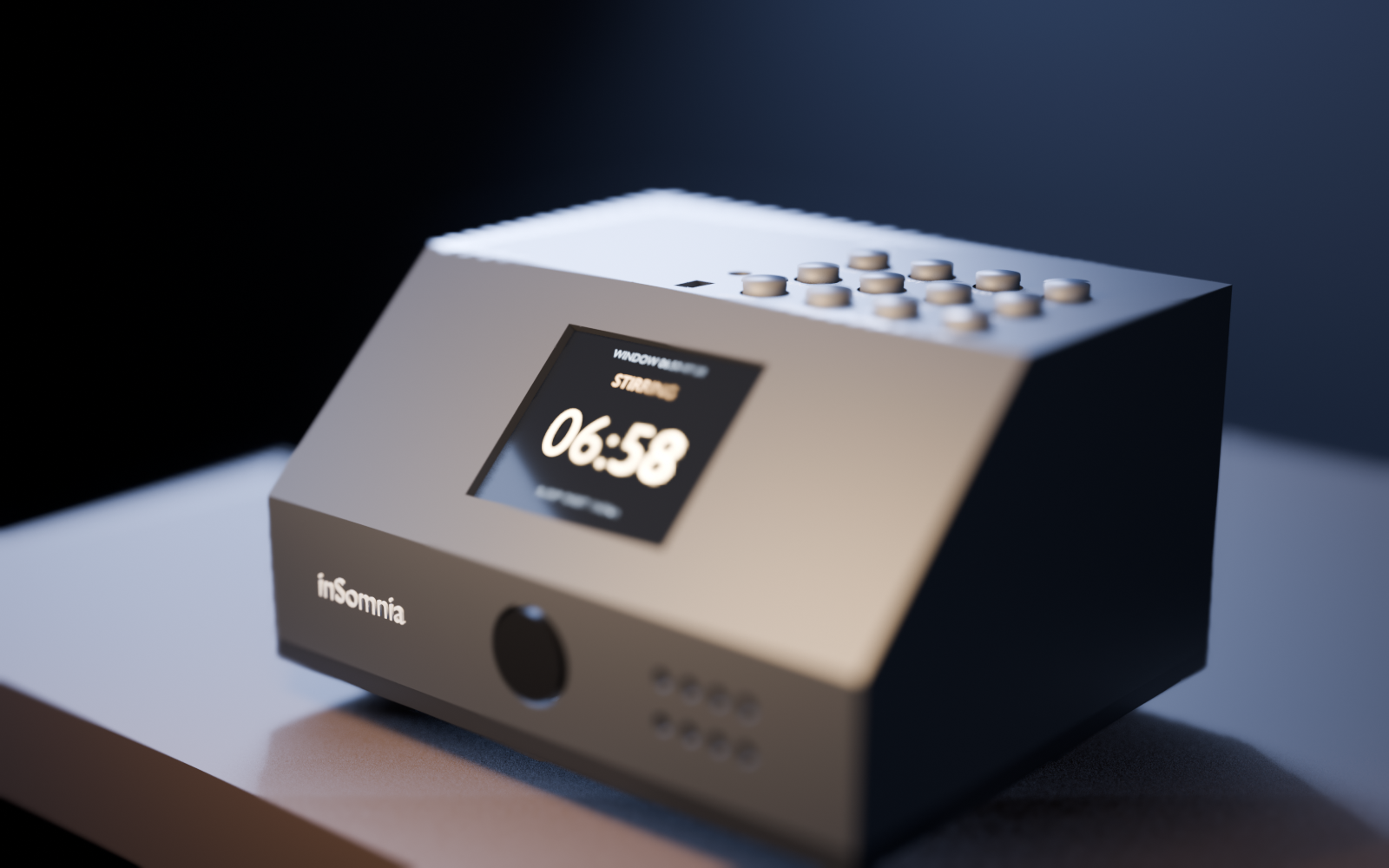
Main components on the InSomnia
InSomnia bill of materials (BOM)
53 components, 34 distinct parts — part numbers from the project's BOM.
| Qty | Part | Footprint | Refs |
|---|---|---|---|
| 1 | ESP32-S3-WROOM-1-N16R8 | ESP32-S3-WROOM-1 | U1 |
| 2 | 74HC165 | SOIC-16_3.9x9.9mm_P1.27mm | U2, U3 |
| 1 | AMS1117-3.3 | SOT-223-3_TabPin2 | U4 |
| 1 | MMBT3904 | SOT-23 | Q1 |
| 1 | Power_In_5V | PinHeader_1x02_P2.54mm_Vertical | J1 |
| 1 | UART_Prog | PinHeader_1x06_P2.54mm_Vertical | J2 |
| 1 | TFT_ST7735 | PinHeader_1x08_P2.54mm_Vertical | J3 |
| 1 | INMP441_Mic | PinHeader_1x06_P2.54mm_Vertical | J4 |
| 1 | MLX90640_Thermal | PinHeader_1x05_P2.54mm_Vertical | J5 |
| 1 | AUX_3pin_spare | PinHeader_1x03_P2.54mm_Vertical | J6 |
| 1 | USB_Native | PinHeader_1x04_P2.54mm_Vertical | J7 |
| 1 | Piezo_5V | Buzzer_TDK_PS1240P02BT_D12.2mm_H6.5mm | BZ1 |
| 1 | RESET | SW_PUSH_6mm | SW1 |
| 1 | BOOT | SW_PUSH_6mm | SW2 |
| 1 | Key_1 | SW_PUSH_6mm | SW3 |
| 1 | Key_2 | SW_PUSH_6mm | SW4 |
| 1 | Key_3 | SW_PUSH_6mm | SW5 |
| 1 | Key_4 | SW_PUSH_6mm | SW6 |
| 1 | Key_5 | SW_PUSH_6mm | SW7 |
| 1 | Key_6 | SW_PUSH_6mm | SW8 |
Show 14 more
| Qty | Part | Footprint | Refs |
|---|---|---|---|
| 1 | Key_7 | SW_PUSH_6mm | SW9 |
| 1 | Key_8 | SW_PUSH_6mm | SW10 |
| 1 | Key_9 | SW_PUSH_6mm | SW11 |
| 1 | Key_10 | SW_PUSH_6mm | SW12 |
| 1 | Key_11 | SW_PUSH_6mm | SW13 |
| 1 | Key_12 | SW_PUSH_6mm | SW14 |
| 1 | 1N4148 | D_SOD-123 | D1 |
| 2 | 10uF | C_0805_2012Metric | C1, C5 |
| 1 | 22uF | C_0805_2012Metric | C2 |
| 4 | 100nF | C_0805_2012Metric | C3, C4, C7, C8 |
| 1 | 1uF | C_0805_2012Metric | C6 |
| 14 | 10k | R_0805_2012Metric | R1, R2, R6, R7, R8, R9, R10, R11 +6 |
| 2 | 4.7k | R_0805_2012Metric | R3, R4 |
| 1 | 1k | R_0805_2012Metric | R5 |
InSomnia design files
The KiCad project lives in the kaorii-ako/inSomnia repository on GitHub; these links point at the commit this page was built from.
InSomnia: common questions
What microcontroller does the InSomnia use?
The InSomnia is built around the ESP32-S3-WROOM-1-N16R8, from the ESP32 family.
How big is the InSomnia PCB?
The InSomnia measures 100 × 80 mm, has 2 copper layers and is 1.6 mm thick.
How many components are on the InSomnia?
53 components, from 34 distinct parts, with part numbers taken from the project's own BOM. The full bill of materials is listed on this page.
Where can I download the InSomnia design files?
From the kaorii-ako/inSomnia repository on GitHub, which has the KiCad layout, the schematic and the BOM; the links under Design files point to each one.
Can I use the InSomnia design in my own project?
The repository has no license, so all rights stay with kaorii-ako. Use it as a reference, and ask the author before reusing the design.
Can I test firmware for the InSomnia without the hardware?
Yes. HardLabs builds a simulation of the board from its netlist and BOM, so you can run and debug ESP32 firmware against it before you order a PCB.
Similar boards
 ESP32
ESP32Open Book Abridged Edition
joeycastillo
85 × 115 mm65 parts2LCC-BY-SA-4.08.1k ESP32
ESP32Badge
atopile
56.3 × 39 mm239 parts4LMIT4.0k ESP32
ESP32Esp32 minimal
36.2 × 26.8 mm20 parts2LMIT4.0k ESP32
ESP32Racer
StuckAtPrototype
36 × 50.2 mm70 parts4LApache-2.03.8k ESP32
ESP32Controller
29 × 74 mm58 parts4LApache-2.03.8k ESP32
ESP32Bitaxe
skot
56.5 × 99.8 mm86 parts4LCERN-OHL-S-2.01.4k