
Pycontrol hub h7

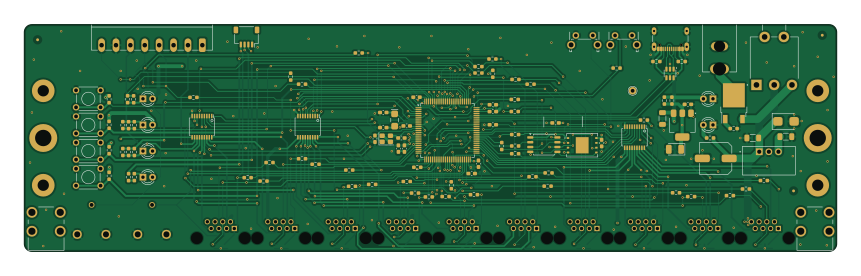
About the Pycontrol hub h7 PCB
Pycontrol hub h7 is an open source STM32 PCB design by Karpova-Lab, published on GitHub. It is a 4-layer board measuring 215 × 60 mm, with 141 components from 37 distinct parts.
Its main chip is the STM32H743VIT6, from the STM32 family. Other key parts include the TSR 3-2450N, AMS1117-3.3, USBLC6-2SC6, W25Q64JVZEIQ and W25Q16JVSSIQ. By type, the board carries 61 resistors, 21 capacitors, 20 ICs, 16 connectors, 7 switches and 7 diodes.
It belongs with the dev boards & breakouts designs in this gallery.
From the project
Hardware hub for pyControl built around an STM32H743 microcontroller.
- Documentation - Development discussion
A high-performance hardware hub for pyControl, built around an STM32H743VIT6 microcontroller. It interfaces with pyControl devices to record inputs and control outputs for behavioral experiments.
- 480 MHz Cortex-M7, 1 MB RAM, 2 MB external QSPI flash - 11 pyControl behavior ports - 10 RJ45 connectors - 1 auxiliary 8-position terminal block that pairs with a screw terminal plug - 2 BNC connectors - 1 I²C connector compatible with Qwiic / STEMMA QT / Qw/ST / Modulino - USB Type-C connector with ESD protection - DC barrel jack input with reverse…
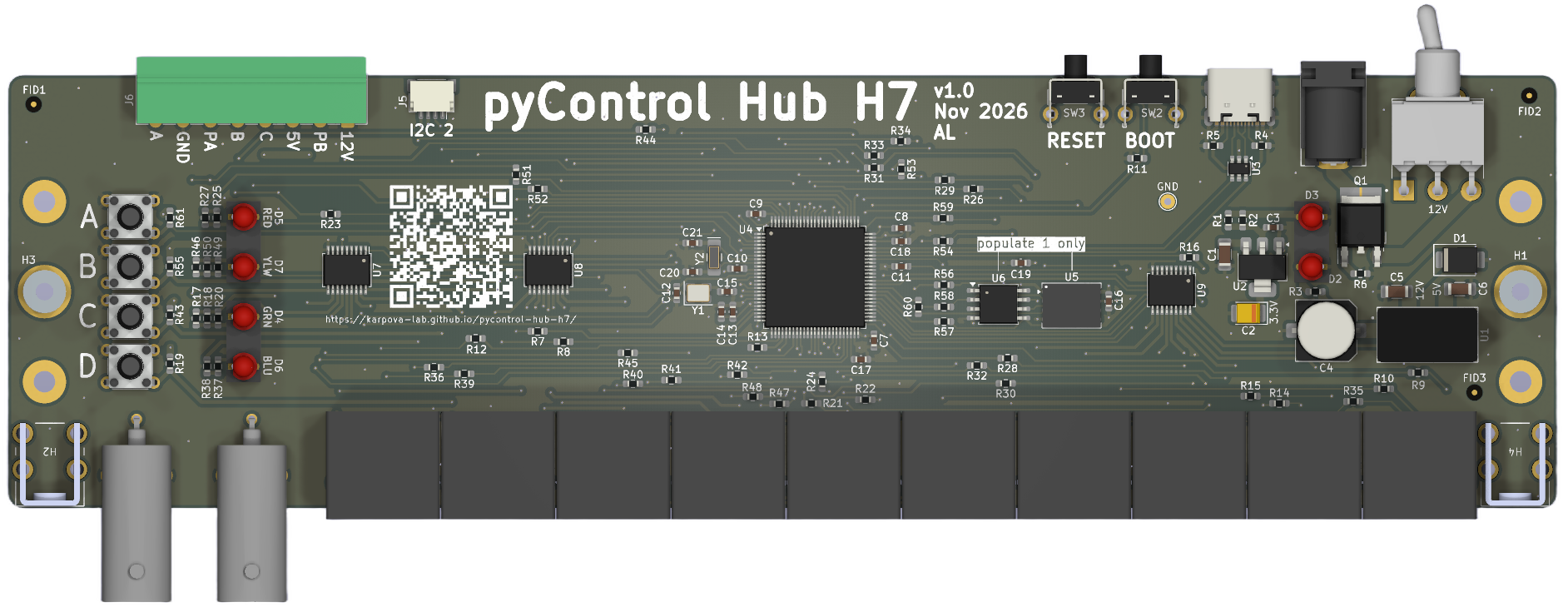
Main components on the Pycontrol hub h7
Pycontrol hub h7 bill of materials (BOM)
141 components, 37 distinct parts.
| Qty | Part | Footprint | Refs |
|---|---|---|---|
| 1 | TSR 3-2450N | Converter_DCDC_traco_3A | U1 |
| 1 | AMS1117-3.3 | SOT-223-3_TabPin2 | U2 |
| 1 | USBLC6-2SC6 | SOT-23-6 | U3 |
| 1 | STM32H743VIT6 | LQFP-100_14x14mm_P0.5mm | U4 |
| 1 | W25Q64JVZEIQ | WSON-8-1EP_8x6mm_P1.27mm_EP3.4x4.3mm | U5 |
| 1 | W25Q16JVSSIQ | SOIC-8_5.3x5.3mm_P1.27mm | U6 |
| 3 | TBD62083AFNG,EL | SSOP-18_4.4x6.5mm_P0.65mm | U7, U8, U9 |
| 11 | SRV05-4 | SOT-23-6 | U10, U11, U12, U13, U14, U15, U16, U17 +3 |
| 1 | DMP4015SK3-13 | TO-252-2 | Q1 |
| 1 | 25 MHz | crystal_STDCRS2-25M | Y1 |
| 1 | 32.768 kHz | Crystal_SMD_EuroQuartz_EQ161-2Pin_3.2x1.5mm_HandSoldering | Y2 |
| 1 | PJ-037AH | DC_Jack | J1 |
| 2 | 0731000154 | BNC RA Jack | J2, J3 |
| 1 | USB4105-GF-A | USB_C_Receptacle_GCT_USB4105-xx-A_16P_TopMnt_Horizontal | J4 |
| 1 | SM04B-SRSS-TB | JST_SH_SM04B-SRSS-TB_1x04-1MP_P1.00mm_Horizontal | J5 |
| 1 | 1803332 | PhoenixContact_MC_1,5_8-G-3.81_1x08_P3.81mm_Horizontal | J6 |
| 10 | E5J88-00LJG2-L | RJ45_THP_tab_on_top | J7, J8, J9, J10, J11, J12, J13, J14 +2 |
| 2 | 1201578 | DIN_Clip | DRA1, DRA2 |
| 2 | 9774130360R | standoff_13mm | H1, H3 |
| 2 | 7790 | RA_screw_mount | H2, H4 |
Show 17 more
| Qty | Part | Footprint | Refs |
|---|---|---|---|
| 4 | TS02-66-170-BK-260-LCR-D | SW_TH_Tactile_TS02-66-170 | S1, S2, S3, S4 |
| 1 | 100SP1T2B4M6QE | RA toggle | SW1 |
| 2 | PTS645VL58-2 LFS | SW_Tactile_SPST_Angled_PTS645Vx58-2LFS | SW2, SW3 |
| 1 | SMBJ15A | D_SMB | D1 |
| 3 | 151031SS06000 | LED_D3.0mm | D2, D3, D5 |
| 1 | 151031VS06000 | LED_D3.0mm | D4 |
| 1 | 151033BS03000 | LED_D3.0mm | D6 |
| 1 | 151031YS05900 | LED_D3.0mm | D7 |
| 3 | 10 µF | C_1206_3216Metric_Pad1.33x1.80mm_HandSolder | C1, C5, C6 |
| 1 | TPSB226K010R0500 22µF | CP_EIA-3528-21_Kemet-B_HandSolder | C2 |
| 9 | 100 nF | C_0603_1608Metric_Pad1.08x0.95mm_HandSolder | C3, C7, C8, C9, C10, C11, C13, C16 +1 |
| 1 | 100µF | C_Elec_8x10.2 | C4 |
| 4 | 10 pF | C_0603_1608Metric_Pad1.08x0.95mm_HandSolder | C12, C15, C20, C21 |
| 3 | 2.2 µF | C_0603_1608Metric_Pad1.08x0.95mm_HandSolder | C14, C17, C18 |
| 20 | 5.1 KΩ | R_0603_1608Metric_Pad0.98x0.95mm_HandSolder | R1, R2, R4, R5, R6, R11, R17, R18 +12 |
| 2 | 20 KΩ | R_0603_1608Metric_Pad0.98x0.95mm_HandSolder | R3, R38 |
| 39 | 33 Ω | R_0603_1608Metric_Pad0.98x0.95mm_HandSolder | R7, R8, R9, R10, R12, R13, R14, R15 +31 |
Pycontrol hub h7 design files
The KiCad project lives in the Karpova-Lab/pycontrol-hub-h7 repository on GitHub; these links point at the commit this page was built from.
- Layoutecad/h7_breakout.kicad_pcb
- Schematicecad/h7_breakout.kicad_sch
Pycontrol hub h7: common questions
What microcontroller does the Pycontrol hub h7 use?
The Pycontrol hub h7 is built around the STM32H743VIT6, from the STM32 family.
How big is the Pycontrol hub h7 PCB?
The Pycontrol hub h7 measures 215 × 60 mm, has 4 copper layers and is 1.6 mm thick.
How many components are on the Pycontrol hub h7?
141 components, from 37 distinct parts. The full bill of materials is listed on this page.
Where can I download the Pycontrol hub h7 design files?
From the Karpova-Lab/pycontrol-hub-h7 repository on GitHub, which has the KiCad layout and the schematic; the links under Design files point to each one.
Can I use the Pycontrol hub h7 design in my own project?
The repository has no license, so all rights stay with Karpova-Lab. Use it as a reference, and ask the author before reusing the design.
Can I test firmware for the Pycontrol hub h7 without the hardware?
Yes. HardLabs builds a simulation of the board from its netlist and BOM, so you can run and debug STM32 firmware against it before you order a PCB.
Similar boards
 STM32
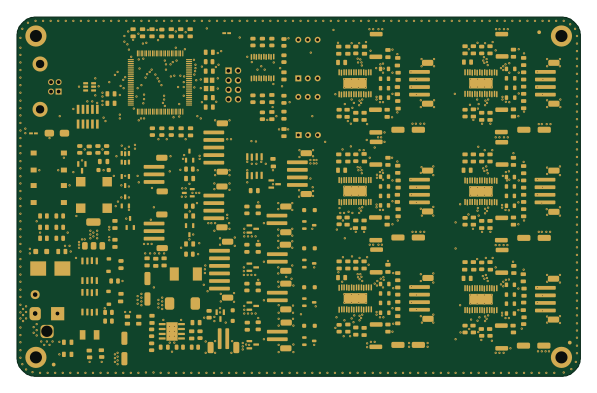
LumenPnP Motherboard
opulo-inc
149 × 95 mm296 parts4LCC-BY-SA-4.03.7k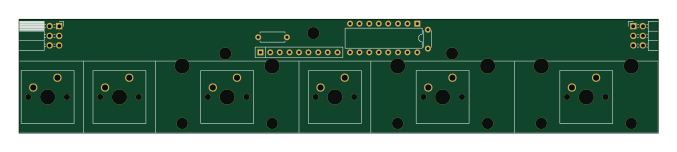 STM32
Type g
google
169 × 30 mm24 parts2LApache-2.02.9k STM32
Base
52.3 × 52.3 mm36 parts2LApache-2.02.9k STM32
Main panel
234 × 84 mm26 parts4LApache-2.02.9k STM32
Type a
150 × 30 mm14 parts2LApache-2.02.9k STM32
Type c
188 × 30 mm17 parts2LApache-2.02.9k