
Mlehaptics

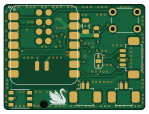
About the Mlehaptics PCB
Mlehaptics is an open source ESP32 PCB design by lemonforest, published on GitHub under the GPL-3.0 license. It is a 2-layer board measuring 37.3 × 27.8 mm, with 29 components from 21 distinct parts.
Its main chip is the XIAO-ESP32-C6-SMD, from the ESP32 family. Other key parts include the DRV2603RUNR, MAX98357AETE_T and MAX9938TEUK_T. By type, the board carries 9 capacitors, 8 resistors, 4 ICs, 3 transistors, 3 connectors and 1 switch.
It belongs with the iot & wireless, audio and test & measurement designs in this gallery.
From the project
Open-source bilateral stimulation technology for mental wellness and therapeutic applications. Professional-grade dual ESP32-C6 hardware with wireless Bluetooth Low Energy pairing and app-based control via GATT services. Cost-effective, reliable alternative to commercial devices for therapists, researchers, wellness practitioners, and self-care.
Open-source hardware for EMDR bilateral stimulation device.
Enclosure: v0.663399u (compatible with both PCB versions)
The "T" designates Tri-Modal output: haptic (motor), visual (RGB LED), and audio (amplified speaker). This is the first revision with a dedicated audio amplifier rather than a simple piezo sounder.
The PCB uses dedicated ICs instead of discrete MOSFETs:
Main components on the Mlehaptics
Mlehaptics bill of materials (BOM)
29 components, 21 distinct parts.
| Qty | Part | Footprint | Refs |
|---|---|---|---|
| 1 | XIAO-ESP32-C6-SMD | XIAO-ESP32C6-SMD | U1 |
| 1 | DRV2603RUNR | DRV2603 | U2 |
| 1 | MAX98357AETE_T | QFN50P300X300X80-17N | U3 |
| 1 | MAX9938TEUK_T | SOT95P280X145-5N | U4 |
| 1 | DMN2004K-7 | SOT-23 | Q1 |
| 2 | DMP2004K-7 | SOT-23 | Q2, Q3 |
| 1 | Conn_01x04_MountingPin | Molex_PicoBlade_53261-0471_1x04-1MP_P1.25mm_Horizontal | J1 |
| 2 | Conn_01x02_MountingPin | Molex_PicoBlade_53261-0271_1x02-1MP_P1.25mm_Horizontal | J2, J3 |
| 1 | SW_Push | SW_PUSH_6mm_H5mm | SW1 |
| 1 | 587-2056-147F | Dialight 587-2056-147F Addressable RGB | LED1 |
| 1 | 47uF | C_1206_3216Metric | C1 |
| 1 | 1uF | C_0805_2012Metric | C2 |
| 2 | 10uF | C_0805_2012Metric | C3, C6 |
| 3 | 0.1uF | C_0805_2012Metric | C4, C5, C7 |
| 2 | 0.1uF | C_0603_1608Metric | C8, C9 |
| 2 | 10K | R_0805_2012Metric | R1, R4 |
| 1 | 100m | R_0402_1005Metric | R2 |
| 1 | 3.3K | R_0805_2012Metric | R3 |
| 2 | 100K | R_0805_2012Metric | R5, R6 |
| 1 | 10K | R_0603_1608Metric | R7 |
Show 1 more
| Qty | Part | Footprint | Refs |
|---|---|---|---|
| 1 | 22 | R_0805_2012Metric | R8 |
Mlehaptics design files
The KiCad project lives in the lemonforest/mlehaptics repository on GitHub; these links point at the commit this page was built from.
Mlehaptics: common questions
What microcontroller does the Mlehaptics use?
The Mlehaptics is built around the XIAO-ESP32-C6-SMD, from the ESP32 family.
How big is the Mlehaptics PCB?
The Mlehaptics measures 37.3 × 27.8 mm, has 2 copper layers and is 1.6 mm thick.
How many components are on the Mlehaptics?
29 components, from 21 distinct parts. The full bill of materials is listed on this page.
Where can I download the Mlehaptics design files?
From the lemonforest/mlehaptics repository on GitHub, which has the KiCad layout and the schematic; the links under Design files point to each one.
Can I use the Mlehaptics design in my own project?
Yes, under the terms of its GPL-3.0 license, which lemonforest chose for the repository.
Can I test firmware for the Mlehaptics without the hardware?
Yes. HardLabs builds a simulation of the board from its netlist and BOM, so you can run and debug ESP32 firmware against it before you order a PCB.
Similar boards
 ESP32
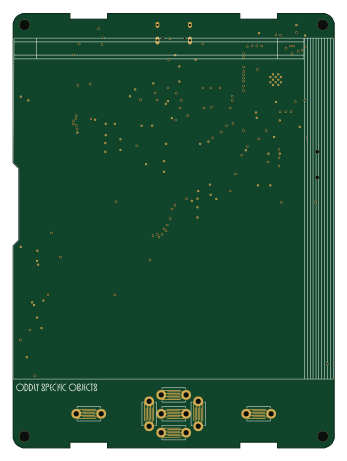
ESP32Open Book Abridged Edition
joeycastillo
85 × 115 mm65 parts2LCC-BY-SA-4.08.1k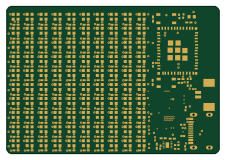 ESP32
ESP32Badge
atopile
56.3 × 39 mm239 parts4LMIT4.0k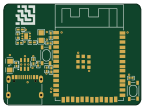 ESP32
ESP32Esp32 minimal
36.2 × 26.8 mm20 parts2LMIT4.0k ESP32
ESP32Racer
StuckAtPrototype
36 × 50.2 mm70 parts4LApache-2.03.8k ESP32
ESP32Controller
29 × 74 mm58 parts4LApache-2.03.8k ESP32
ESP32Bitaxe
skot
56.5 × 99.8 mm86 parts4LCERN-OHL-S-2.01.4k