
Attention-Seeker

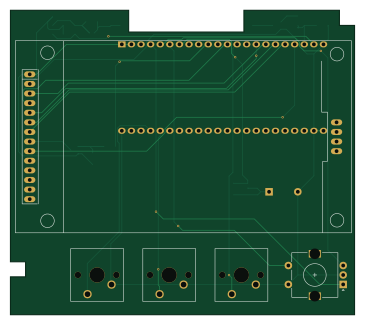
About the Attention-Seeker PCB
Attention-Seeker is an open source ESP32 PCB design by M-Mrk, published on GitHub under the Apache-2.0 license. It is a 2-layer board measuring 91 × 80.5 mm, with 19 components from 15 distinct parts.
Its main chip is the ESP32-S3-DEVKITC, from the ESP32 family. Other key parts include the TFT_320X240, IRLML2502TRPBF and AMS1117-3.3. By type, the board carries 6 resistors, 4 ICs, 4 switches, 2 capacitors, 1 transistor and 1 buzzer.
It belongs with the keyboards and displays & leds designs in this gallery.
From the project
A hackpad with features to alert you to notifications (kde only for now). Zone out alot or focus intensely when doing stuff? You also miss some important notifications? Well me too, so I build this so I can hopefully not miss them again
Attention-Seeker receives notifications from a companion app and displays them on its 2.8" color screen, with optional visual and audible alerts. It also features a rotary encoder and three mechanical keyboard switches for user input (no touch!).
In addition to notification-related features, it functions as a clock, desk light, and macropad.
Place the pcb in the bottom and press fit the top on.
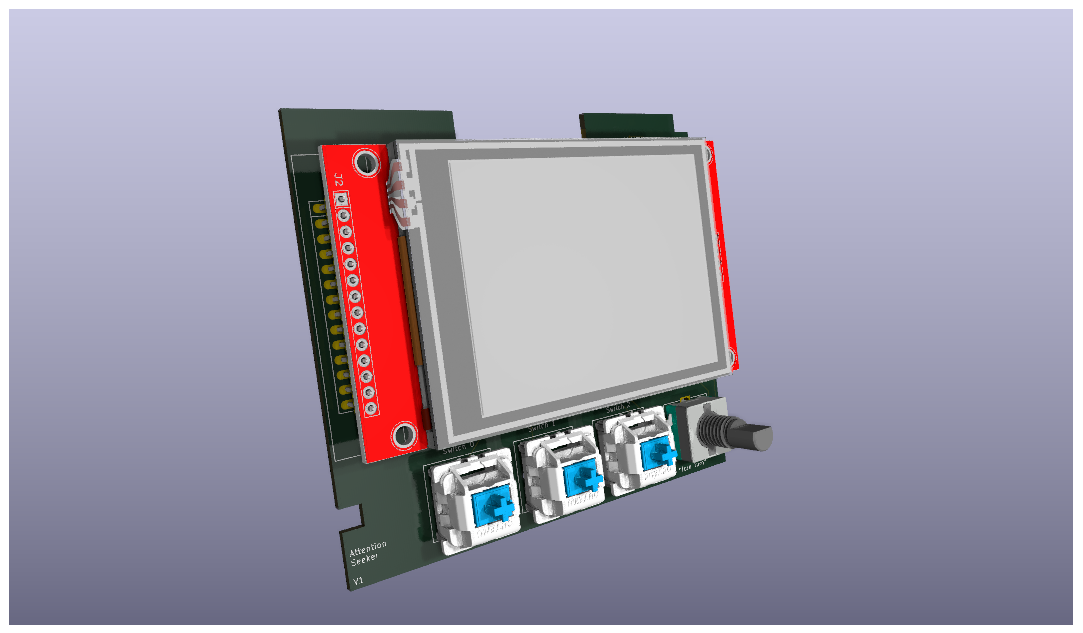
Main components on the Attention-Seeker
Attention-Seeker bill of materials (BOM)
19 components, 15 distinct parts — part numbers from the project's BOM.
| Qty | Part | Footprint | Refs |
|---|---|---|---|
| 1 | TFT_320X240 TFT_320x240 | TFT-320x240 | U1 |
| 1 | ESP32-S3-DEVKITC ESP32-S3-DevKitC | ESP32-S3-DevKitC | U2 |
| 1 | IRLML2502TRPBF | SOT23 | U3 |
| 1 | AMS1117-3.3 | SOT-223-3_TabPin2 | U4 |
| 1 | BSS84 | SOT-23 | Q1 |
| 1 | Buzzer | Buzzer_12x9.5RM7.6 | BZ1 |
| 1 | RotaryEncoder_Switch | RotaryEncoder_Alps_EC11E-Switch_Vertical_H20mm | SW1 |
| 3 | SW_Push | SW_Cherry_MX_1.00u_PCB | SW2, SW3, SW4 |
| 1 | LED | 38mm rigid LED filament | D1 |
| 2 | 10µC | C_1206_3216Metric_Pad1.33x1.80mm_HandSolder | C1, C2 |
| 1 | 220R | R_1206_3216Metric_Pad1.30x1.75mm_HandSolder | R1 |
| 1 | 10KR | R_1206_3216Metric_Pad1.30x1.75mm_HandSolder | R2 |
| 1 | 3R | R_1206_3216Metric_Pad1.30x1.75mm_HandSolder | R3 |
| 2 | 100R | R_1206_3216Metric_Pad1.30x1.75mm_HandSolder | R4, R6 |
| 1 | 100KR | R_1206_3216Metric_Pad1.30x1.75mm_HandSolder | R5 |
Attention-Seeker design files
The KiCad project lives in the M-Mrk/Attention-Seeker repository on GitHub; these links point at the commit this page was built from.
Attention-Seeker: common questions
What microcontroller does the Attention-Seeker use?
The Attention-Seeker is built around the ESP32-S3-DEVKITC, from the ESP32 family.
How big is the Attention-Seeker PCB?
The Attention-Seeker measures 91 × 80.5 mm, has 2 copper layers and is 1.6 mm thick.
How many components are on the Attention-Seeker?
19 components, from 15 distinct parts, with part numbers taken from the project's own BOM. The full bill of materials is listed on this page.
Where can I download the Attention-Seeker design files?
From the M-Mrk/Attention-Seeker repository on GitHub, which has the KiCad layout, the schematic and the BOM; the links under Design files point to each one.
Can I use the Attention-Seeker design in my own project?
Yes, under the terms of its Apache-2.0 license, which M-Mrk chose for the repository.
Can I test firmware for the Attention-Seeker without the hardware?
Yes. HardLabs builds a simulation of the board from its netlist and BOM, so you can run and debug ESP32 firmware against it before you order a PCB.
Similar boards
 ESP32
ESP32Open Book Abridged Edition
joeycastillo
85 × 115 mm65 parts2LCC-BY-SA-4.08.1k ESP32
ESP32Badge
atopile
56.3 × 39 mm239 parts4LMIT4.0k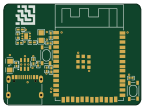 ESP32
ESP32Esp32 minimal
36.2 × 26.8 mm20 parts2LMIT4.0k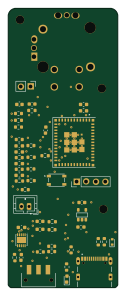 ESP32
ESP32Controller
StuckAtPrototype
29 × 74 mm58 parts4LApache-2.03.8k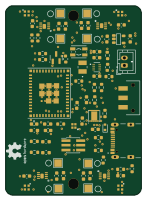 ESP32
ESP32Racer
36 × 50.2 mm70 parts4LApache-2.03.8k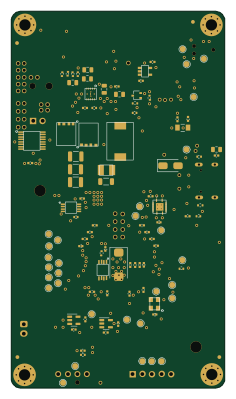 ESP32
ESP32Bitaxe
skot
56.5 × 99.8 mm86 parts4LCERN-OHL-S-2.01.4k