
Ai walkie revb

About the Ai walkie revb PCB
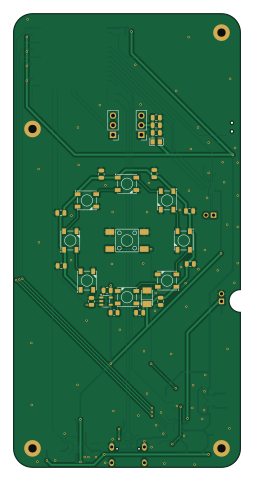
Ai walkie revb is an open source ESP32 PCB design by martinbear1, published on GitHub under the CERN-OHL-S-2.0 license. It is a 2-layer board measuring 60 × 120 mm, with 89 components from 48 distinct parts.
Its main chip is the ESP32-S3-WROOM-1U-N16R8, from the ESP32 family. Other key parts include the MAX98357A, TPS63021DSJR, SN74AHCT1G125DBVR(UMW), BQ25896RTWR and BAT54C. By type, the board carries 40 capacitors, 20 resistors, 9 diodes, 7 ICs, 4 connectors and 4 switches.
It belongs with the power & battery designs in this gallery.
From the project
This repository contains the current editable KiCad source for the routed RevB PCB of AI Walkie, a screenless ESP32-S3 voice-companion / walkie-talkie device.
This repository contains the current editable KiCad source for the routed RevB PCB of AI Walkie, a screenless ESP32-S3 voice-companion / walkie-talkie device.
The original hardware design files in this repository are licensed under CERN-OHL-S-2.0. It permits making and commercial use while requiring distributed modified hardware documentation to remain under the same license. Third-party assets are not covered; see ATTRIBUTION.md.
Main components on the Ai walkie revb
Ai walkie revb bill of materials (BOM)
89 components, 48 distinct parts.
| Qty | Part | Footprint | Refs |
|---|---|---|---|
| 1 | MAX98357A ADI(亚德诺)/MAXIM(美信) | TQFN-16_L3.0-W3.0-P0.50-BL-EP1.5 | U1 |
| 1 | ESP32-S3-WROOM-1U-N16R8 | WIRELM-SMD_ESP32-S3-WROOM-1U | U2 |
| 1 | TPS63021DSJR TI(德州仪器) | VSON-14_L4.0-W3.0-P0.50-BL-EP_TI_DSJ | U3 |
| 1 | SN74AHCT1G125DBVR(UMW) UMW(友台半导体) | SOT-23-5_L3.0-W1.5-P0.95-LS2.8-BL | U4 |
| 1 | BQ25896RTWR TI(德州仪器) | QFN-24_L4.0-W4.0-P0.50-TL-EP2.7 | U5 |
| 1 | BAT54C CJ(江苏长电/长晶) | SOT-23-3_L2.9-W1.6-P1.90-LS2.8-BR | U6 |
| 1 | SY7088DGC Silergy(矽力杰) | DFN-8_L3.0-W2.0-P0.50-BL-EP | U7 |
| 1 | Battery JST | CONN-TH_S2B-PH-K-S-LF-SN | J2 |
| 2 | Conn_01x03 | PinHeader_1x03_P2.54mm_Vertical | J3, J5 |
| 1 | Speaker JST | CONN-TH_S2B-PH-K-S-LF-SN | J4 |
| 2 | ~ XUNPU(讯普) | SW-SMD_L3.9-W3.0-P4.45 | SW1, SW2 |
| 1 | PWR_KEY kinghelm(金航标) | SW-SMD_4P-L6.0-W6.0-P4.50-LS9.0_H5.0 | SW3 |
| 1 | PTT SHOU HAN(首韩) | SW-SMD_SHOU_TS36CA-0.6 | SW4 |
| 1 | ~ 韩国韩荣 | USB-C_SMD-TYPE-C-31-M-12_1 | USBC1 |
| 1 | PRTR5V0U2X UMW(友台半导体) | SOT-143_L2.9-W1.3-P1.92-LS2.3-BL | D1 |
| 8 | ~ worldsemi | LED-SMD_4P-L5.0-W5.0-TL_WS2812B-B | D4, D5, D6, D7, D8, D9, D10, D11 |
| 1 | 600Ω@100MHz 700mA muRata(村田) | L0805 | FB1 |
| 2 | 1.5uH Isat6.5A JIERR(捷而瑞) | IND-SMD_L4.6-W4.1_SRG0420 | L1, L2 |
| 1 | 1µH Isat>=4A Low DCR Sunlord(顺络) | IND-SMD_L5.4-W5.2_FXL0530 | L3 |
| 1 | 10µF 16V X7R | C_0805_2012Metric | C1 |
Show 28 more
| Qty | Part | Footprint | Refs |
|---|---|---|---|
| 1 | 22μF Taiyo Yuden | C_0805_2012Metric | C2 |
| 1 | 0.1µF 16V X7R | C_0805_2012Metric | C3 |
| 1 | 1μF | C_0805_2012Metric | C5 |
| 1 | 10μF | C_0805_2012Metric | C6 |
| 10 | 0.1μF | C_0805_2012Metric | C7, C10, C11, C12, C13, C14, C15, C16 +2 |
| 5 | 10µF 10V X7R | C_0805_2012Metric | C8, C21, C22, C39, C40 |
| 1 | 1µF 16V X7R | C_0805_2012Metric | C18 |
| 4 | 0.1µF 10V X7R | C_0805_2012Metric | C19, C36, C41, C42 |
| 1 | 47nF 16V X7R | C_0805_2012Metric | C20 |
| 3 | 22µF | C_0805_2012Metric | C23, C27, C28 |
| 1 | 10µF | C_0805_2012Metric | C24 |
| 1 | 1µF | C_0805_2012Metric | C25 |
| 2 | 0.1µF | C_0805_2012Metric | C26, C29 |
| 1 | 1µF 10V X7R | C_0805_2012Metric | C30 |
| 1 | 22µF 6.3V X5R/X7R | C_0805_2012Metric | C31 |
| 1 | 4.7µF 10V X7R | C_0805_2012Metric | C32 |
| 2 | 100µF 10V Polymer C600583 KEMET(基美) | CAP-SMD_L3.5-W2.8 | C33, C37 |
| 2 | 22µF 10V X5R/X7R | C_0805_2012Metric | C34, C35 |
| 3 | 5.1kΩ | R_0805_2012Metric | R1, R2, R3 |
| 2 | 10kΩ | R_0805_2012Metric | R5, R8 |
| 6 | 10kΩ 1% | R_0805_2012Metric | R6, R10, R11, R18, R19, R20 |
| 2 | 100kΩ | R_0805_2012Metric | R7, R15 |
| 1 | 100Ω | R_0805_2012Metric | R9 |
| 1 | 1MΩ 1% | R_0805_2012Metric | R12 |
| 1 | 316kΩ 1% | R_0805_2012Metric | R13 |
| 1 | 100kΩ 1% | R_0805_2012Metric | R14 |
| 2 | 22Ω 1% | R_0805_2012Metric | R16, R17 |
| 1 | 390Ω 1% | R_0805_2012Metric | R21 |
Ai walkie revb design files
The KiCad project lives in the martinbear1/ai-walkie-revb-pcb repository on GitHub; these links point at the commit this page was built from.
- Layoutai_walkie_pcb.kicad_pcb
- Schematicai_walkie_pcb.kicad_sch
Ai walkie revb: common questions
What microcontroller does the Ai walkie revb use?
The Ai walkie revb is built around the ESP32-S3-WROOM-1U-N16R8, from the ESP32 family.
How big is the Ai walkie revb PCB?
The Ai walkie revb measures 60 × 120 mm, has 2 copper layers and is 1.6 mm thick.
How many components are on the Ai walkie revb?
89 components, from 48 distinct parts. The full bill of materials is listed on this page.
Where can I download the Ai walkie revb design files?
From the martinbear1/ai-walkie-revb-pcb repository on GitHub, which has the KiCad layout and the schematic; the links under Design files point to each one.
Can I use the Ai walkie revb design in my own project?
Yes, under the terms of its CERN-OHL-S-2.0 license, which martinbear1 chose for the repository.
Can I test firmware for the Ai walkie revb without the hardware?
Yes. HardLabs builds a simulation of the board from its netlist and BOM, so you can run and debug ESP32 firmware against it before you order a PCB.
Similar boards
 ESP32
ESP32Open Book Abridged Edition
joeycastillo
85 × 115 mm65 parts2LCC-BY-SA-4.08.1k ESP32
ESP32Badge
atopile
56.3 × 39 mm239 parts4LMIT4.0k ESP32
ESP32Esp32 minimal
36.2 × 26.8 mm20 parts2LMIT4.0k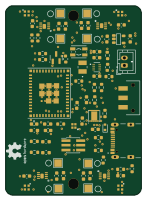 ESP32
ESP32Racer
StuckAtPrototype
36 × 50.2 mm70 parts4LApache-2.03.8k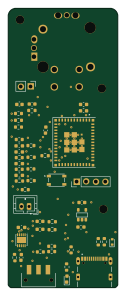 ESP32
ESP32Controller
29 × 74 mm58 parts4LApache-2.03.8k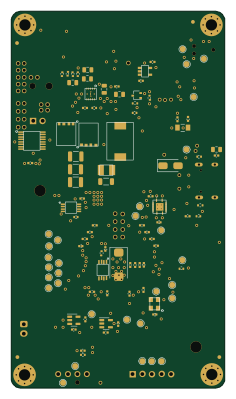 ESP32
ESP32Bitaxe
skot
56.5 × 99.8 mm86 parts4LCERN-OHL-S-2.01.4k