
Cosmic library

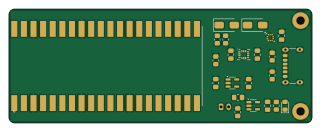
About the Cosmic library PCB
Cosmic library is an open source RP2040/RP2350 PCB design by Normansrule, published on GitHub under the MIT license. It is a 2-layer board measuring 80 × 30 mm, with 45 components from 27 distinct parts.
Its main chip is the SC0915, from the RP2040/RP2350 family. Other key parts include the MCP73831T-2ACI/OT, LSM6DSO32TR, BMP390 and AP2112K-3.3TRG1. By type, the board carries 16 resistors, 10 capacitors, 7 connectors, 5 ICs, 5 diodes and 1 transistor.
It belongs with the sensors, rf & radio and power & battery designs in this gallery.
From the project
Level 3 · stage 3 — design, build and test CC-FL1, an 80 × 30 mm printed circuit board that rides inside a 38 mm airframe and records a rocket flight at 100 samples per second: a Bosch BMP390 barometer, an ST LSM6DSO32 ±32 g inertial measurement unit (IMU), a microSD card, a Li-P
Level 3 · stage 3 — design, build and test CC-FL1, an 80 × 30 mm printed circuit board that rides inside a 38 mm airframe and records a rocket flight at 100 samples per second: a Bosch BMP390 barometer, an ST LSM6DSO32 ±32 g inertial measurement unit (IMU), a microSD card, a Li-Po charger, a beeper and a header for the LoRa radio of experiment 31. The brain is a Raspberry Pi Pico soldered flat by its castellated edge, so there is no 0.4 mm-pitch microcontroller to solder. You get a complete KiCad project generated from one Python file, firmware with a Kalman filter and a flight state machine…
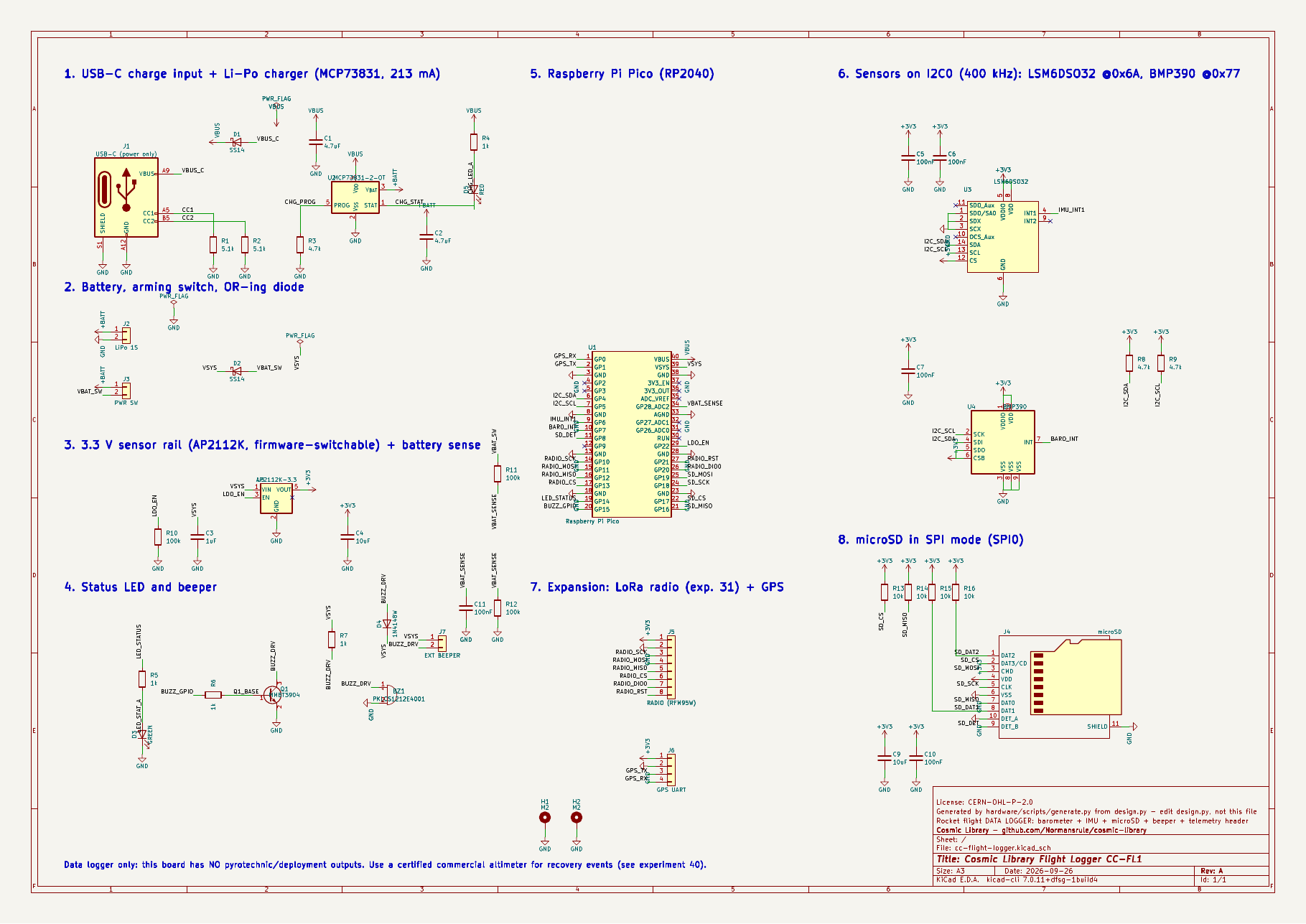
Main components on the Cosmic library
Cosmic library bill of materials (BOM)
45 components, 27 distinct parts — part numbers from the project's BOM.
| Qty | Part | Footprint | Refs |
|---|---|---|---|
| 1 | SC0915 Raspberry Pi Pico Raspberry Pi Ltd | RaspberryPi_Pico_Castellated_HandSolder | U1 |
| 1 | MCP73831T-2ACI/OT MCP73831-2-OT Microchip | SOT-23-5 | U2 |
| 1 | LSM6DSO32TR LSM6DSO32 STMicroelectronics | LGA-14_3x2.5mm_P0.5mm_LayoutBorder3x4y | U3 |
| 1 | BMP390 Bosch Sensortec | Bosch_LGA-10_2x2mm_P0.5mm_BMP390 | U4 |
| 1 | AP2112K-3.3TRG1 AP2112K-3.3 Diodes Inc | SOT-23-5 | U5 |
| 1 | MMBT3904 Changjiang | SOT-23 | Q1 |
| 1 | USB4125-GF-A USB-C (power only) GCT | USB_C_Receptacle_GCT_USB4125-xx-x_6P_TopMnt_Horizontal | J1 |
| 1 | B2B-PH-K-S(LF)(SN) LiPo 1S JST | JST_PH_B2B-PH-K_1x02_P2.00mm_Vertical | J2 |
| 1 | 2.54 mm 1x02 SMD header PWR SW generic | PinHeader_1x02_P2.54mm_Vertical_SMD_Pin1Left | J3 |
| 1 | DM3AT-SF-PEJM5 microSD Hirose | microSD_HC_Hirose_DM3AT-SF-PEJM5 | J4 |
| 1 | 2.54 mm 1x08 SMD header RADIO (RFM95W) generic | PinHeader_1x08_P2.54mm_Vertical_SMD_Pin1Left | J5 |
| 1 | 2.54 mm 1x04 SMD header GPS UART generic | PinHeader_1x04_P2.54mm_Vertical_SMD_Pin1Left | J6 |
| 1 | 2.54 mm 1x02 SMD header EXT BEEPER generic | PinHeader_1x02_P2.54mm_Vertical_SMD_Pin1Left | J7 |
| 1 | PKLCS1212E4001-R1 PKLCS1212E4001 Murata | Buzzer_Murata_PKLCS1212E | BZ1 |
| 2 | SS14 MDD | D_SMA | D1, D2 |
| 1 | KT-0805G GREEN Hubei KENTO | LED_0805_2012Metric_Pad1.15x1.40mm_HandSolder | D3 |
| 1 | 1N4148W Changjiang | D_SOD-123 | D4 |
| 1 | KT-0805R RED Hubei KENTO | LED_0805_2012Metric_Pad1.15x1.40mm_HandSolder | D5 |
| 2 | CL21A475KAQNNNE 4.7uF Samsung | C_0805_2012Metric_Pad1.18x1.45mm_HandSolder | C1, C2 |
| 1 | CL21B105KAFNNNE 1uF Samsung | C_0805_2012Metric_Pad1.18x1.45mm_HandSolder | C3 |
Show 7 more
| Qty | Part | Footprint | Refs |
|---|---|---|---|
| 2 | CL21A106KAYNNNE 10uF Samsung | C_0805_2012Metric_Pad1.18x1.45mm_HandSolder | C4, C9 |
| 5 | CL21B104KBCNNNC 100nF Samsung | C_0805_2012Metric_Pad1.18x1.45mm_HandSolder | C5, C6, C7, C10, C11 |
| 2 | 0805W8F5101T5E 5.1k UNI-ROYAL | R_0805_2012Metric_Pad1.20x1.40mm_HandSolder | R1, R2 |
| 3 | 0805W8F4701T5E 4.7k UNI-ROYAL | R_0805_2012Metric_Pad1.20x1.40mm_HandSolder | R3, R8, R9 |
| 4 | 0805W8F1001T5E 1k UNI-ROYAL | R_0805_2012Metric_Pad1.20x1.40mm_HandSolder | R4, R5, R6, R7 |
| 3 | 0805W8F1003T5E 100k UNI-ROYAL | R_0805_2012Metric_Pad1.20x1.40mm_HandSolder | R10, R11, R12 |
| 4 | 0805W8F1002T5E 10k UNI-ROYAL | R_0805_2012Metric_Pad1.20x1.40mm_HandSolder | R13, R14, R15, R16 |
Cosmic library design files
The KiCad project lives in the Normansrule/cosmic-library repository on GitHub; these links point at the commit this page was built from.
Cosmic library: common questions
What microcontroller does the Cosmic library use?
The Cosmic library is built around the SC0915, from the RP2040/RP2350 family.
How big is the Cosmic library PCB?
The Cosmic library measures 80 × 30 mm, has 2 copper layers and is 1.6 mm thick.
How many components are on the Cosmic library?
45 components, from 27 distinct parts, with part numbers taken from the project's own BOM. The full bill of materials is listed on this page.
Where can I download the Cosmic library design files?
From the Normansrule/cosmic-library repository on GitHub, which has the KiCad layout, the schematic and the BOM; the links under Design files point to each one.
Can I use the Cosmic library design in my own project?
Yes, under the terms of its MIT license, which Normansrule chose for the repository.
Can I test firmware for the Cosmic library without the hardware?
Yes. HardLabs builds a simulation of the board from its netlist and BOM, so you can run and debug RP2040/RP2350 firmware against it before you order a PCB.
Similar boards
 RP2040/RP2350
Open Book Abridged Edition
joeycastillo
85 × 115 mm29 parts2LCC-BY-SA-4.08.1k RP2040/RP2350
Corne
foostan
277.2 × 107.5 mm164 parts2LCC-BY-4.07.7k RP2040/RP2350
Corne
277.2 × 107.5 mm164 parts2LCC-BY-4.07.7k RP2040/RP2350
LogicAnalyzer
gusmanb
57 × 55.2 mm6 parts2LGPL-3.05.0k RP2040/RP2350
Jitx design
55.5 × 65 mm26 parts4LGPL-3.05.0k RP2040/RP2350
Pro V2
kata0510
290.1 × 130 mm270 parts2LMIT2.3k