
PicoGUS

About the PicoGUS PCB
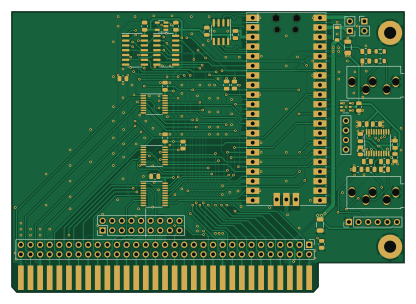
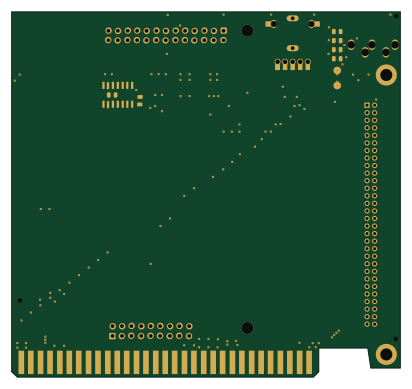
PicoGUS is an open source RP2040/RP2350 PCB design by polpo, published on GitHub under the GPL-2.0 license. It is a 2-layer board measuring 103.7 × 74.1 mm, with 46 components from 25 distinct parts.
Its main chip is the Pico, from the RP2040/RP2350 family. Other key parts include the GHOST-20P, 74LVC244, 74FST3257DR2G, 74AHC14 and 74LVC00. By type, the board carries 20 capacitors, 11 ICs, 8 resistors, 4 connectors, 2 inductors and 1 diode.
It belongs with the audio and wearables designs in this gallery.
From the project
Emulation of ISA sound cards and CD-ROM on Raspberry Pi Pico (GUS, SB/Adlib, MPU-401, Tandy, CMS, Panasonic CD-ROM) with USB mouse/joystick support
ISA sound card and CD-ROM drive emulation on the Raspberry Pi Pico's RP2040 microcontroller. PicoGUS can emulate:
Gravis Ultrasound (GUS) - the primary focus of PicoGUS, hence the name Sound Blaster 16 (OPL3) / Sound Blaster Pro 2 (OPL3) / AdLib (OPL2) MPU-401 (with intelligent mode) - outputs MIDI data on 3.5mm MIDI TRS connector Tandy 3-voice CMS/Game Blaster Game port joystick * Panasonic/MKE CD-ROM

Main components on the PicoGUS
PicoGUS bill of materials (BOM)
46 components, 25 distinct parts — part numbers from the project's BOM.
| Qty | Part | Footprint | Refs |
|---|---|---|---|
| 1 | Pico | RPi_Pico_SMD_TH | U1 |
| 1 | GHOST-20P | Ghost-20P | U1-R |
| 1 | 74LVC244 | TSSOP-20_4.4x6.5mm_P0.65mm | U2 |
| 2 | 74FST3257DR2G SN74CB3T3257 | TSSOP-16_4.4x5mm_P0.65mm | U3, U4 |
| 1 | 74AHC14 | SOIC-14_3.9x8.7mm_P1.27mm | U5 |
| 1 | 74LVC00 | SOIC-14_3.9x8.7mm_P1.27mm | U6 |
| 1 | 74LVC1G00 | SOT-23-5 | U7 |
| 1 | APS6404L-3SQR-SN | SOIC-8_3.9x4.9mm_P1.27mm | U8 |
| 1 | PCM5100 | TSSOP-20_4.4x6.5mm_P0.65mm | U9 |
| 1 | 74LVC2G06 | TSOP-6_1.65x3.05mm_P0.95mm | U10 |
| 1 | IRQDMA_JP | PinHeader_2x09_P2.54mm_Vertical | J1 |
| 2 | SJ1-3535NG | Jack_3.5mm_CUI_SJ1-3535NG_Horizontal | J5, J8 |
| 1 | Conn_01x02_Pin | PinHeader_1x02_P2.54mm_Vertical | J7 |
| 1 | D_Schottky | D_SOD-123 | D1 |
| 2 | 1KOhm @ 100MHz | L_0805_2012Metric | FB1, FB2 |
| 2 | 47uF | C_1206_3216Metric | C1, C2 |
| 12 | 0.1uF | C_0805_2012Metric | C3, C4, C5, C6, C7, C8, C9, C11 +4 |
| 1 | 1uF | C_0805_2012Metric | C10 |
| 1 | 10uF | C_0805_2012Metric | C15 |
| 2 | 2.2uF | C_0805_2012Metric | C16, C17 |
Show 5 more
| Qty | Part | Footprint | Refs |
|---|---|---|---|
| 2 | 2.2nF | C_0805_2012Metric | C19, C20 |
| 1 | 1K | R_0805_2012Metric | R1 |
| 3 | 15K | R_0805_2012Metric | R2, R5, R6 |
| 2 | 220 | R_0805_2012Metric | R3, R4 |
| 2 | 470 | R_0805_2012Metric | R7, R8 |
PicoGUS design files
The KiCad project lives in the polpo/picogus repository on GitHub; these links point at the commit this page was built from.
- Layouthw/PicoGUS.kicad_pcb
- Schematichw/PicoGUS.kicad_sch
- BOMhw/BOM (DAC module).csv
PicoGUS: common questions
What microcontroller does the PicoGUS use?
The PicoGUS is built around the Pico, from the RP2040/RP2350 family.
How big is the PicoGUS PCB?
The PicoGUS measures 103.7 × 74.1 mm, has 2 copper layers and is 0.57 mm thick.
How many components are on the PicoGUS?
46 components, from 25 distinct parts, with part numbers taken from the project's own BOM. The full bill of materials is listed on this page.
Where can I download the PicoGUS design files?
From the polpo/picogus repository on GitHub, which has the KiCad layout, the schematic and the BOM; the links under Design files point to each one.
Can I use the PicoGUS design in my own project?
Yes, under the terms of its GPL-2.0 license, which polpo chose for the repository.
Can I test firmware for the PicoGUS without the hardware?
Yes. HardLabs builds a simulation of the board from its netlist and BOM, so you can run and debug RP2040/RP2350 firmware against it before you order a PCB.
More boards in picogus
Similar boards
 RP2040/RP2350
Open Book Abridged Edition
joeycastillo
85 × 115 mm29 parts2LCC-BY-SA-4.08.1k RP2040/RP2350
Corne
foostan
277.2 × 107.5 mm164 parts2LCC-BY-4.07.7k RP2040/RP2350
Corne
277.2 × 107.5 mm164 parts2LCC-BY-4.07.7k RP2040/RP2350
Hid remapper
jfedor2
100 × 100 mm124 parts2LMIT1.7k RP2040/RP2350
Open Source Smart Glasses
Mentra-Community
93 × 10.5 mm80 parts4LMIT1.2k RP2040/RP2350
MSA
30.5 × 138 mm61 parts2LMIT1.2k