
Zap bracelet

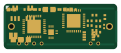
About the Zap bracelet PCB
Zap bracelet is an open source ESP32 PCB design by Raf3-Tech, published on GitHub. It is a 4-layer board measuring 30.1 × 12 mm, with 34 components from 20 distinct parts.
Its main chip is the ESP32-C3, from the ESP32 family. Other key parts include the ST25R3911B, ATECC608A, DRV2605L, MCP73831 and AP2112K-3.3. By type, the board carries 15 capacitors, 10 resistors, 6 ICs, 1 connector and 1 diode.
It belongs with the iot & wireless and wearables designs in this gallery.
From the project
NFC wearable for Malawi — tap to pay with Airtel Money or TNM Mpamba, and extend Afrimax WiFi. Built with Diode Computers' Zener PCB tooling, Rust firmware on ESP32-C3, and a TypeScript payment layer.
Zero-friction Access & Payment — an NFC wearable for the Malawian market.
Tap a ZAP bracelet against a reader to trigger a contactless Airtel Money or TNM Mpamba payment, or to purchase an Afrimax WiFi session. The entire stack runs on Malawi Kwacha (MWK). No USD. No floats.
- Project Overview - Project Boundaries - Repository Structure - Architecture - Tech Stack - Hardware Overview - Getting Started - Firmware - Backend - Payment Sidecar (Adapters) - Dashboard - Full Stack via Docker Compose - Environment Variables - API Reference - Database Schema - Deployment
Main components on the Zap bracelet
Zap bracelet bill of materials (BOM)
34 components, 20 distinct parts.
| Qty | Part | Footprint | Refs |
|---|---|---|---|
| 1 | ESP32-C3 | ESP32C3_QFN32_5x5 | U1 |
| 1 | ST25R3911B | ST25R3911B_QFN32_5x5 | U2 |
| 1 | ATECC608A | ATECC608A_UDFN8 | U3 |
| 1 | DRV2605L | DRV2605L_YZF10 | U4 |
| 1 | MCP73831 | MCP73831_SOT235 | U5 |
| 1 | AP2112K-3.3 | AP2112K_SOT25 | U6 |
| 1 | LiPo_JST-PH | JST_PH_2pin | J1 |
| 1 | TestPoint | TestPoint_THTPad_1.0x1.0mm | TP_3V3 |
| 1 | LED_RGB_0606 | LED_RGB_0606 | D1 |
| 3 | 10uF | C_0805 | C1, C5, C10 |
| 5 | 100nF | C_0402 | C2, C6, C7, C9, C11 |
| 2 | 1uF | C_0402 | C3, C4 |
| 2 | 4.7uF | C_0603 | C8, C12 |
| 3 | DNI | C_0402 | C13, C14, C15 |
| 3 | 33 | R_0402 | R1, R2, R3 |
| 2 | 10k | R_0402 | R4, R5 |
| 2 | 4k7 | R_0402 | R6, R7 |
| 1 | 20k | R_0402 | R8 |
| 1 | 100k | R_0402 | R9 |
| 1 | 0R | R_0402 | R10 |
Zap bracelet design files
The KiCad project lives in the Raf3-Tech/zap-bracelet repository on GitHub; these links point at the commit this page was built from.
Zap bracelet: common questions
What microcontroller does the Zap bracelet use?
The Zap bracelet is built around the ESP32-C3, from the ESP32 family.
How big is the Zap bracelet PCB?
The Zap bracelet measures 30.1 × 12 mm, has 4 copper layers and is 1.6 mm thick.
How many components are on the Zap bracelet?
34 components, from 20 distinct parts. The full bill of materials is listed on this page.
Where can I download the Zap bracelet design files?
From the Raf3-Tech/zap-bracelet repository on GitHub, which has the KiCad layout; the links under Design files point to each one.
Can I use the Zap bracelet design in my own project?
The repository has no license, so all rights stay with Raf3-Tech. Use it as a reference, and ask the author before reusing the design.
Can I test firmware for the Zap bracelet without the hardware?
Yes. HardLabs builds a simulation of the board from its netlist and BOM, so you can run and debug ESP32 firmware against it before you order a PCB.
Similar boards
 ESP32
ESP32Open Book Abridged Edition
joeycastillo
85 × 115 mm65 parts2LCC-BY-SA-4.08.1k ESP32
ESP32Powertrain
byrantech
64 × 45.4 mm171 parts4LMIT4.3k ESP32
ESP32Badge
atopile
56.3 × 39 mm239 parts4LMIT4.0k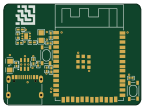 ESP32
ESP32Esp32 minimal
36.2 × 26.8 mm20 parts2LMIT4.0k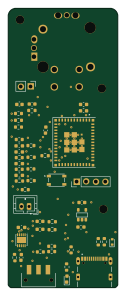 ESP32
ESP32Controller
StuckAtPrototype
29 × 74 mm58 parts4LApache-2.03.8k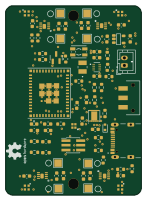 ESP32
ESP32Racer
36 × 50.2 mm70 parts4LApache-2.03.8k