
TundraIOExpansion

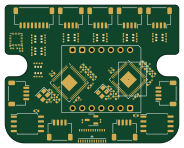
About the TundraIOExpansion PCB
TundraIOExpansion is an open source RP2040/RP2350 PCB design by ras-marques, published on GitHub under the MIT license. It is a 4-layer board measuring 46 × 36.5 mm, with 89 components from 24 distinct parts.
Its main chip is the BMI270, from the RP2040/RP2350 family. Other key parts include the QMC5883L, MOUDLE-SEEEDUINO-XIAO-ESP32C3, HE6206-18NR, W25Q32JVSS and ICM-20948. By type, the board carries 34 resistors, 29 capacitors, 7 ICs, 7 transformers, 2 crystals and 1 connector.
It belongs with the sensors designs in this gallery.
From the project
I want to share how I am making vr gloves using 2 Tundra Trackers, 2 interface boards and 12 inertial sensors.
I want to share how I am making vr gloves using 2 Tundra Trackers, 2 interface boards and 12 inertial sensors.
https://github.com/ras-marques/ImmersiveGloves/assets/6479742/4af1af61-4261-44ce-aa3d-e45de0df7709
Check the full presentation on youtube https://www.youtube.com/watch?v=5OSYiYDkOE8
Hand tracking works with curl and splay on all fingers with 1 IMU on each finger. There is a joystick that is enabled by touching the thumb to the index finger and B, A and System buttons are available by touching the thumb to the middle, ring and pinky fingers respectively.
Main components on the TundraIOExpansion
TundraIOExpansion bill of materials (BOM)
89 components, 24 distinct parts — part numbers from the project's BOM.
| Qty | Part | Footprint | Refs |
|---|---|---|---|
| 1 | BMI270 RP2040 | QFN-56-1EP_7x7mm_P0.4mm_EP3.2x3.2mm | U1 |
| 1 | QMC5883L RP2040 | QFN-56-1EP_7x7mm_P0.4mm_EP3.2x3.2mm | U2 |
| 1 | MOUDLE-SEEEDUINO-XIAO-ESP32C3 | MOUDLE14P-SMD-2.54-21X17.8MM_TH | U3 |
| 1 | HE6206-18NR | SOT-23-3 | U4 |
| 2 | W25Q32JVSS | SOIC-8_5.23x5.23mm_P1.27mm | U5, U6 |
| 1 | ICM-20948 | InvenSense_QFN-24_3x3mm_P0.4mm | U7 |
| 2 | 12.000MHz | Crystal_SMD_2520-4Pin_2.5x2.0mm | Y1, Y2 |
| 1 | Conn_01x25 | 25PIN FRONT FLIP 0.6mm PITCH AYF332535A | J1 |
| 8 | Conn_01x04 | JST_SH_SM04B-SRSS-TB_1x04-1MP_P1.00mm_Horizontal | FINGER1, FINGER2, FINGER3, FINGER4, FINGER5L1, FINGER5R1, USB1, USB2 |
| 1 | Conn_01x08 | JST_SH_SM08B-SRSS-TB_1x08-1MP_P1.00mm_Horizontal | FingerAux1 |
| 7 | BSS138BKS_115 | SOT363 | T1, T2, T3, T4, T5, T6, T7 |
| 1 | 4.7U 2.2u | C_0402_1005Metric | C1 |
| 1 | 220N 100n | C_0402_1005Metric | C2 |
| 3 | 100N 100n | C_0402_1005Metric | C3, C4, C5 |
| 10 | 100n | C_0402_1005Metric | C6, C8, C9, C18, C20, C22, C24, C25 +2 |
| 5 | 2.2u | C_0402_1005Metric | C7, C10, C17, C23, C28 |
| 4 | 33p | C_0402_1005Metric | C11, C12, C19, C21 |
| 2 | 1u | C_0201_0603Metric | C13, C14 |
| 3 | 100n | C_0201_0603Metric | C15, C16, C29 |
| 1 | 2K2 200 | R_0402_1005Metric | R1 |
Show 4 more
| Qty | Part | Footprint | Refs |
|---|---|---|---|
| 1 | 2K2 1k | R_0402_1005Metric | R2 |
| 28 | 10k | R_0201_0603Metric | R3, R4, R5, R6, R11, R12, R13, R14 +20 |
| 3 | 1k | R_0402_1005Metric | R7, R9, R10 |
| 1 | 200 | R_0402_1005Metric | R8 |
TundraIOExpansion design files
The KiCad project lives in the ras-marques/ImmersiveGloves repository on GitHub; these links point at the commit this page was built from.
TundraIOExpansion: common questions
What microcontroller does the TundraIOExpansion use?
The TundraIOExpansion is built around the BMI270, from the RP2040/RP2350 family.
How big is the TundraIOExpansion PCB?
The TundraIOExpansion measures 46 × 36.5 mm, has 4 copper layers and is 1.6 mm thick.
How many components are on the TundraIOExpansion?
89 components, from 24 distinct parts, with part numbers taken from the project's own BOM. The full bill of materials is listed on this page.
Where can I download the TundraIOExpansion design files?
From the ras-marques/ImmersiveGloves repository on GitHub, which has the KiCad layout, the schematic and the BOM; the links under Design files point to each one.
Can I use the TundraIOExpansion design in my own project?
Yes, under the terms of its MIT license, which ras-marques chose for the repository.
Can I test firmware for the TundraIOExpansion without the hardware?
Yes. HardLabs builds a simulation of the board from its netlist and BOM, so you can run and debug RP2040/RP2350 firmware against it before you order a PCB.
More boards in ImmersiveGloves

ICM-20948 First Bone
7 × 10.1 mm14 parts4LMIT29
BMI160-and-QMC5883L Second Bone
6.7 × 13.4 mm14 parts4LMIT29
BNO085 0x4B Board
8.1 × 8.8 mm12 parts4LMIT29
BNO085 0x4A Board
8.1 × 8.8 mm12 parts4LMIT29
BMI270-and-QMC5883L
5 × 8.1 mm12 parts2LMIT29
Multi imu
7.4 × 12.7 mm8 parts4LMIT29
ICM-20948 I2C 1V8 levels
4.4 × 6.6 mm7 parts4LMIT29
Similar boards
 RP2040/RP2350
Open Book Abridged Edition
joeycastillo
85 × 115 mm29 parts2LCC-BY-SA-4.08.1k RP2040/RP2350
Corne
foostan
277.2 × 107.5 mm164 parts2LCC-BY-4.07.7k RP2040/RP2350
Corne
277.2 × 107.5 mm164 parts2LCC-BY-4.07.7k RP2040/RP2350
Open Source Smart Glasses
Mentra-Community
93 × 10.5 mm80 parts4LMIT1.2k RP2040/RP2350
MSA
30.5 × 138 mm61 parts2LMIT1.2k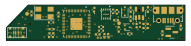 RP2040/RP2350
Msa
47.8 × 9.4 mm53 parts2LMIT1.2k