
Bgc syringe cycler

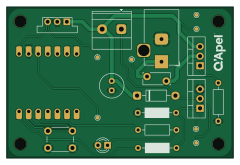
About the Bgc syringe cycler PCB
Bgc syringe cycler is an open source ESP32 PCB design by ravi-nataraj, published on GitHub under the MIT license. It is a 2-layer board measuring 60 × 40 mm, with 15 components from 14 distinct parts.
Its main chip is the XIAO-ESP32-C3-SMD, from the ESP32 family. Other key parts include the OKI-78SR-5_1.5-W36-C. By type, the board carries 4 resistors, 2 ICs, 2 transistors, 2 connectors, 2 diodes and 1 fuse.
It belongs with the iot & wireless designs in this gallery.
From the project
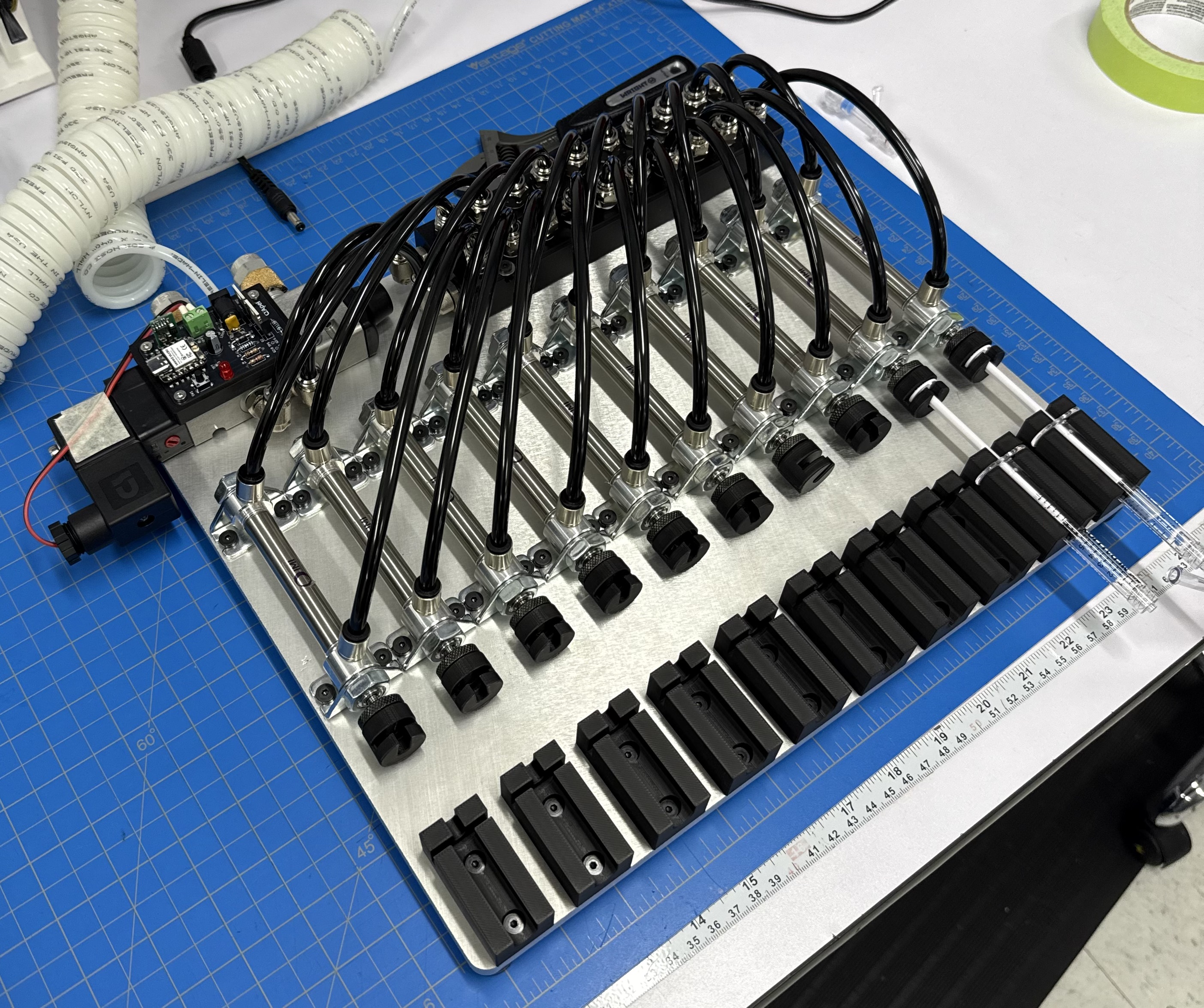
10-station pneumatic fatigue cycling fixture for PTA balloon inflation testing, with ESP32 control and WiFi configurable timing.
Ten-station pneumatic fatigue cycling fixture for balloon guide catheter inflation testing. A single 5/2 solenoid valve drives ten double-acting air cylinders in parallel, each actuating a 1 mL Merit Medical Medallion syringe. Pusher and mount spacing fixes the stroke to displace ~0.6 mL per cycle.
The cycling regime is adapted from ISO 10555-4:2023 Annex B (balloon fatigue / repeated inflation). Annex B is written for dilatation balloons and cycles to rated burst pressure; a balloon guide catheter is specified by recommended inflation volume rather than RBP, so the fixture cycles a fixed…
Main components on the Bgc syringe cycler
Bgc syringe cycler bill of materials (BOM)
15 components, 14 distinct parts — part numbers from the project's BOM.
| Qty | Part | Footprint | Refs |
|---|---|---|---|
| 1 | XIAO-ESP32-C3-SMD XIAO-ESP32-C3-DIP | XIAO-ESP32-C3-DIP | U1 |
| 1 | OKI-78SR-5_1.5-W36-C OKI-78SR-5 | Converter_DCDC_Murata_OKI-78SR_Vertical | U2 |
| 1 | IRF9540N | TO-220-3_Vertical | Q1 |
| 1 | IRLZ44N | TO-220-3_Vertical | Q2 |
| 1 | SCREW_TERMINAL_01X02 Screw_Terminal_01x02 | TerminalBlock_Phoenix_MKDS-1,5-2-5.08_1x02_P5.08mm_Horizontal | J1 |
| 1 | Barrel_Jack | BarrelJack_Horizontal | J2 |
| 1 | Polyfuse | Fuse_Bourns_MF-RG300 | F1 |
| 1 | SW_Push | SW_PUSH_6mm | SW1 |
| 1 | LED | LED_D3.0mm | D1 |
| 1 | 1N4007 | D_DO-41_SOD81_P10.16mm_Horizontal | D2 |
| 1 | 100 uF | C_Radial_D6.3mm_H11.0mm_P2.50mm | C2 |
| 1 | 220 | R_Axial_DIN0207_L6.3mm_D2.5mm_P10.16mm_Horizontal | R1 |
| 2 | 10K 10k | R_Axial_DIN0207_L6.3mm_D2.5mm_P10.16mm_Horizontal | R2, R4 |
| 1 | 1k | R_Axial_DIN0207_L6.3mm_D2.5mm_P10.16mm_Horizontal | R3 |
Bgc syringe cycler design files
The KiCad project lives in the ravi-nataraj/bgc-syringe-cycler repository on GitHub; these links point at the commit this page was built from.
Bgc syringe cycler: common questions
What microcontroller does the Bgc syringe cycler use?
The Bgc syringe cycler is built around the XIAO-ESP32-C3-SMD, from the ESP32 family.
How big is the Bgc syringe cycler PCB?
The Bgc syringe cycler measures 60 × 40 mm, has 2 copper layers and is 1.6 mm thick.
How many components are on the Bgc syringe cycler?
15 components, from 14 distinct parts, with part numbers taken from the project's own BOM. The full bill of materials is listed on this page.
Where can I download the Bgc syringe cycler design files?
From the ravi-nataraj/bgc-syringe-cycler repository on GitHub, which has the KiCad layout, the schematic and the BOM; the links under Design files point to each one.
Can I use the Bgc syringe cycler design in my own project?
Yes, under the terms of its MIT license, which ravi-nataraj chose for the repository.
Can I test firmware for the Bgc syringe cycler without the hardware?
Yes. HardLabs builds a simulation of the board from its netlist and BOM, so you can run and debug ESP32 firmware against it before you order a PCB.
Similar boards
 ESP32
ESP32Open Book Abridged Edition
joeycastillo
85 × 115 mm65 parts2LCC-BY-SA-4.08.1k ESP32
ESP32Badge
atopile
56.3 × 39 mm239 parts4LMIT4.0k ESP32
ESP32Esp32 minimal
36.2 × 26.8 mm20 parts2LMIT4.0k ESP32
ESP32Racer
StuckAtPrototype
36 × 50.2 mm70 parts4LApache-2.03.8k ESP32
ESP32Controller
29 × 74 mm58 parts4LApache-2.03.8k ESP32
ESP32Bitaxe
skot
56.5 × 99.8 mm86 parts4LCERN-OHL-S-2.01.4k