
Slippi

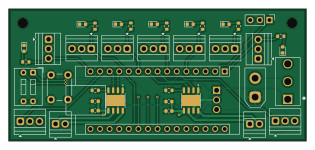
About the Slippi PCB
Slippi is an open source AVR/Arduino PCB design by RoboJackets, published on GitHub under the MIT license. It is a 2-layer board measuring 78.7 × 34.9 mm, with 42 components from 16 distinct parts.
Its main chip is the Arduino_Nano_v3.x, from the AVR/Arduino family. Other key parts include the DRV8871DDAR and L7805CV. By type, the board carries 13 connectors, 9 resistors, 7 diodes, 6 capacitors, 3 ICs and 3 switches.
It belongs with the robotics & motion designs in this gallery.
From the project
Autonomous 3kg sumo
Main components on the Slippi
Slippi bill of materials (BOM)
42 components, 16 distinct parts.
| Qty | Part | Footprint | Refs |
|---|---|---|---|
| 2 | DRV8871DDAR | DRV8871 | U1, U2 |
| 1 | L7805CV | TO255P1040X460X1968-3 | U3 |
| 1 | Arduino_Nano_v3.x | Arduino_Nano | A1 |
| 9 | Conn_01x03 | TerminalBlock_Xinya_XY308-2.54-3P_1x03_P2.54mm_Horizontal | J1, J2, J3, J4, J5, J6, J7, J8 +1 |
| 1 | Conn_01x03 | PinHeader_1x03_P2.54mm_Vertical | J10 |
| 1 | Conn_01x02 | AMASS_XT30UPB-M_1x02_P5.0mm_Vertical | J11 |
| 2 | Conn_01x02 | TerminalBlock_Xinya_XY308-2.54-2P_1x02_P2.54mm_Horizontal | J12, J13 |
| 1 | SW_SPDT | SW_1101M2S3CQE2 | SW1 |
| 1 | SW_DIP_x02 | SW_DIP_SPSTx02_Slide_9.78x7.26mm_W7.62mm_P2.54mm | SW2 |
| 1 | SW_Push | SW_PUSH_6mm | SW3 |
| 7 | LED | LED_0603_1608Metric | D2, D3, D4, D5, D6, D7, D8 |
| 3 | 0.1uF | C_0603_1608Metric | C1, C3, C6 |
| 2 | 47uF | C_0603_1608Metric | C2, C4 |
| 1 | 0.33uF | C_0603_1608Metric | C5 |
| 2 | 30k | R_0603_1608Metric | R1, R2 |
| 7 | 1k | R_0603_1608Metric | R4, R5, R6, R7, R8, R9, R10 |
Slippi design files
The KiCad project lives in the RoboJackets/robowrestling repository on GitHub; these links point at the commit this page was built from.
- Layout500g/Slippi/Slippi.kicad_pcb
- Schematic500g/Slippi/Slippi.kicad_sch
Slippi: common questions
What microcontroller does the Slippi use?
The Slippi is built around the Arduino_Nano_v3.x, from the AVR/Arduino family.
How big is the Slippi PCB?
The Slippi measures 78.7 × 34.9 mm, has 2 copper layers and is 1.6 mm thick.
How many components are on the Slippi?
42 components, from 16 distinct parts. The full bill of materials is listed on this page.
Where can I download the Slippi design files?
From the RoboJackets/robowrestling repository on GitHub, which has the KiCad layout and the schematic; the links under Design files point to each one.
Can I use the Slippi design in my own project?
Yes, under the terms of its MIT license, which RoboJackets chose for the repository.
Can I test firmware for the Slippi without the hardware?
Yes. HardLabs builds a simulation of the board from its netlist and BOM, so you can run and debug AVR/Arduino firmware against it before you order a PCB.
More boards in robowrestling
 NXP
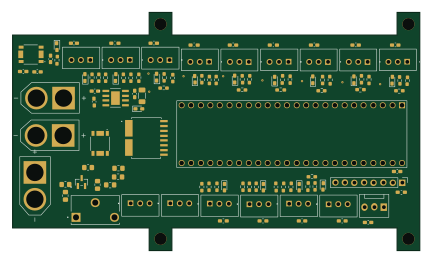
NXPTeam2(10-30)
107.9 × 63.2 mm112 parts2LMIT9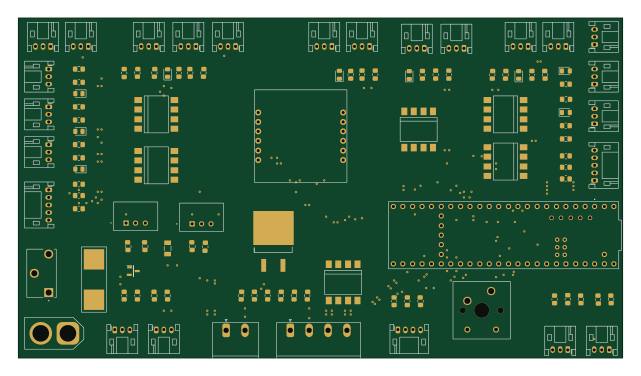
FewawiOwO
160 × 90 mm106 parts2LMIT9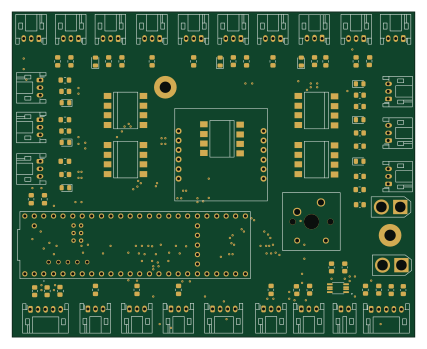
FewawiControlBoard
106.5 × 86 mm88 parts2LMIT9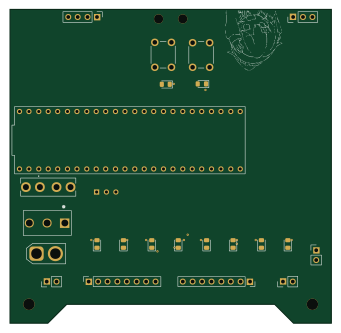
Ferrarii
85 × 83 mm53 parts2LMIT9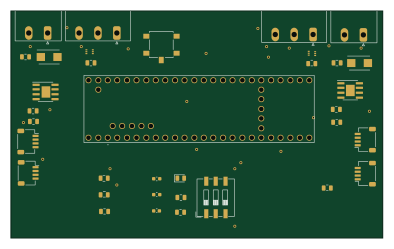 NXP
NXPRatatoulliBoard
98.3 × 59.9 mm52 parts2LMIT9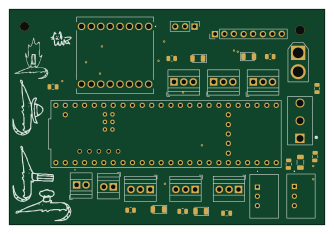 NXP
NXPSchematic
83.5 × 57 mm30 parts2LMIT9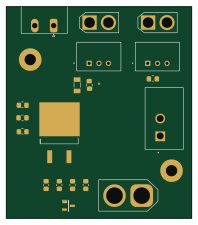
FewawiPowerBoard
49 × 56 mm19 parts2LMIT9
CustomML2
10 × 22 mm7 parts2LMIT9
Similar boards
 AVR/Arduino
Magspoof
samyk
35 × 29 mm11 parts2LNo license4.2k AVR/Arduino
Redox keyboard
mattdibi
162.2 × 126.5 mm77 parts2LMIT2.0k AVR/Arduino
Labrador
espotek-org
36.8 × 34.7 mm75 parts2LNo license1.2k AVR/Arduino
ModuleV450
stuartpittaway
30 × 61.4 mm39 parts2LCC-BY-NC-4.01.1k AVR/Arduino
V4
30 × 50 mm38 parts2LCC-BY-NC-4.01.1k AVR/Arduino
Discipline
coseyfannitutti
304.9 × 122.8 mm170 parts2LCC-BY-NC-4.01.0k