
USB2RoMeLa Boosted

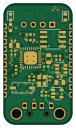
About the USB2RoMeLa Boosted PCB
USB2RoMeLa Boosted is an open source STM32 PCB design by RoMeLaUCLA, published on GitHub under the MIT license. It is a 4-layer board measuring 18 × 31.8 mm, with 58 components from 32 distinct parts.
Its main chip is the STM32L432KBU6, from the STM32 family. Other key parts include the USBLC6-2SC6, 93LC56BT-I/OT, FT232HL-REEL, MAX14775EASA+ and TLV70233DBVR. By type, the board carries 22 capacitors, 10 resistors, 6 ICs, 6 jumpers, 4 connectors and 3 diodes.
It belongs with the usb & debug tools designs in this gallery.
From the project
USB2RoMeLa boosted RS-485 USB adapter.
USB2RoMeLa Boosted is a low latency USB to RS-485 adapter. FT232H is used for USB to serial conversion. STM32 intercepts data packets and signals FT232H whenever a complete data packet is received, lowering roundtrip communication latency. Packet acceleration is designed around Dynamixel communication protocols.
firmware: STM32 firmware with STM32CubeIDE project. \ firmware\Bin: binary file of compiled firmware.
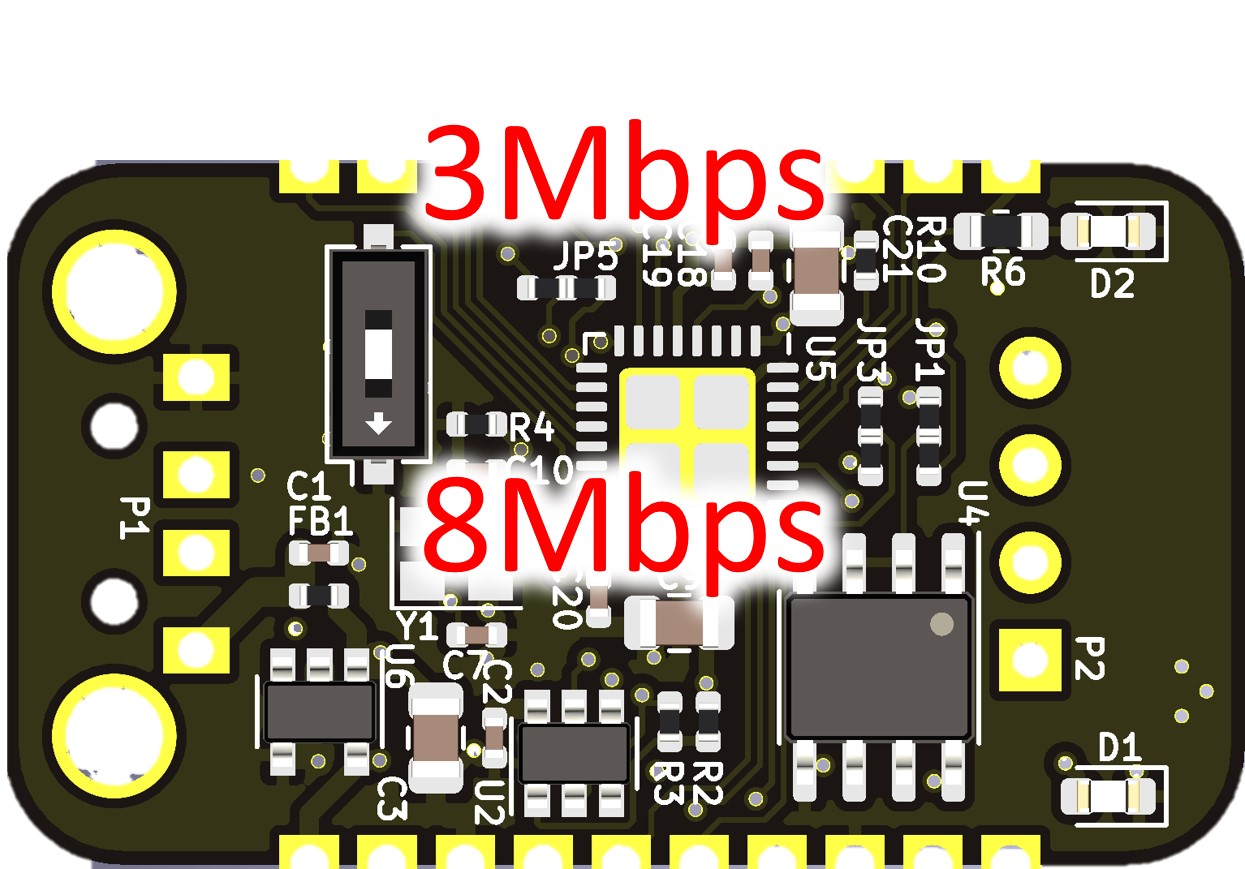
Main components on the USB2RoMeLa Boosted
USB2RoMeLa Boosted bill of materials (BOM)
58 components, 32 distinct parts — part numbers from the project's BOM.
| Qty | Part | Footprint | Refs |
|---|---|---|---|
| 1 | USBLC6-2SC6 USBLC6-2 STMicroelectronics | SOT-23-6 | U1 |
| 1 | 93LC56BT-I/OT 93LC56B_sot23-6 Microchip Technology | SOT-23-6 | U2 |
| 1 | FT232HL-REEL FT232H FTDI, Future Technology Devices International Ltd | LQFP-48_7x7mm_P0.5mm_0.25mm_Spacing | U3 |
| 1 | MAX14775EASA+ MAX14775E Maxim Integrated | SOIC-8_3.9x4.9mm_P1.27mm | U4 |
| 1 | STM32L432KBU6 stm32l432 STMicroelectronics | VQFN-32-1EP_5x5mm_P0.5mm_EP3.5x3.5mm | U5 |
| 1 | TLV70233DBVR TLV70233 Texas Instruments | SOT-23-5 | U6 |
| 1 | ABM10-166-12.000MHZ-T3 12MHz 30PPM Abracon LLC | Crystal_SMD_2520-4Pin_2.5x2.0mm | Y1 |
| 1 | 0480370001 USB_A Molex | USB_typeA_TH | P1 |
| 1 | 0022057045 molex 4P Molex | Molex_4P | P2 |
| 2 | CONN_01X10 | castellation_10P_2mm | P3, P4 |
| 3 | CR0402-J/-000GLF Jumper_NC_Small Bourns Inc. | R_0402_1005Metric | JP1, JP3, JP5 |
| 3 | Jumper_NC_Small | R_0402_1005Metric | JP2, JP4, JP6 |
| 1 | ESR10EZPF1200 120* Rohm Semiconductor | R_0805_2012Metric | Rt1 |
| 2 | CHS-01TA SW_DIP_x01 Nidec Copal Electronics | SW_DIP_SPSTx01_Slide_Copal_CHS-01A_W5.08mm_P1.27mm_JPin | SW1, SW2 |
| 1 | SML-D13M8WT86 LED_G Rohm Semiconductor | LED_0603_1608Metric | D1 |
| 1 | SML-D12U1WT86 LED_R Rohm Semiconductor | LED_0603_1608Metric | D2 |
| 1 | ESDCAN02-2BWY TVS_ESDCAN02 STMicroelectronics | SOT-323_SC-70 | D3 |
| 3 | BLM15PX601SN1D Ferrite_Bead Murata Electronics | R_0402_1005Metric | FB1, FB2, FB3 |
| 2 | CL05B103KB5NNNC 103 Samsung Electro-Mechanics | C_0402_1005Metric | C1, C4 |
| 4 | CL05B104KO5NFNC 104 Samsung Electro-Mechanics | C_0402_1005Metric | C2, C5, C6, C8 |
Show 12 more
| Qty | Part | Footprint | Refs |
|---|---|---|---|
| 1 | CL21B106KPQNFNE 10uF 10v Samsung Electro-Mechanics | C_0805_2012Metric | C3 |
| 2 | CL05C100DB5NNNC 10pF Samsung Electro-Mechanics | C_0402_1005Metric | C7, C10 |
| 1 | CL21B106KPQNFNE 10uF Samsung Electro-Mechanics | C_0805_2012Metric | C9 |
| 9 | 104 | C_0402_1005Metric | C11, C12, C13, C14, C15, C16, C18, C19 +1 |
| 1 | CL21B106KPQNFNE 4.7uF 6.3V Samsung Electro-Mechanics | C_0805_2012Metric | C21 |
| 2 | CL10B105KP8NFNC 1uF 10v Samsung Electro-Mechanics | C_0603_1608Metric | C24, C25 |
| 3 | CR0402-JW-103GLF 10k Bourns Inc. | R_0402_1005Metric | R1, R2, R10 |
| 1 | CR0402-JW-202GLF 2k Bourns Inc. | R_0402_1005Metric | R3 |
| 1 | CR0402-FX-1202GLF 12k 1% Bourns Inc. | R_0402_1005Metric | R4 |
| 2 | CR0603-JW-181ELF 180 Bourns Inc. | R_0603_1608Metric | R5, R6 |
| 2 | ESR03EZPF10R0 10* Rohm Semiconductor | R_0603_1608Metric | R7, R8 |
| 1 | ESR10EZPF1200 120* Rohm Semiconductor | R_0805_2012Metric | R9 |
USB2RoMeLa Boosted design files
The KiCad project lives in the RoMeLaUCLA/usb2romela repository on GitHub; these links point at the commit this page was built from.
USB2RoMeLa Boosted: common questions
What microcontroller does the USB2RoMeLa Boosted use?
The USB2RoMeLa Boosted is built around the STM32L432KBU6, from the STM32 family.
How big is the USB2RoMeLa Boosted PCB?
The USB2RoMeLa Boosted measures 18 × 31.8 mm, has 4 copper layers and is 1.6 mm thick.
How many components are on the USB2RoMeLa Boosted?
58 components, from 32 distinct parts, with part numbers taken from the project's own BOM. The full bill of materials is listed on this page.
Where can I download the USB2RoMeLa Boosted design files?
From the RoMeLaUCLA/usb2romela repository on GitHub, which has the KiCad layout and the BOM; the links under Design files point to each one.
Can I use the USB2RoMeLa Boosted design in my own project?
Yes, under the terms of its MIT license, which RoMeLaUCLA chose for the repository.
Can I test firmware for the USB2RoMeLa Boosted without the hardware?
Yes. HardLabs builds a simulation of the board from its netlist and BOM, so you can run and debug STM32 firmware against it before you order a PCB.
More boards in usb2romela
Similar boards
 STM32
STM32AxxSolder
AxxAxx
39 × 82.5 mm122 parts2LGPL-3.01.7k STM32
STM32AIOC
skuep
21 × 31.5 mm47 parts2LMIT1.4k STM32
STM32Ferris
pierrechevalier83
208.8 × 86.8 mm102 parts2LSHL-2.11.3k STM32
STM32Module 16S
stuartpittaway
71.1 × 89.6 mm113 parts4LCC-BY-NC-4.01.1k STM32
STM32Djinn
tzarc
192.3 × 150.5 mm216 parts2LCERN-OHL-S-2.0988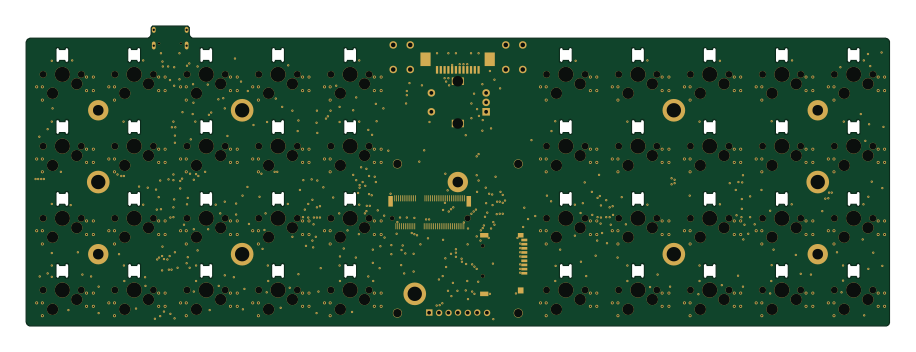 STM32
STM32Ghoul
228.6 × 79.4 mm163 parts2LCERN-OHL-S-2.0988