
PicoCalc-Open-Source-Student-Scientific-Calculator

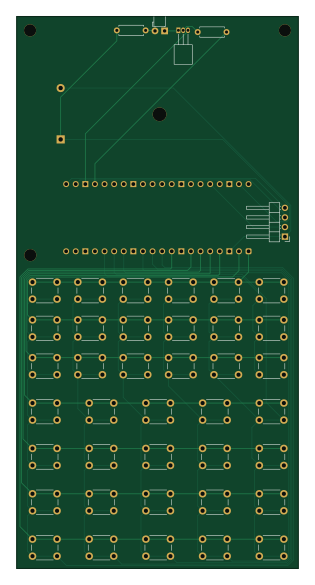
About the PicoCalc-Open-Source-Student-Scientific-Calculator PCB
PicoCalc-Open-Source-Student-Scientific-Calculator is an open source Raspberry Pi PCB design by Samuel-Malaj, published on GitHub. It is a 2-layer board measuring 74.5 × 146 mm, with 45 components from 8 distinct parts.
Its main chip is the RaspberryPi_Pico_W, from the Raspberry Pi family. By type, the board carries 38 switches, 2 resistors, 1 module, 1 transistor, 1 connector and 1 battery holder.
It belongs with the iot & wireless, displays & leds and science & space designs in this gallery.
From the project
Open source scientific calculator built on Raspberry Pi Pico W — custom PCB, WiFi messaging, IR projector control and games.
A fully custom scientific calculator built on the Raspberry Pi Pico W, designed specifically for students. Features wireless peer-to-peer messaging, IR classroom projector control, a custom PCB, and built-in games — all running on MicroPython.
PicoCalc is an end-to-end hardware and software project encompassing PCB design, embedded systems programming, wireless networking, and circuit design. Every component — from the button matrix to the IR driver circuit — was designed, calculated, and implemented from scratch.
Main components on the PicoCalc-Open-Source-Student-Scientific-Calculator
PicoCalc-Open-Source-Student-Scientific-Calculator bill of materials (BOM)
45 components, 8 distinct parts.
| Qty | Part | Footprint | Refs |
|---|---|---|---|
| 1 | RaspberryPi_Pico_W | RaspberryPi_Pico_Common_THT | A1 |
| 1 | BC547 | TO-92_Inline_Horizontal1 | Q1 |
| 1 | Conn_01x04 | PinHeader_1x04_P2.54mm_Horizontal | J1 |
| 1 | Battery | BatteryHolder_MPD_BC2AAPC_2xAA | BT1 |
| 38 | SW_Push_Dual_x2 | SW_PUSH_6mm_H4.3mm | SW1, SW2, SW3, SW4, SW5, SW6, SW7, SW8 +30 |
| 1 | TSAL6200 | LED_D3.0mm_Horizontal_O1.27mm_Z2.0mm_IRGrey | D1 |
| 1 | 22R | R_Axial_DIN0207_L6.3mm_D2.5mm_P7.62mm_Horizontal | R1 |
| 1 | 1000R | R_Axial_DIN0207_L6.3mm_D2.5mm_P7.62mm_Horizontal | R2 |
PicoCalc-Open-Source-Student-Scientific-Calculator design files
The KiCad project lives in the Samuel-Malaj/PicoCalc-Open-Source-Student-Scientific-Calculator repository on GitHub; these links point at the commit this page was built from.
PicoCalc-Open-Source-Student-Scientific-Calculator: common questions
What microcontroller does the PicoCalc-Open-Source-Student-Scientific-Calculator use?
The PicoCalc-Open-Source-Student-Scientific-Calculator is built around the RaspberryPi_Pico_W, from the Raspberry Pi family.
How big is the PicoCalc-Open-Source-Student-Scientific-Calculator PCB?
The PicoCalc-Open-Source-Student-Scientific-Calculator measures 74.5 × 146 mm, has 2 copper layers and is 1.6 mm thick.
How many components are on the PicoCalc-Open-Source-Student-Scientific-Calculator?
45 components, from 8 distinct parts. The full bill of materials is listed on this page.
Where can I download the PicoCalc-Open-Source-Student-Scientific-Calculator design files?
From the Samuel-Malaj/PicoCalc-Open-Source-Student-Scientific-Calculator repository on GitHub, which has the KiCad layout and the schematic; the links under Design files point to each one.
Can I use the PicoCalc-Open-Source-Student-Scientific-Calculator design in my own project?
The repository has no license, so all rights stay with Samuel-Malaj. Use it as a reference, and ask the author before reusing the design.
Can I test firmware for the PicoCalc-Open-Source-Student-Scientific-Calculator without the hardware?
Yes. HardLabs builds a simulation of the board from its netlist and BOM, so you can run and debug Raspberry Pi firmware against it before you order a PCB.
Similar boards
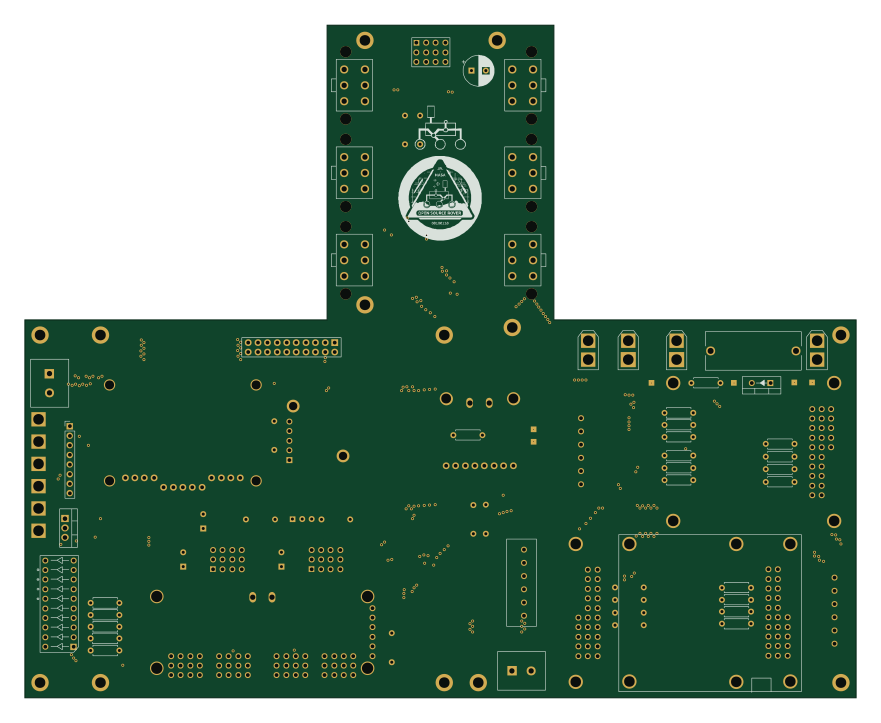 Raspberry Pi
Open source rover
nasa-jpl
220 × 178 mm144 parts2LApache-2.09.7k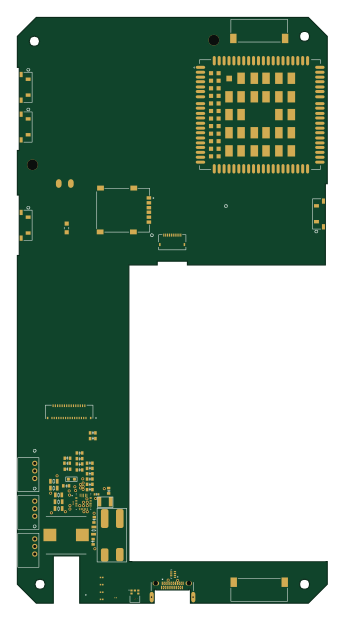 Raspberry Pi
SPIRIT
SPIRIT-org
82 × 155 mm130 parts6LCERN-OHL-S-2.01.3k Raspberry Pi
CM5RevEng
schlae
55 × 40 mm417 parts10LNo license1.0k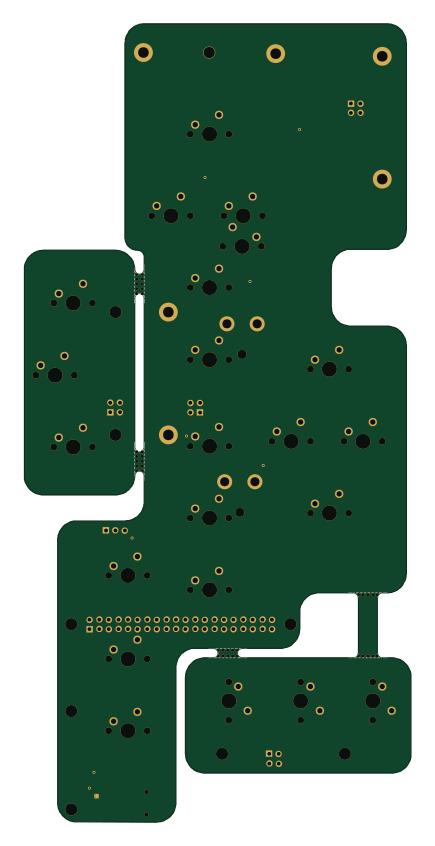 Raspberry Pi
Haxo hw
cardonabits
102.4 × 211.3 mm38 parts2LCustom license672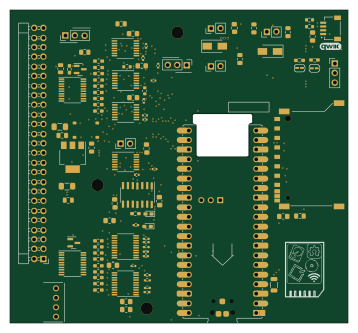 Raspberry Pi
Desktop 50 Pin TopConn
BlueSCSI
89.2 × 82.6 mm103 parts2LGPL-3.0449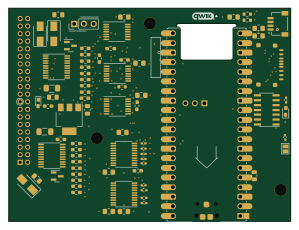 Raspberry Pi
PowerBook
74.5 × 56.3 mm78 parts2LGPL-3.0449