
CCVDrum

About the CCVDrum PCB
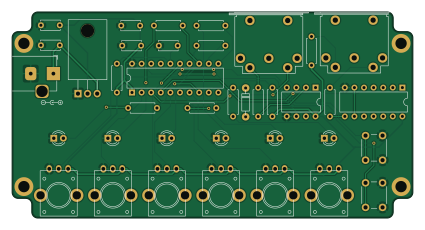
CCVDrum is an open source TI MSP430/CC PCB design by sensai7, published on GitHub under the MIT license. It is a 2-layer board measuring 106 × 54.5 mm, with 38 components from 24 distinct parts.
Its main chip is the MSP430G2533, from the TI MSP430/CC family. Other key parts include the LM1117IMP-3.3, 6N139 and 74HC14. By type, the board carries 11 resistors, 7 diodes, 5 capacitors, 4 ICs, 3 connectors and 2 switches.
It belongs with the audio designs in this gallery.
From the project
Energia code and Kicad files for a Korg Volca Drum MIDI CC board
In the Korg Volca Drum there's a hidden menu when you press the edit/step to change five adittional settings for each part and layer: bit resolution, overdrive, wave folding, pan, and pre-amp gain.
This repository contains the code, schematic, and PCB files to build and program a circuit board to control the 'hidden' paramenters from a Korg Volca Drum, having one dedicated knob control for each one and being able to select the first, second, or both layers with the provided push buttons. The circuit is based on a MSP430G2553, a common and cheap microprocessor from Texas Instruments, and it's…

Main components on the CCVDrum
CCVDrum bill of materials (BOM)
38 components, 24 distinct parts.
| Qty | Part | Footprint | Refs |
|---|---|---|---|
| 1 | MSP430G2533 | DIP-20_W7.62mm | U1 |
| 1 | LM1117IMP-3.3 | TO-220-3_Horizontal_TabDown | U2 |
| 1 | 6N139 | DIP-8_W7.62mm | U3 |
| 1 | 74HC14 | DIP-14_W7.62mm | U4 |
| 1 | Barrel_Jack | BarrelJack_Horizontal | J1 |
| 1 | MIDI_in | din-5 | J4 |
| 1 | MIDI_out | din-5 | J5 |
| 6 | 10k | trimmer_alps-rk09k1130ah1 | RV1, RV2, RV3, RV4, RV5, RV6 |
| 2 | SW_Push | SW_PUSH_6mm_H4.3mm | SW1, SW2 |
| 1 | 1N4148 | diode_do35 | D1 |
| 1 | 1 | LED_D3.0mm | D2 |
| 1 | 2 | LED_D3.0mm | D3 |
| 1 | 3 | LED_D3.0mm | D4 |
| 1 | 4 | LED_D3.0mm | D5 |
| 1 | 5 | LED_D3.0mm | D6 |
| 1 | 6 | LED_D3.0mm | D7 |
| 2 | 10 | C_Disc_D5.0mm_W2.5mm_P5.00mm | C1, C4 |
| 1 | 330 | C_Disc_D5.0mm_W2.5mm_P5.00mm | C2 |
| 2 | 100 | C_Disc_D5.0mm_W2.5mm_P5.00mm | C3, C5 |
| 1 | 47k | R_Axial_DIN0207_L6.3mm_D2.5mm_P7.62mm_Horizontal | R1 |
Show 4 more
| Qty | Part | Footprint | Refs |
|---|---|---|---|
| 2 | 68 | R_Axial_DIN0207_L6.3mm_D2.5mm_P7.62mm_Horizontal | R2, R8 |
| 1 | 220 | R_Axial_DIN0207_L6.3mm_D2.5mm_P7.62mm_Horizontal | R3 |
| 6 | RLED | R_Axial_DIN0207_L6.3mm_D2.5mm_P7.62mm_Horizontal | R4, R5, R7, R10, R11, R12 |
| 1 | 270 | R_Axial_DIN0207_L6.3mm_D2.5mm_P7.62mm_Horizontal | R9 |
CCVDrum design files
The KiCad project lives in the sensai7/CCVDrum repository on GitHub; these links point at the commit this page was built from.
- LayoutTHD/CCdrum.kicad_pcb
CCVDrum: common questions
What microcontroller does the CCVDrum use?
The CCVDrum is built around the MSP430G2533, from the TI MSP430/CC family.
How big is the CCVDrum PCB?
The CCVDrum measures 106 × 54.5 mm, has 2 copper layers and is 1.6 mm thick.
How many components are on the CCVDrum?
38 components, from 24 distinct parts. The full bill of materials is listed on this page.
Where can I download the CCVDrum design files?
From the sensai7/CCVDrum repository on GitHub, which has the KiCad layout; the links under Design files point to each one.
Can I use the CCVDrum design in my own project?
Yes, under the terms of its MIT license, which sensai7 chose for the repository.
Can I test firmware for the CCVDrum without the hardware?
Yes. HardLabs builds a simulation of the board from its netlist and BOM, so you can run and debug TI MSP430/CC firmware against it before you order a PCB.
Similar boards
 TI MSP430/CC
Pluto
carrotIndustries
24.4 × 24.4 mm36 parts2LGPL-3.0533 TI MSP430/CC
Nsumo hardware
artfulbytes
50 × 65 mm73 parts2LMIT33 TI MSP430/CC
Elektronika-1
BenjaminSoelberg
29.5 × 29.5 mm14 parts4LGPL-3.029 TI MSP430/CC
CheeseDip
upsidedownlabs
21.6 × 60 mm27 parts2LCERN-OHL-S-2.021 TI MSP430/CC
CheeseDip-Castellated
21.6 × 60 mm27 parts2LCERN-OHL-S-2.021 TI MSP430/CC
MSP430 Breadstick - Apple Sauce
18.5 × 65.8 mm31 parts2LCERN-OHL-S-2.021