
Sam17-midicv

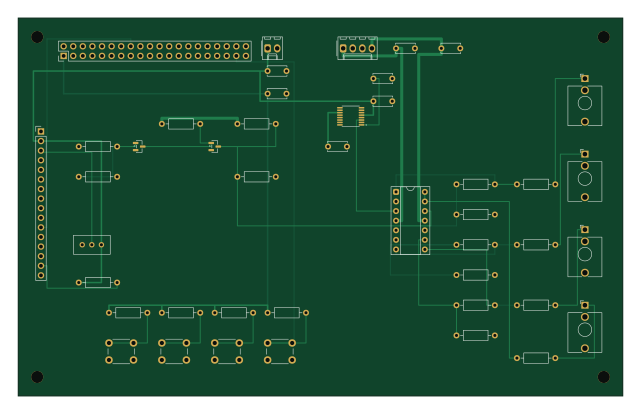
About the Sam17-midicv PCB
Sam17-midicv is an open source PCB design by sssamuelll, published on GitHub under the CERN-OHL-S-2.0 license. It is a 2-layer board measuring 160 × 100 mm, with 44 components from 12 distinct parts.
Other key parts include the SSI2130. By type, the board carries 20 resistors, 8 connectors, 7 capacitors, 4 switches, 2 ICs and 2 transistors.
It belongs with the audio designs in this gallery.
From the project
SAM17, an open-source polyphonic analog synthesizer: 16 analog channels, a 16-line FM matrix, an 8x8 patch bay through an analog crosspoint, and an STM32N657 brain running Rust. CERN-OHL-S / GPL-3.0 / CC BY-SA. Began as a 2020 engineering thesis in Venezuela.
El único módulo digital del sintetizador. Combina un Raspberry Pi 3B+ con un DAC AD5686R (16-bit, cuádruple) para generar 3 salidas CV (1 V/oct) y 1 GATE digital (10 V) a partir de mensajes MIDI USB.
GPIO BCM: UP=4, DOWN=17, BACK=16, ENTER=26, GATE=27, DAC RESET=6. LCD: RS=25, EN=24, D4=23, D5=18, D6=15, D7=14. SPI: bus 0, device 1, mode 0b01, max 50 MHz.
Es la fuente del CV de tono, así que su error se suma al de la masa del bus. El presupuesto está en tuningbudget.py y sale a 1.68 cents, de los cuales 1.21 siguen siendo la masa** del bus board.
Main components on the Sam17-midicv
Sam17-midicv bill of materials (BOM)
44 components, 12 distinct parts — part numbers from the project's BOM.
| Qty | Part | Footprint | Refs |
|---|---|---|---|
| 1 | SSI2130 TSSOP-16_4.4x5mm_P0.65mm | TSSOP-16_4.4x5mm_P0.65mm | U1 |
| 1 | SSI2130 DIP-14_W7.62mm_Socket | DIP-14_W7.62mm_Socket | U2 |
| 2 | SOT-23 | SOT-23 | Q1, Q2 |
| 1 | Molex_KK-254_AE-6410-04A_1x04_P2.54mm_Vertical | Molex_KK-254_AE-6410-04A_1x04_P2.54mm_Vertical | J1 |
| 1 | Molex_KK-254_AE-6410-02A_1x02_P2.54mm_Vertical | Molex_KK-254_AE-6410-02A_1x02_P2.54mm_Vertical | J2 |
| 1 | PinHeader_2x20_P2.54mm_Vertical | PinHeader_2x20_P2.54mm_Vertical | J3 |
| 4 | Jack_3.5mm_QingPu_WQP-PJ398SM_Vertical_CircularHoles | Jack_3.5mm_QingPu_WQP-PJ398SM_Vertical_CircularHoles | J4, J5, J6, J7 |
| 1 | PinHeader_1x16_P2.54mm_Vertical | PinHeader_1x16_P2.54mm_Vertical | J8 |
| 1 | Potentiometer_Bourns_3296W_Vertical | Potentiometer_Bourns_3296W_Vertical | RV1 |
| 4 | SW_PUSH_6mm | SW_PUSH_6mm | SW1, SW2, SW3, SW4 |
| 7 | C_Disc_D5.0mm_W2.5mm_P5.00mm | C_Disc_D5.0mm_W2.5mm_P5.00mm | C1, C2, C3, C4, C5, C6, C7 |
| 20 | R_Axial_DIN0207_L6.3mm_D2.5mm_P10.16mm_Horizontal | R_Axial_DIN0207_L6.3mm_D2.5mm_P10.16mm_Horizontal | R1, R2, R3, R4, R5, R6, R7, R8 +12 |
Sam17-midicv design files
The KiCad project lives in the sssamuelll/sam17 repository on GitHub; these links point at the commit this page was built from.
Sam17-midicv: common questions
How big is the Sam17-midicv PCB?
The Sam17-midicv measures 160 × 100 mm, has 2 copper layers and is 1.6 mm thick.
How many components are on the Sam17-midicv?
44 components, from 12 distinct parts, with part numbers taken from the project's own BOM. The full bill of materials is listed on this page.
Where can I download the Sam17-midicv design files?
From the sssamuelll/sam17 repository on GitHub, which has the KiCad layout, the schematic and the BOM; the links under Design files point to each one.
Can I use the Sam17-midicv design in my own project?
Yes, under the terms of its CERN-OHL-S-2.0 license, which sssamuelll chose for the repository.
More boards in sam17
Similar boards
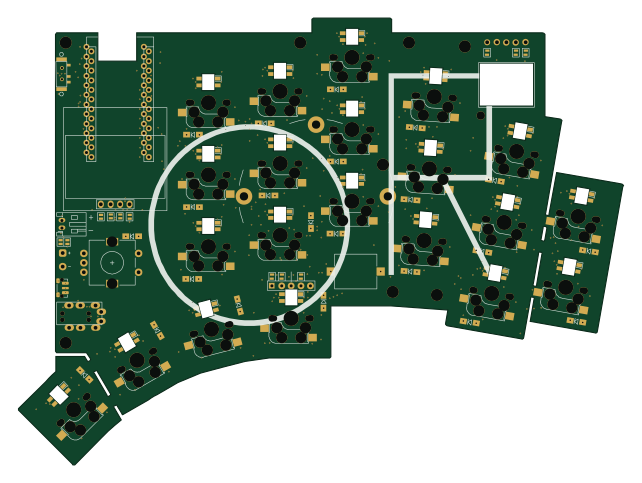
KLOR
GEIGEIGEIST
160.2 × 118.3 mm79 parts2LGPL-3.01.2k
ButtonsLEDs
shanteacontrols
390 × 37 mm82 parts2LApache-2.0956
USB
52 × 12.6 mm6 parts2LApache-2.0956
Pots
390 × 93 mm75 parts2LApache-2.0956
PicoGUS Hand386
polpo
29.2 × 75.2 mm43 parts4LGPL-2.0800
Snark barker
schlae
231.1 × 106.7 mm193 parts2LNo license687