
Handheld-Game

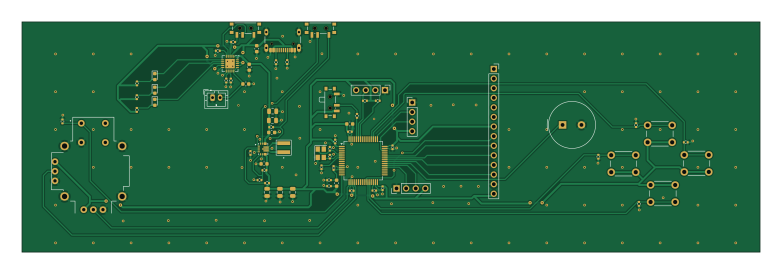
About the Handheld-Game PCB
Handheld-Game is an open source STM32 PCB design by StevenKourani, published on GitHub under the MIT license. It is a 2-layer board measuring 195.2 × 60.8 mm, with 69 components from 35 distinct parts.
Its main chip is the STM32F411RETx, from the STM32 family. Other key parts include the MCP73871-2CC, COM-09032 and TPS63070RNMR. By type, the board carries 24 capacitors, 21 resistors, 6 connectors, 4 ICs, 3 switches and 3 diodes.
It belongs with the displays & leds and power & battery designs in this gallery.
From the project
A custom-built handheld console powered by an STM32 microcontroller, featuring a 2.8" TFT display, joystick/button controls, and modular game firmware. This repository contains both the hardware design files (KiCad) and firmware source code.
- MCU: STM32F411RE (Nucleo board in development, custom PCB for production) - Display: ILI9341 2.8" TFT LCD (SPI) - Controls: Analog joystick + push buttons - Audio: Passive buzzer with PWM for sound effects - Power: - Li-ion battery with power management - Buck-boost converter allows the battery to be used both above and below 3.3V - USB-C charging option - Current switch for allowing fast charging of the battery - Power switch (on/off) - LED indicators for low battery and fully charged states - PCB Design: Created in KiCad 9, includes Gerbers, BOM, and KiCad project files. - Status: Board…
Main components on the Handheld-Game
Handheld-Game bill of materials (BOM)
69 components, 35 distinct parts — part numbers from the project's BOM.
| Qty | Part | Footprint | Refs |
|---|---|---|---|
| 1 | STM32F411RETx | LQFP-64_10x10mm_P0.5mm | U1 |
| 1 | MCP73871-2CC | QFN-20-1EP_4x4mm_P0.5mm_EP2.5x2.5mm | U3 |
| 1 | COM-09032 | XDCR_COM-09032 | U4 |
| 1 | TPS63070RNMR | VREG_TPS63070RNMR | U5 |
| 1 | 16MHz | Crystal_SMD_SeikoEpson_TSX3225-4Pin_3.2x2.5mm | Y1 |
| 1 | Serial Wire | PinHeader_1x04_P2.54mm_Vertical | J1 |
| 1 | USB_C_Receptacle_USB2.0_16P | USB_C_Receptacle_GCT_USB4105-xx-A_16P_TopMnt_Horizontal | J2 |
| 1 | batt pin | JST_PH_B2B-PH-K_1x02_P2.00mm_Vertical | J3 |
| 1 | Conn_01x14_Socket | PinSocket_1x14_P2.54mm_Vertical | J4 |
| 1 | USART | PinHeader_1x04_P2.54mm_Vertical | J5 |
| 1 | I2C | PinHeader_1x04_P2.54mm_Vertical | J6 |
| 4 | ~ | SW_PUSH_6mm_H4.3mm | BTN1, BTN2, BTN3, BTN4 |
| 1 | Buzzer | Buzzer_TDK_PS1240P02BT_D12.2mm_H6.5mm | BZ1 |
| 3 | SW_SPDT | SW_SPDT_PCM12 | SW1, SW2, SW4 |
| 3 | ~ | LED_0603_1608Metric | D1, D2, D3 |
| 1 | 120R | L_0603_1608Metric | FB1 |
| 1 | XFL4020-152MEC | IND_XFL4020-152MEC | L1 |
| 7 | 100n | C_0402_1005Metric | C1, C2, C3, C4, C5, C10, C19 |
| 3 | 10u | C_0603_1608Metric | C6, C16, C20 |
| 1 | 10n | C_0402_1005Metric | C7 |
Show 15 more
| Qty | Part | Footprint | Refs |
|---|---|---|---|
| 2 | 1u | C_0402_1005Metric | C8, C9 |
| 2 | 10p | C_0402_1005Metric | C11, C12 |
| 3 | 4.7u | C_0603_1608Metric | C13, C14, C15 |
| 2 | 10u | C_0805_2012Metric | C17, C18 |
| 3 | 22u | C_0805_2012Metric | C21, C22, C23 |
| 1 | 2.2u | C_0402_1005Metric | C24 |
| 8 | 10k | R_0402_1005Metric | R1, R2, R3, R4, R5, R6, R9, R16 |
| 2 | 5.1k | R_0402_1005Metric | R7, R8 |
| 1 | 2k | R_0402_1005Metric | R10 |
| 2 | 15k | R_0402_1005Metric | R11, R12 |
| 3 | 470 | R_0402_1005Metric | R13, R14, R15 |
| 1 | 470k | R_0402_1005Metric | R17 |
| 1 | 150k | R_0402_1005Metric | R18 |
| 1 | 100k | R_0402_1005Metric | R19 |
| 2 | 1.5k | R_0402_1005Metric | R20, R21 |
Handheld-Game design files
The KiCad project lives in the StevenKourani/Handheld-Game repository on GitHub; these links point at the commit this page was built from.
Handheld-Game: common questions
What microcontroller does the Handheld-Game use?
The Handheld-Game is built around the STM32F411RETx, from the STM32 family.
How big is the Handheld-Game PCB?
The Handheld-Game measures 195.2 × 60.8 mm, has 2 copper layers and is 1.6 mm thick.
How many components are on the Handheld-Game?
69 components, from 35 distinct parts, with part numbers taken from the project's own BOM. The full bill of materials is listed on this page.
Where can I download the Handheld-Game design files?
From the StevenKourani/Handheld-Game repository on GitHub, which has the KiCad layout, the schematic and the BOM; the links under Design files point to each one.
Can I use the Handheld-Game design in my own project?
Yes, under the terms of its MIT license, which StevenKourani chose for the repository.
Can I test firmware for the Handheld-Game without the hardware?
Yes. HardLabs builds a simulation of the board from its netlist and BOM, so you can run and debug STM32 firmware against it before you order a PCB.
Similar boards
 STM32
LumenPnP Motherboard
opulo-inc
149 × 95 mm296 parts4LCC-BY-SA-4.03.7k STM32
Type g
google
169 × 30 mm24 parts2LApache-2.02.9k STM32
Main panel
234 × 84 mm26 parts4LApache-2.02.9k STM32
Base
52.3 × 52.3 mm36 parts2LApache-2.02.9k STM32
Type a
150 × 30 mm14 parts2LApache-2.02.9k STM32
Type c
188 × 30 mm17 parts2LApache-2.02.9k