
Flight-Computer

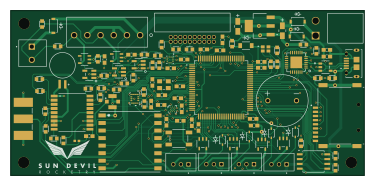
About the Flight-Computer PCB
Flight-Computer is an open source STM32 PCB design by SunDevilRocketry, published on GitHub. It is a 4-layer board measuring 93.7 × 43.7 mm, with 109 components from 50 distinct parts.
Its main chip is the STM32H750VBTx, from the STM32 family. Other key parts include the LMS8117AMP-3.3_NOPB, BMI323, MAX-8C-0-10, BMP390 and SST25VF040B-50-4I-S2AE-T. By type, the board carries 36 resistors, 25 capacitors, 12 ICs, 12 connectors, 10 diodes and 6 transistors.
From the project
General purpose flight computer for high powered rocketry projects.
Folder for all PCB design files, including project, schematic, and PCB layout files
Main components on the Flight-Computer
Flight-Computer bill of materials (BOM)
109 components, 50 distinct parts.
| Qty | Part | Footprint | Refs |
|---|---|---|---|
| 1 | STM32H750VBTx | STM32H750VBT6 | U1 |
| 1 | LMS8117AMP-3.3_NOPB | LMS8117AMP-3.3NOPB | U2 |
| 1 | BMI323 | BMI323 | U3 |
| 1 | MAX-8C-0-10 | MAX-8C-0 | U4 |
| 1 | BMP390 | BMP390 | U5 |
| 1 | SST25VF040B-50-4I-S2AE-T | SST25VF040B-50-4I-S2AE-T | U6 |
| 1 | RFM95W-868S2 | RFM95 | U7 |
| 1 | CP2102-GMR CP2102-GMR(QFN28) | CP2012-GMR | U8 |
| 3 | TS391IYLT | TS391IYLT | U9, U10, U11 |
| 1 | BMM150 | BMM150 | U12 |
| 6 | QS5U17TR | QS5U17TR | Q1, Q2, Q3, Q4, Q5, Q6 |
| 1 | ECS-240-18-33-JGN-TR | ECS-240-18-33-JGN-TR | Y1 |
| 2 | Jumper_NO | Jumper-NO | J1, J2 |
| 1 | 647676-2 | 647676-2 | P1 |
| 1 | 1546551-2 | 1546551-2 | P2 |
| 1 | 3220-20-0200-00 | 3220-20-0200-00 | P3 |
| 4 | 440054-3 | 440054-3 | P4, P5, P6, P7 |
| 1 | USB | 10118194-0001LF | P8 |
| 1 | 1984659 | 1984659 | P9 |
| 1 | Micro_SD_Card | MEM2075-00-140-01-A | P10 |
Show 30 more
| Qty | Part | Footprint | Refs |
|---|---|---|---|
| 1 | 0734120110 | 73412-0110 | AE1 |
| 1 | 142-0701-851 | 142-0701-851 | AE2 |
| 1 | PTS647SM38SMTR2LFS | PTS647SM38SMTR2LFS | B1 |
| 1 | MS614SE-FL28E | MS621FE-FL11E | BT1 |
| 1 | AT-1438-TWT-R | AT-1438-TWT-R | BZ1 |
| 1 | TP | TP | TP1 |
| 1 | CLMVC-FKA-CL1D1L71BB7C3C3 | CLMVC-FKA-CL1D1L71BB7C3C3 | D1 |
| 3 | SM5819PL-TP | SM5819PL-TP | D2, D3, D4 |
| 1 | SML-LX1206GC-TR | SML-LX1206GC-TR | D5 |
| 4 | MM3Z3V3B | MM3Z3V3B | D6, D7, D8, D9 |
| 1 | SP0504BAHTG | SP0504BAHTG | D10 |
| 1 | 27nH | L-07C27NJV6T | L1 |
| 1 | 4.7uF | CAP_0603 | C1 |
| 13 | 0.1uF | CAP_0603 | C2, C3, C4, C5, C6, C7, C8, C17 +5 |
| 4 | 1uF | CAP_0603 | C9, C23, C25, C26 |
| 2 | 10uF | T491A106K010AT | C10, C13 |
| 2 | 2.2uF | CAP_0603 | C11, C15 |
| 2 | 8pF | CAP_0603 | C12, C14 |
| 1 | 0.01uF | CAP_0603 | C16 |
| 1 | 68 | RES_0603 | R1 |
| 1 | 82 | RES_0603 | R2 |
| 1 | 280 | RES_0603 | R3 |
| 4 | 100k | RES_0603 | R4, R5, R31, R32 |
| 1 | 240 | RES_0603 | R6 |
| 14 | 10k | RES_0603 | R7, R9, R20, R21, R23, R24, R26, R28 +6 |
| 1 | 10 | RES_0603 | R8 |
| 8 | 33 | RES_0603 | R10, R11, R12, R13, R14, R15, R16, R17 |
| 3 | 4.7k | RES_0603 | R18, R19, R25 |
| 1 | 20k | RES_0603 | R22 |
| 1 | 1k | RES_0603 | R27 |
Flight-Computer design files
The KiCad project lives in the SunDevilRocketry/Flight-Computer repository on GitHub; these links point at the commit this page was built from.
Flight-Computer: common questions
What microcontroller does the Flight-Computer use?
The Flight-Computer is built around the STM32H750VBTx, from the STM32 family.
How big is the Flight-Computer PCB?
The Flight-Computer measures 93.7 × 43.7 mm, has 4 copper layers and is 1.6 mm thick.
How many components are on the Flight-Computer?
109 components, from 50 distinct parts. The full bill of materials is listed on this page.
Where can I download the Flight-Computer design files?
From the SunDevilRocketry/Flight-Computer repository on GitHub, which has the KiCad layout and the schematic; the links under Design files point to each one.
Can I use the Flight-Computer design in my own project?
The repository has no license, so all rights stay with SunDevilRocketry. Use it as a reference, and ask the author before reusing the design.
Can I test firmware for the Flight-Computer without the hardware?
Yes. HardLabs builds a simulation of the board from its netlist and BOM, so you can run and debug STM32 firmware against it before you order a PCB.
Similar boards
 STM32
LumenPnP Motherboard
opulo-inc
149 × 95 mm296 parts4LCC-BY-SA-4.03.7k STM32
Type g
google
169 × 30 mm24 parts2LApache-2.02.9k STM32
Main panel
234 × 84 mm26 parts4LApache-2.02.9k STM32
Base
52.3 × 52.3 mm36 parts2LApache-2.02.9k STM32
Type a
150 × 30 mm14 parts2LApache-2.02.9k STM32
Type c
188 × 30 mm17 parts2LApache-2.02.9k