
Micromouse

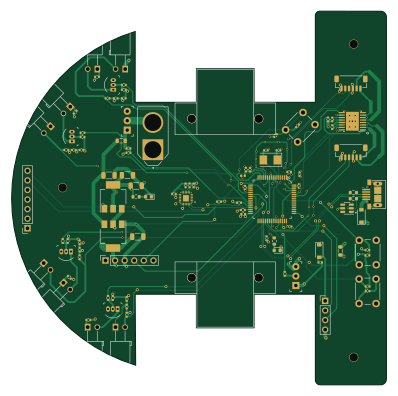
About the Micromouse PCB
Micromouse is an open source STM32 PCB design by tadzio8425, published on GitHub under the MIT license. It is a 4-layer board measuring 99.3 × 98.9 mm, with 97 components from 47 distinct parts.
Its main chip is the STM32F405RGT6, from the STM32 family. Other key parts include the C6187, C6186, C85364, C50278 and DRV8833PWPR. By type, the board carries 18 resistors, 10 ICs, 8 capacitors, 7 connectors, 5 switches and 4 transistors.
It belongs with the robotics & motion and sensors designs in this gallery.
From the project
Micromouse developed by the IEEE Robotics and Automation Society chapter of the Universidad de Los Andes, Bogotá (2023-2024).
- SoB built around the STM32F405RGT6 - Wall detection based on peripheral infrared sensors and ToF - Position and speed control using magnetic encoders for Micro Metal Motors - IMU aided control - Bluetooth support
- Developed in the Universidad de Los Andes for the Robotics and Automation Society Chapter of the IEEE.
Main components on the Micromouse
Micromouse bill of materials (BOM)
97 components, 47 distinct parts — part numbers from the project's BOM.
| Qty | Part | Footprint | Refs |
|---|---|---|---|
| 1 | STM32F405RGT6 STMicroelectronics | LQFP-64_10x10mm | U1 |
| 1 | C6187 AMS1117-5.0 | SOT-223-3_TabPin2 | U2 |
| 1 | C6186 AMS1117-3.3 | SOT-223-3_TabPin2 | U3 |
| 1 | C85364 SRV05-4 | SOT-23-6 | U4 |
| 1 | C50278 MPU-6500 | QFN40P300X300X95-25N | U5 |
| 1 | DRV8833PWPR Texas Instruments | TSSOP-16-1EP_W4.40mm | U6 |
| 4 | TCRT5000 | OPTO_TCRT5000 | U7, U8, U9, U10 |
| 4 | BS170 ON Semiconductor | TO-92-3 | Q1, Q2, Q3, Q4 |
| 1 | C115962 8MHz | Crystal_SMD_5032-2Pin_5.0x3.2mm | Y1 |
| 1 | SWD | PinHeader_1x04_P2.54mm_Vertical | J1 |
| 1 | C393940 USB_B_Micro | MICRO-USB-SMD_5P-P0.65-H-F_MICRO5.9MMUSB | J2 |
| 1 | UARTBTH | PinSocket_1x06_P2.54mm_Vertical | J3 |
| 1 | C98733 Batería | AMASS_XT60-M | J4 |
| 1 | VL6180x | PinSocket_1x07_P2.54mm_Vertical | J5 |
| 1 | C160392 MotorEncodL | JST_SH_BM06B-SRSS-TB_1x06-1MP_P1.00mm_Vertical | J6 |
| 1 | C160392 MotorEncodR | JST_SH_BM06B-SRSS-TB_1x06-1MP_P1.00mm_Vertical | J7 |
| 12 | C1525 100nF | C_0402_1005Metric | CBOT1, CBOT2, CD1, CD2, CD3, CD4, CD5, CF2 +4 |
| 2 | C15195 10nF | C_0402_1005Metric | CD6, CM3 |
| 1 | C12530 2.2uF | C_0402_1005Metric | CD7 |
| 1 | C23733 4.7uF | C_0402_1005Metric | CDR1 |
Show 27 more
| Qty | Part | Footprint | Refs |
|---|---|---|---|
| 1 | C52923 1uF | C_0402_1005Metric | CF1 |
| 2 | C1554 20pF | C_0402_1005Metric | CH1, CH2 |
| 1 | C1857 0.22uF | C_1206_3216Metric | CR1 |
| 3 | C7171 10uF | C_1206_3216Metric | CR2, CR3, CR4 |
| 1 | C18830 27nH | L_0402_1005Metric | LF1 |
| 5 | C25744 10K | R_0402_1005Metric | RB1, RB2, RBOT1, RBOT2, RRST1 |
| 1 | C25768 22K | R_0402_1005Metric | RBat1 |
| 1 | C25762 18K | R_0402_1005Metric | RBat2 |
| 1 | C25792 47K | R_0402_1005Metric | RD1 |
| 3 | C25900 4.7K | R_0402_1005Metric | RM1, RPU1, RPU2 |
| 1 | C25867 1.5K | R_0402_1005Metric | RU1 |
| 2 | C23345 22 | R_0603_1608Metric | RU2, RU3 |
| 1 | RST | SW_PUSH_6mm_H5mm | SW1 |
| 1 | BootSwitch | Switch_Slide | SW2 |
| 1 | PowerSwitch | Switch_Slide | SW3 |
| 2 | BTN | SW_PUSH_6mm_H5mm | SW4, SW5 |
| 1 | C72041 AZUL | LED_0603_1608Metric | DL2 |
| 1 | C72043 VERDE | LED_0603_1608Metric | DL7 |
| 2 | C8598 B5819W | D_SOD-123 | D1, D2 |
| 2 | C1015 100Ohm 100MHz | L_0805_2012Metric | FB1, FB2 |
| 4 | C23733 4.7uF | C_0402_1005Metric | C1, C2, C5, C6 |
| 4 | C1525 0.1uF | C_0402_1005Metric | C3, C4, C7, C8 |
| 2 | C22962 220 | R_0603_1608Metric | R1, R4 |
| 4 | C25076 100 | R_0402_1005Metric | R5, R6, R13, R14 |
| 4 | C25792 47K | R_0402_1005Metric | R7, R8, R15, R16 |
| 4 | C25125 51 | R_0402_1005Metric | R9, R10, R17, R18 |
| 4 | C25867 1.8K | R_0402_1005Metric | R11, R12, R19, R20 |
Micromouse design files
The KiCad project lives in the tadzio8425/Micromouse repository on GitHub; these links point at the commit this page was built from.
Micromouse: common questions
What microcontroller does the Micromouse use?
The Micromouse is built around the STM32F405RGT6, from the STM32 family.
How big is the Micromouse PCB?
The Micromouse measures 99.3 × 98.9 mm, has 4 copper layers and is 4.69 mm thick.
How many components are on the Micromouse?
97 components, from 47 distinct parts, with part numbers taken from the project's own BOM. The full bill of materials is listed on this page.
Where can I download the Micromouse design files?
From the tadzio8425/Micromouse repository on GitHub, which has the KiCad layout, the schematic and the BOM; the links under Design files point to each one.
Can I use the Micromouse design in my own project?
Yes, under the terms of its MIT license, which tadzio8425 chose for the repository.
Can I test firmware for the Micromouse without the hardware?
Yes. HardLabs builds a simulation of the board from its netlist and BOM, so you can run and debug STM32 firmware against it before you order a PCB.
Similar boards
 STM32
LumenPnP Motherboard
opulo-inc
149 × 95 mm296 parts4LCC-BY-SA-4.03.7k STM32
Type g
google
169 × 30 mm24 parts2LApache-2.02.9k STM32
Base
52.3 × 52.3 mm36 parts2LApache-2.02.9k STM32
Main panel
234 × 84 mm26 parts4LApache-2.02.9k STM32
Type a
150 × 30 mm14 parts2LApache-2.02.9k STM32
Type c
188 × 30 mm17 parts2LApache-2.02.9k