
Three Octave Sharp

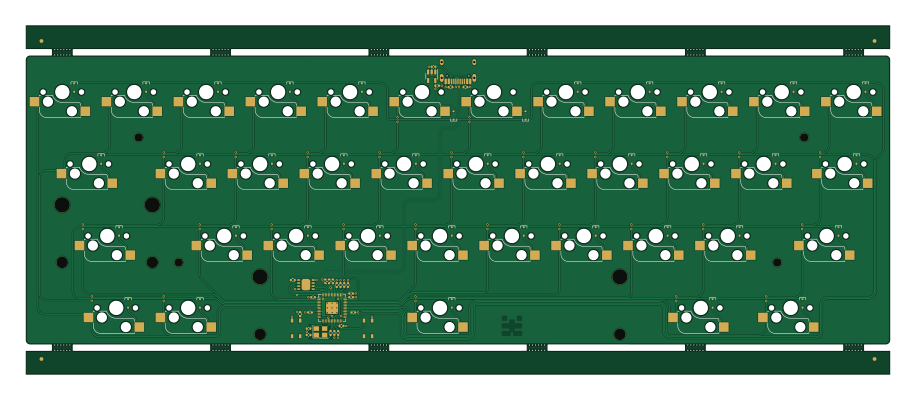
About the Three Octave Sharp PCB
Three Octave Sharp is an open source RP2040/RP2350 PCB design by takayoshiotake, published on GitHub under the CC-BY-SA-4.0 license. It is a 2-layer board measuring 228.6 × 92.2 mm, with 107 components from 52 distinct parts.
Its main chip is the RASPBERRY_PI_RP2040, from the RP2040/RP2350 family. Other key parts include the W25Q64JVXGIQ and AP2112K-3.3. By type, the board carries 38 switches, 38 diodes, 16 capacitors, 8 resistors, 3 ICs and 1 crystal.
It belongs with the keyboards designs in this gallery.
From the project
A 38-key (3-octave + 1) keyboard
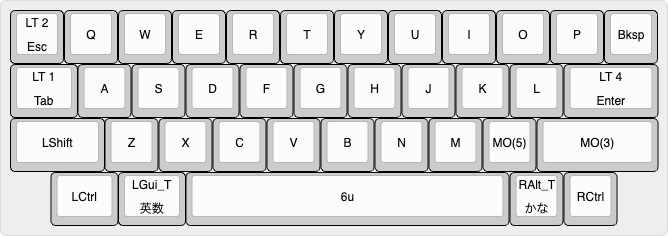
A 38-key (3-octave + 1) keyboard. Powered by Vial firmware.
This keyboard is based on a 60% column staggered keyboard like the HHKB, which omits the number and symbol keys to reduce the number of keys to 38.
MEMO: I couldn't figure out how to map keys to fn on macOS using Vial, so I am using Karabiner-Elements, a macOS app, to modify rightcontrol to fn`.
RAW data for Keyboard Layout Editor v0.15:
Main components on the Three Octave Sharp
Three Octave Sharp bill of materials (BOM)
107 components, 52 distinct parts — part numbers from the project's BOM.
| Qty | Part | Footprint | Refs |
|---|---|---|---|
| 1 | RASPBERRY_PI_RP2040 Raspberry_Pi_RP2040 | RP2040_QFN-56 | U1 |
| 1 | W25Q64JVXGIQ | XSON-8-EP_4x4mm | U2 |
| 1 | AP2112K-3.3 | SOT-23-5 | U3 |
| 1 | 12MHZ 12MHz | Crystal_SMD_3225-4Pin_3.2x2.5mm | Y1 |
| 1 | HRO_TYPE-C-31-M-12 | HRO_TYPE-C-31-M-12 | J1 |
| 1 | C5156480 Key Tab | Hot_Swap_Socket_CPG151101S11 | SW1 |
| 1 | C5156480 Key Q | Hot_Swap_Socket_CPG151101S11 | SW2 |
| 1 | C5156480 Key W | Hot_Swap_Socket_CPG151101S11 | SW3 |
| 1 | C5156480 Key E | Hot_Swap_Socket_CPG151101S11 | SW4 |
| 1 | C5156480 Key R | Hot_Swap_Socket_CPG151101S11 | SW5 |
| 1 | C5156480 Key T | Hot_Swap_Socket_CPG151101S11 | SW6 |
| 1 | C5156480 Key Y | Hot_Swap_Socket_CPG151101S11 | SW7 |
| 1 | C5156480 Key U | Hot_Swap_Socket_CPG151101S11 | SW8 |
| 1 | C5156480 Key I | Hot_Swap_Socket_CPG151101S11 | SW9 |
| 1 | C5156480 Key O | Hot_Swap_Socket_CPG151101S11 | SW10 |
| 1 | C5156480 Key P | Hot_Swap_Socket_CPG151101S11 | SW11 |
| 1 | C5156480 Key BS | Hot_Swap_Socket_CPG151101S11 | SW12 |
| 1 | C5156480 Key Caps | Hot_Swap_Socket_CPG151101S11 | SW13 |
| 1 | C5156480 Key A | Hot_Swap_Socket_CPG151101S11 | SW14 |
| 1 | C5156480 Key S | Hot_Swap_Socket_CPG151101S11 | SW15 |
Show 32 more
| Qty | Part | Footprint | Refs |
|---|---|---|---|
| 1 | C5156480 Key D | Hot_Swap_Socket_CPG151101S11 | SW16 |
| 1 | C5156480 Key F | Hot_Swap_Socket_CPG151101S11 | SW17 |
| 1 | C5156480 Key G | Hot_Swap_Socket_CPG151101S11 | SW18 |
| 1 | C5156480 Key H | Hot_Swap_Socket_CPG151101S11 | SW19 |
| 1 | C5156480 Key J | Hot_Swap_Socket_CPG151101S11 | SW20 |
| 1 | C5156480 Key K | Hot_Swap_Socket_CPG151101S11 | SW21 |
| 1 | C5156480 Key L | Hot_Swap_Socket_CPG151101S11 | SW22 |
| 1 | C5156480 Key Return | Hot_Swap_Socket_CPG151101S11 | SW23 |
| 2 | C5156480 Key Shift | Hot_Swap_Socket_CPG151101S11 | SW24, SW33 |
| 1 | C5156480 Key Z | Hot_Swap_Socket_CPG151101S11 | SW25 |
| 1 | C5156480 Key X | Hot_Swap_Socket_CPG151101S11 | SW26 |
| 1 | C5156480 Key C | Hot_Swap_Socket_CPG151101S11 | SW27 |
| 1 | C5156480 Key V | Hot_Swap_Socket_CPG151101S11 | SW28 |
| 1 | C5156480 Key B | Hot_Swap_Socket_CPG151101S11 | SW29 |
| 1 | C5156480 Key N | Hot_Swap_Socket_CPG151101S11 | SW30 |
| 1 | C5156480 Key M | Hot_Swap_Socket_CPG151101S11 | SW31 |
| 1 | C5156480 Key , | Hot_Swap_Socket_CPG151101S11 | SW32 |
| 1 | C5156480 Key Ctrl | Hot_Swap_Socket_CPG151101S11 | SW34 |
| 1 | C5156480 Key Cmd | Hot_Swap_Socket_CPG151101S11 | SW35 |
| 1 | C5156480 Key Space | Hot_Swap_Socket_CPG151101S11 | SW36 |
| 1 | C5156480 Key Opt | Hot_Swap_Socket_CPG151101S11 | SW37 |
| 1 | C5156480 Key Fn | Hot_Swap_Socket_CPG151101S11 | SW38 |
| 2 | Alps_Alpine_SKRP | Tactile_Switch_SKRP_Series | SW_B1, SW_R1 |
| 38 | 1N4148WS | D_SOD-323F | D1, D2, D3, D4, D5, D6, D7, D8 +30 |
| 2 | 30PF 30pF | C_0402_1005Metric | C1, C2 |
| 2 | 1UF 1uF | C_0402_1005Metric | C3, C4 |
| 10 | 0.1UF 0.1uF | C_0402_1005Metric | C5, C6, C7, C8, C9, C10, C11, C12 +2 |
| 2 | 10UF 10uF | C_0402_1005Metric | C15, C16 |
| 2 | 10K | R_0402_1005Metric | R1, R3 |
| 2 | 1K | R_0402_1005Metric | R2, R4 |
| 2 | 27 | R_0402_1005Metric | R5, R6 |
| 2 | 5.1K | R_0402_1005Metric | R7, R8 |
Three Octave Sharp design files
The KiCad project lives in the takayoshiotake/three-octave-sharp-38-key-keyboard repository on GitHub; these links point at the commit this page was built from.
Three Octave Sharp: common questions
What microcontroller does the Three Octave Sharp use?
The Three Octave Sharp is built around the RASPBERRY_PI_RP2040, from the RP2040/RP2350 family.
How big is the Three Octave Sharp PCB?
The Three Octave Sharp measures 228.6 × 92.2 mm, has 2 copper layers and is 1.2 mm thick.
How many components are on the Three Octave Sharp?
107 components, from 52 distinct parts, with part numbers taken from the project's own BOM. The full bill of materials is listed on this page.
Where can I download the Three Octave Sharp design files?
From the takayoshiotake/three-octave-sharp-38-key-keyboard repository on GitHub, which has the KiCad layout, the schematic and the BOM; the links under Design files point to each one.
Can I use the Three Octave Sharp design in my own project?
Yes, under the terms of its CC-BY-SA-4.0 license, which takayoshiotake chose for the repository.
Can I test firmware for the Three Octave Sharp without the hardware?
Yes. HardLabs builds a simulation of the board from its netlist and BOM, so you can run and debug RP2040/RP2350 firmware against it before you order a PCB.
More boards in three-octave-sharp-38-key-keyboard
Similar boards
 RP2040/RP2350
OSO-BOOK-C1
joeycastillo
85 × 115 mm29 parts2LCC-BY-SA-4.08.1k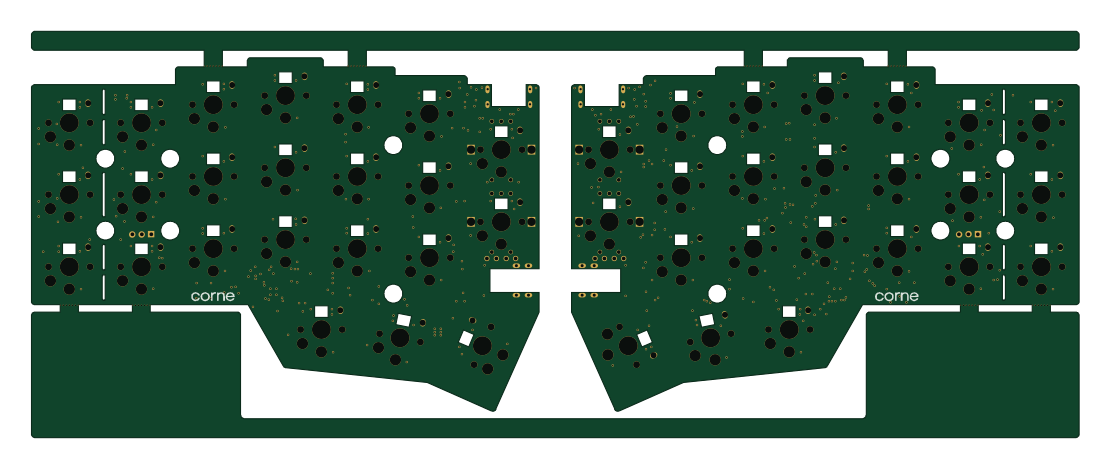 RP2040/RP2350
Corne chocolate
foostan
277.2 × 107.5 mm164 parts2LCC-BY-4.07.7k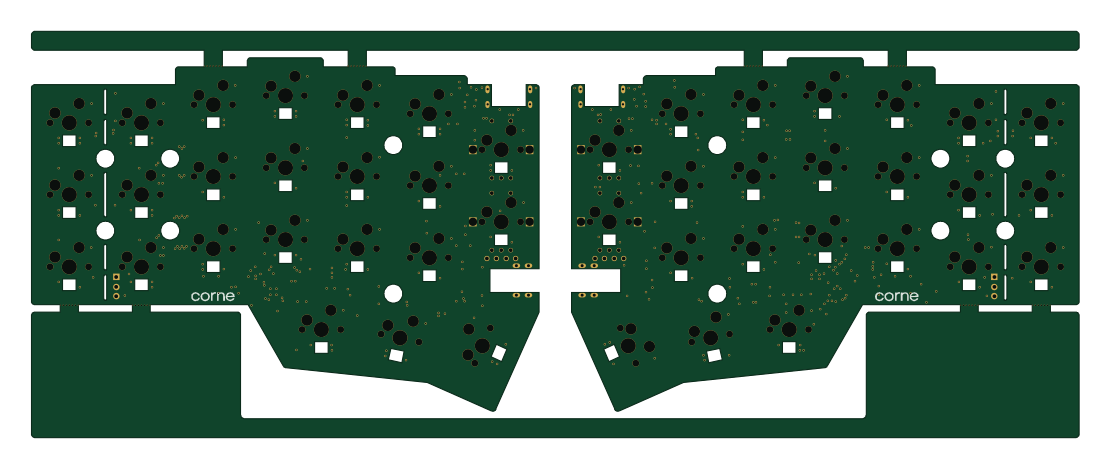 RP2040/RP2350
Corne cherry
277.2 × 107.5 mm164 parts2LCC-BY-4.07.7k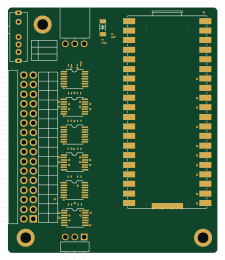 RP2040/RP2350
Jitx design
gusmanb
55.5 × 65 mm26 parts4LGPL-3.05.0k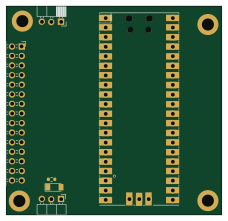 RP2040/RP2350
LogicAnalyzer
57 × 55.2 mm6 parts2LGPL-3.05.0k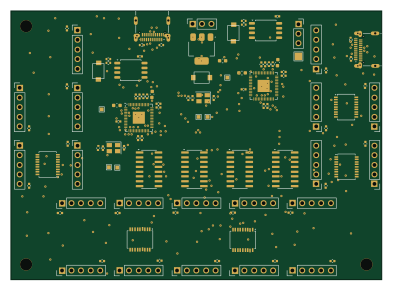 RP2040/RP2350
Main
google
98 × 71 mm102 parts2LApache-2.02.9k