
Neo robot

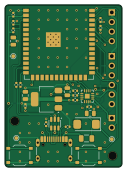
About the Neo robot PCB
Neo robot is an open source ESP32 PCB design by techmiguel, published on GitHub under the MIT license. It is a 2-layer board measuring 31 × 43 mm, with 27 components from 19 distinct parts.
Its main chip is the ESP32-S3-WROOM-1-N16R8, from the ESP32 family. Other key parts include the TLV1117LV33DCYR and MAX98357AETE+T. By type, the board carries 10 resistors, 9 capacitors, 3 ICs, 2 switches, 1 connector and 1 fuse.
It belongs with the audio, iot & wireless and robotics & motion designs in this gallery.
From the project
Open-source ESP32-S3 voice assistant: offline wake word with TinyML (TensorFlow Lite Micro + ESP-NN), Whisper speech-to-text, local LLM (Ollama, Gemma, Qwen) or Groq, streaming TTS. A DIY Spanish-speaking smart speaker with measured results.
Placa económica y compacta (31 × 43 mm, 2 capas, revisión C) para NEO: módulo ESP32-S3-WROOM-1-N16R8 con su antena integrada sobresaliendo del borde, USB-C con el USB nativo del S3 (sin puente USB-UART), conector para el micrófono INMP441, amplificador I2S MAX98357A con salida de dos pines para el altavoz y conector I2C para la OLED SSD1306. Montaje SMT de JLCPCB por una cara; conectores soldados a mano.
Main components on the Neo robot
Neo robot bill of materials (BOM)
27 components, 19 distinct parts — part numbers from the project's BOM.
| Qty | Part | Footprint | Refs |
|---|---|---|---|
| 1 | TLV1117LV33DCYR TLV1117LV33 | SOT-223-3_TabPin2 | U1 |
| 1 | ESP32-S3-WROOM-1-N16R8 | ESP32-S3-WROOM-1 | U2 |
| 1 | MAX98357AETE+T MAX98357A | TQFN-16-1EP_3x3mm_P0.5mm_EP1.23x1.23mm | U4 |
| 1 | TYPE-C-31-M-12 USB-C | USB_C_Receptacle_HRO_TYPE-C-31-M-12 | J1 |
| 1 | BSMD1206-110-6V 1.1A | Fuse_1206_3216Metric | F1 |
| 1 | C318884 RESET | SW_Push_1P1T_XKB_TS-1187A | SW1 |
| 1 | C318884 BOOT | SW_Push_1P1T_XKB_TS-1187A | SW2 |
| 1 | USBLC6-2SC6 | SOT-23-6 | D1 |
| 1 | TPSC476K016R0350 47uF 16V | CP_EIA-6032-28_Kemet-C | C1 |
| 3 | 10UF 10uF | C_0805_2012Metric | C2, C5, C9 |
| 1 | 22UF 22uF | C_0805_2012Metric | C3 |
| 3 | 100NF 100nF | C_0402_1005Metric | C4, C7, C10 |
| 1 | 1UF 1uF | C_0402_1005Metric | C6 |
| 2 | 5.1K 5.1k | R_0402_1005Metric | R1, R2 |
| 1 | 10K 10k | R_0402_1005Metric | R3 |
| 2 | 22 | R_0402_1005Metric | R4, R5 |
| 1 | 470K 470k | R_0402_1005Metric | R6 |
| 2 | 0 | R_0402_1005Metric | R7, R8 |
| 2 | 4.7K 4.7k | R_0402_1005Metric | R9, R10 |
Neo robot design files
The KiCad project lives in the techmiguel/neo-robot repository on GitHub; these links point at the commit this page was built from.
Neo robot: common questions
What microcontroller does the Neo robot use?
The Neo robot is built around the ESP32-S3-WROOM-1-N16R8, from the ESP32 family.
How big is the Neo robot PCB?
The Neo robot measures 31 × 43 mm, has 2 copper layers and is 1.6 mm thick.
How many components are on the Neo robot?
27 components, from 19 distinct parts, with part numbers taken from the project's own BOM. The full bill of materials is listed on this page.
Where can I download the Neo robot design files?
From the techmiguel/neo-robot repository on GitHub, which has the KiCad layout, the schematic and the BOM; the links under Design files point to each one.
Can I use the Neo robot design in my own project?
Yes, under the terms of its MIT license, which techmiguel chose for the repository.
Can I test firmware for the Neo robot without the hardware?
Yes. HardLabs builds a simulation of the board from its netlist and BOM, so you can run and debug ESP32 firmware against it before you order a PCB.
Similar boards
 ESP32
OSO-BOOK-B1
joeycastillo
85 × 115 mm65 parts2LCC-BY-SA-4.08.1k ESP32
Powertrain
byrantech
64 × 45.4 mm171 parts4LMIT4.3k ESP32
Esp32 minimal
atopile
36.2 × 26.8 mm20 parts2LMIT4.0k ESP32
Badge
56.3 × 39 mm239 parts4LMIT4.0k ESP32
Racer
StuckAtPrototype
36 × 50.2 mm70 parts4LApache-2.03.8k ESP32
Controller
29 × 74 mm58 parts4LApache-2.03.8k