
Base station

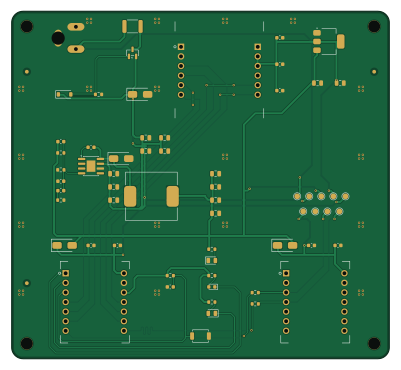
About the Base station PCB
Base station is an open source ESP32 PCB design by yeyintlwin, published on GitHub under the MIT license. It is a 2-layer board measuring 100 × 92 mm, with 53 components from 32 distinct parts.
Its main chip is the 113991114, from the ESP32 family. Other key parts include the TPS5430DDAR, AP2114H-3.3TRG1, 113991054 and WIZ850io. By type, the board carries 25 capacitors, 10 resistors, 8 diodes, 5 ICs, 1 transistor and 1 connector.
From the project
Design a two-layer KiCad PCB entirely from Python scripts - no GUI step, no commercial autorouter
Or clone it and point KiCad's Python at examples/base-station/scripts/. The method, the shared library and both boards are in this one repository.
A method for designing KiCad PCBs entirely from Python scripts — no interactive editing, and no commercial autorouter. Symbols, footprints, schematic, placement, copper and ground pours are all generated. The board on disk is a pure function of the scripts, so it can be re-run from nothing, and a change shows up in git as only that change.
Main components on the Base station
Base station bill of materials (BOM)
53 components, 32 distinct parts.
| Qty | Part | Footprint | Refs |
|---|---|---|---|
| 1 | TPS5430DDAR TPS5430 Texas Instruments | SOIC-8-1EP_3.9x4.9mm_P1.27mm_EP2.29x3mm | U1 |
| 1 | AP2114H-3.3TRG1 AP2114H-3.3 Diodes Incorporated | SOT-223-3_TabPin2 | U2 |
| 1 | 113991114 XIAO ESP32-S3 (DNP) Seeed Studio | XIAO_Socket | U3 |
| 1 | 113991054 XIAO ESP32-C3 (DNP) Seeed Studio | XIAO_Socket | U4 |
| 1 | WIZ850io W5500 module (DNP) WIZnet / USR IOT | W5500_Socket | U5 |
| 1 | AO3401A Alpha & Omega | SOT-23 | Q1 |
| 1 | DC-005-5A-2.0 DC-005 5.5x2.1 XKB Connection | BarrelJack_DC005 | J1 |
| 1 | mSMD110-33V 1.1A 33V TECHFUSE | Fuse_1812_4532Metric | F1 |
| 1 | TS-1088-AR02016 SETUP XUNPU | SW_SPST_TS-1088-xR020 | SW1 |
| 1 | BZT52C10 See parts.csv | D_SOD-123 | D1 |
| 1 | SMAJ15A See parts.csv - LCSC brand and datasheet publisher differ | D_SMA | D2 |
| 3 | SS54 MDD | D_SMA | D3, D4, D5 |
| 1 | KT-0805G GREEN PWR Hubei KENTO Elec | LED_0805_2012Metric | D6 |
| 1 | KT-0603R RED WIFI Hubei KENTO Elec | LED_0603_1608Metric | D7 |
| 1 | KT-0805Y YELLOW ETH/RADIO Hubei KENTO Elec | LED_0805_2012Metric | D8 |
| 1 | MWSA1205S-150MT 15uH 8A Sunlord | L_Sunlord_MWSA1205S-150 | L1 |
| 1 | 0603B103K500NT 10nF Fenghua Advanced Technology | C_0603_1608Metric | C1 |
| 7 | GRM21BR61H106KE43L 10uF 50V Murata | C_0805_2012Metric | C2, C3, C4, C5, C19, C20, C21 |
| 6 | CL21A226MAQNNNE 22uF 25V Samsung Electro-Mechanics | C_0805_2012Metric | C6, C7, C8, C9, C10, C22 |
| 3 | CL10A106MA8NRNC 10uF 25V Samsung Electro-Mechanics | C_0603_1608Metric | C11, C12, C17 |
Show 12 more
| Qty | Part | Footprint | Refs |
|---|---|---|---|
| 5 | CC0603KRX7R9BB104 100nF YAGEO | C_0603_1608Metric | C13, C14, C15, C16, C18 |
| 1 | 0603B222K500NT 2.2nF Fenghua Advanced Technology | C_0603_1608Metric | C23 |
| 1 | 0603B151K500NT 150pF Fenghua Advanced Technology | C_0603_1608Metric | C24 |
| 1 | CL10B224KA8NNNC 220nF Samsung Electro-Mechanics | C_0603_1608Metric | C25 |
| 1 | 0603WAF1003T5E 100k UNI-ROYAL | R_0603_1608Metric | R1 |
| 1 | 0603WAF6801T5E 6.8k UNI-ROYAL | R_0603_1608Metric | R2 |
| 1 | 0603WAF2201T5E 2.2k UNI-ROYAL | R_0603_1608Metric | R3 |
| 2 | 0603WAF1000T5E 100 UNI-ROYAL | R_0603_1608Metric | R4, R5 |
| 1 | 0603WAF1001T5E 1k UNI-ROYAL | R_0603_1608Metric | R6 |
| 2 | 0603WAF6800T5E 680 UNI-ROYAL | R_0603_1608Metric | R7, R8 |
| 1 | 0603WAF1002T5E 10k UNI-ROYAL | R_0603_1608Metric | R9 |
| 1 | 0603WAF2200T5E 220 UNI-ROYAL | R_0603_1608Metric | R10 |
Base station design files
The KiCad project lives in the yeyintlwin/kicad-board-design repository on GitHub; these links point at the commit this page was built from.
Base station: common questions
What microcontroller does the Base station use?
The Base station is built around the 113991114, from the ESP32 family.
How big is the Base station PCB?
The Base station measures 100 × 92 mm, has 2 copper layers and is 1.6 mm thick.
How many components are on the Base station?
53 components, from 32 distinct parts. The full bill of materials is listed on this page.
Where can I download the Base station design files?
From the yeyintlwin/kicad-board-design repository on GitHub, which has the KiCad layout and the schematic; the links under Design files point to each one.
Can I use the Base station design in my own project?
Yes, under the terms of its MIT license, which yeyintlwin chose for the repository.
Can I test firmware for the Base station without the hardware?
Yes. HardLabs builds a simulation of the board from its netlist and BOM, so you can run and debug ESP32 firmware against it before you order a PCB.
More boards in kicad-board-design
Similar boards
 ESP32
OSO-BOOK-B1
joeycastillo
85 × 115 mm65 parts2LCC-BY-SA-4.08.1k ESP32
Powertrain
byrantech
64 × 45.4 mm171 parts4LMIT4.3k ESP32
Esp32 minimal
atopile
36.2 × 26.8 mm20 parts2LMIT4.0k ESP32
Badge
56.3 × 39 mm239 parts4LMIT4.0k ESP32
Racer
StuckAtPrototype
36 × 50.2 mm70 parts4LApache-2.03.8k ESP32
Controller
29 × 74 mm58 parts4LApache-2.03.8k