
Hap

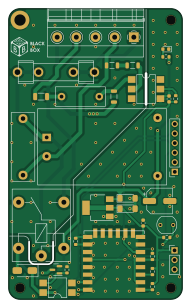
About the Hap PCB
Hap is an open source ESP8266 PCB design by AlanCarvalhoEE, published on GitHub. It is a 2-layer board measuring 46 × 77 mm, with 33 components from 27 distinct parts.
Its main chip is the ESP-12E, from the ESP8266 family. Other key parts include the AMS1117-3.3, PC817 and H11AA1. By type, the board carries 12 resistors, 7 capacitors, 4 ICs, 3 connectors, 2 diodes and 1 transistor.
It belongs with the iot & wireless and sensors designs in this gallery.
From the project
Home Automation Platform with custom hardware and firmware (ESP8266), a Raspberry Pi–based server, and an Android client. Features modular IoT devices, TCP/IP and MQTT messaging, and a scalable system architecture.
A modular, self-hosted home automation platform focused on reliability, local control, and secure remote access.
The system is designed around a Raspberry Pi server that centralizes application logic and device state, ESP8266-based IoT modules for field control, and a mobile application as the primary user interface. Communication between components is event-driven and optimized for embedded and low-latency environments.
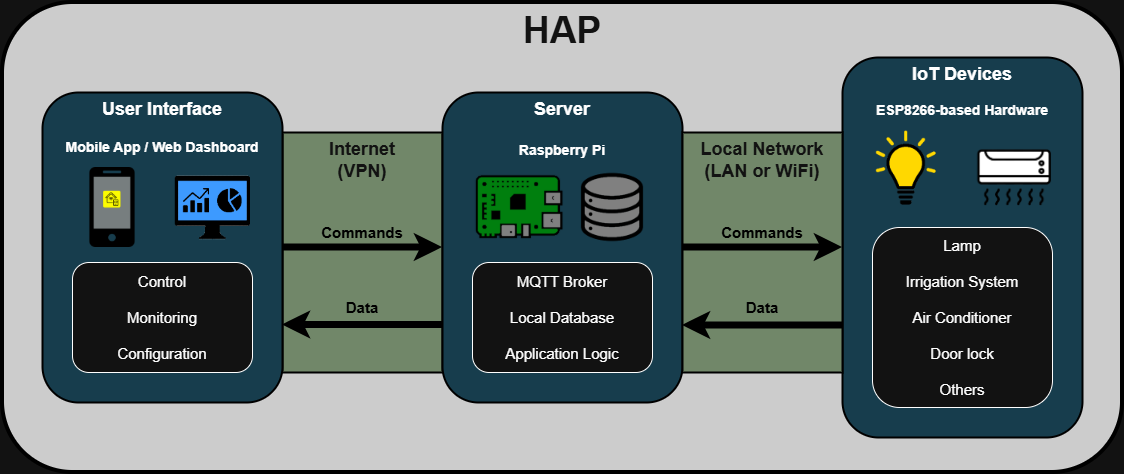
Main components on the Hap
Hap bill of materials (BOM)
33 components, 27 distinct parts.
| Qty | Part | Footprint | Refs |
|---|---|---|---|
| 1 | AMS1117-3.3 | SOT-223-3_TAB2 | U1 |
| 1 | ESP-12E | MOD_ESP-12E | U2 |
| 1 | PC817 | SMDIP-4_7.62 | U3 |
| 1 | H11AA1 | SMDIP-6_7.62 | U4 |
| 1 | 2N7002H | SOT-23 | Q1 |
| 1 | CONN_TERMINAL-BLOCK_5P_P5.08 | CONN_TERMINAL-BLOCK_5P_P5.08 | J1 |
| 1 | Conn_01x06_Socket | CONN_SOCKET-HEADER_1x06_V | J2 |
| 1 | Conn_01x03_Socket | CONN_PIN-HEADER_1x03_V | J3 |
| 1 | 0,25A | FUSEHOLDER_THT_5x20_CLIP | F1 |
| 1 | 12V 5A | RELAY_SPDT_FINDER_36.11 | K1 |
| 1 | HLK-PM12 | HILINK_HLK-PMxx | PS1 |
| 1 | LED | LED_SMD_0603 | D1 |
| 1 | S1A | DIODE_SMD_SMA | D2 |
| 1 | 600R | BEAD_SMD_1206 | L1 |
| 1 | 0.1uF | CAP_THT_CERAMIC_X2_18x6x15 | C1 |
| 1 | 100uF | CAP_SMD_ELEC_6.3x7.7 | C2 |
| 2 | 10uF | CAP_SMD_TANTALUM_CASE-A | C3, C4 |
| 1 | 0.1uF | CAP_SMD_CERAMIC_0603 | C5 |
| 1 | 47nF | CAP_THT_CERAMIC_X2_13x5x11_P10 | C6 |
| 1 | 100nF | CAP_SMD_CERAMIC_0603 | C7 |
Show 7 more
| Qty | Part | Footprint | Refs |
|---|---|---|---|
| 5 | 10k | RES_SMD_0603 | R1, R2, R3, R6, R12 |
| 1 | 2k2 | RES_SMD_0603 | R4 |
| 1 | 390R | RES_SMD_0603 | R5 |
| 1 | 33k | RES_SMD_0603 | R7 |
| 1 | 10k | LDR_5_V | R8 |
| 1 | 470k | RES_SMD_1206 | R9 |
| 2 | 33k | RES_SMD_1206 | R10, R11 |
Hap design files
The KiCad project lives in the AlanCarvalhoEE/hap repository on GitHub; these links point at the commit this page was built from.
Hap: common questions
What microcontroller does the Hap use?
The Hap is built around the ESP-12E, from the ESP8266 family.
How big is the Hap PCB?
The Hap measures 46 × 77 mm, has 2 copper layers and is 1.6 mm thick.
How many components are on the Hap?
33 components, from 27 distinct parts. The full bill of materials is listed on this page.
Where can I download the Hap design files?
From the AlanCarvalhoEE/hap repository on GitHub, which has the KiCad layout and the schematic; the links under Design files point to each one.
Can I use the Hap design in my own project?
The repository has no license, so all rights stay with AlanCarvalhoEE. Use it as a reference, and ask the author before reusing the design.
Can I test firmware for the Hap without the hardware?
Yes. HardLabs builds a simulation of the board from its netlist and BOM, so you can run and debug ESP8266 firmware against it before you order a PCB.
Similar boards
 ESP8266
ESP8266ControllerCircuit
stuartpittaway
75 × 30 mm20 parts2LCC-BY-NC-4.01.1k ESP8266
HASwitchPlate
aderusha
60 × 40 mm8 parts2LMIT738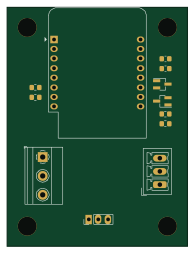 ESP8266
RatGDO-OpenSource-D1Mini-ESP8266
Kaldek
47.8 × 63.3 mm12 parts2LMIT506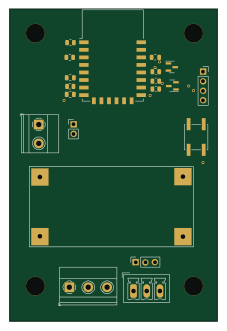 ESP8266
RatGDO-OpenSource-Bare-ESP8266
55 × 82.7 mm20 parts2LMIT506 ESP8266
Goatgdo
32.9 × 53.3 mm23 parts2LMIT506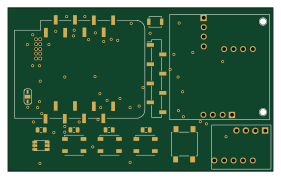 ESP8266
Iaq board
nkitanov
70.1 × 43.2 mm17 parts2LNo license398