
Camberwell Parrot

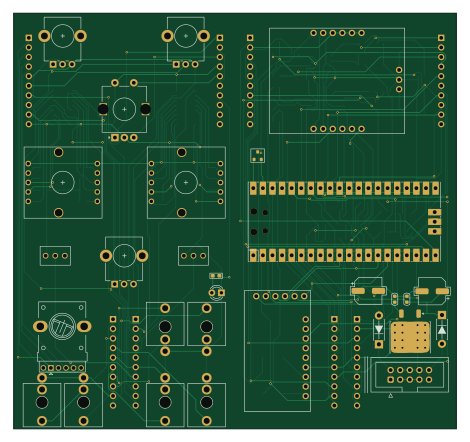
About the Camberwell Parrot PCB
Camberwell Parrot is an open source RP2040/RP2350 PCB design by AudioMorphology, published on GitHub under the GPL-3.0 license. It is a 2-layer board measuring 117.2 × 110 mm, with 96 components from 36 distinct parts.
Its main chip is the Pico, from the RP2040/RP2350 family. Other key parts include the PCM1808, TL072CD, GY_PCM5102A, APS6404L and L7805. By type, the board carries 39 resistors, 17 capacitors, 15 connectors, 9 ICs, 5 switches and 4 transistors.
It belongs with the audio designs in this gallery.
From the project
Parrot is a 12hp Eurorack digital delay powered by a Raspberry Pi Pico microcontroller.
Parrot is a 12hp Eurorack digital delay powered by a Raspberry Pi Pico microcontroller.
The objective is to provide a CD-Quality audio delay / reverb effect, with a reasonably low BOM count
It utilises an 8Mb x 8-Bit (64mBit) PSRAM Memory chip (the AP6404L), and the whole of this is treated as a 2Mb x 32-Bit audio buffer. This means that we can wrap the read and write pointers with a simple logical &.
Main components on the Camberwell Parrot
Camberwell Parrot bill of materials (BOM)
96 components, 36 distinct parts — part numbers from the project's BOM.
| Qty | Part | Footprint | Refs |
|---|---|---|---|
| 1 | Pico | RPi_Pico_SMD_TH | U1 |
| 1 | PCM1808 | PCM1808 | U2 |
| 2 | TL072CD | SO-8_3.9x4.9mm_P1.27mm | U3, U4 |
| 1 | GY_PCM5102A | GY_PCM5102A | U5 |
| 1 | APS6404L | SOIC-8_3.9x4.9mm_P1.27mm | U6 |
| 1 | L7805 | TO-252-2 with heatsink | U7 |
| 2 | MC14532B | SOIC-16_3.9x9.9mm_P1.27mm | U8, U9 |
| 1 | DMG2305UX | SOT-23 | Q1 |
| 2 | MMBT3904 | SOT-23 | Q2, Q3 |
| 1 | MMBT3906 | SOT-23 | Q4 |
| 1 | Eurorack Power | IDC-Header_2x05_P2.54mm_Vertical | J1 |
| 6 | Thonkiconn | Thonkiconn | J2, J3, J4, J5, J6, J7 |
| 4 | CONN_01X10_PIN Conn_01x10_Pin | PinHeader_1x10_P2.54mm_Vertical | J9, J12, J14, J16 |
| 4 | CONN_01X10_SOCKET Conn_01x10_Socket | PinSocket_1x10_P2.54mm_Vertical | J10, J11, J13, J15 |
| 1 | PTV112-4420A-A503 | Potentiometer_Bourns_PTV112-4_Dual_Vertical | RV1 |
| 3 | B100K | Potentiometer_Alpha_RD901F-40-00D_Single_Vertical_CircularHoles | RV2, RV3, RV4 |
| 2 | SW_ROTARY_1X8 SW_Rotary_1x8 | ALPS Alpine 8-Way rotary switch SRBV Series | SW1, SW5 |
| 2 | SW_SPST | SPDT_Switch | SW2, SW4 |
| 1 | RotaryEncoder_Switch | RotaryEncoder_Alps_EC11E-Switch_Vertical_H20mm | SW3 |
| 2 | 1N5819 | D_DO-41_SOD81_P7.62mm_Horizontal | D1, D2 |
Show 16 more
| Qty | Part | Footprint | Refs |
|---|---|---|---|
| 1 | LED | LED_D3.0mm | D7 |
| 2 | 47U 47u | CP_Elec_6.3x5.8 | C1, C2 |
| 6 | 100N 100n | C_0603_1608Metric | C3, C5, C14, C15, C16, C17 |
| 1 | 300N 300n | C_0603_1608Metric | C4 |
| 2 | 220P 220p | C_0603_1608Metric | C6, C7 |
| 4 | 10U 10u | CP_Elec_6.3x5.8 | C8, C9, C10, C11 |
| 2 | 18P 18p | C_0603_1608Metric | C12, C13 |
| 1 | 330 | R_0603_1608Metric_Pad1.05x0.95mm_HandSolder | R1 |
| 2 | 22K 22k | R_0603_1608Metric_Pad1.05x0.95mm_HandSolder | R2, R3 |
| 2 | 3.3K 3.3k | R_0603_1608Metric_Pad1.05x0.95mm_HandSolder | R4, R5 |
| 6 | 5.6K 5.6k | R_0603_1608Metric_Pad1.05x0.95mm_HandSolder | R6, R7, R8, R9, R10, R11 |
| 4 | 39K 39k | R_0603_1608Metric_Pad1.05x0.95mm_HandSolder | R12, R13, R14, R15 |
| 4 | 1k | R_0603_1608Metric_Pad1.05x0.95mm_HandSolder | R16, R17, R39, R40 |
| 2 | 10K 10k | R_0603_1608Metric_Pad1.05x0.95mm_HandSolder | R18, R41 |
| 2 | 100K 100k | R_0603_1608Metric_Pad1.05x0.95mm_HandSolder | R19, R42 |
| 16 | 4K7 4k7 | R_0603_1608Metric_Pad1.05x0.95mm_HandSolder | R23, R24, R25, R26, R27, R28, R29, R30 +8 |
Camberwell Parrot design files
The KiCad project lives in the AudioMorphology/ParrotRev2 repository on GitHub; these links point at the commit this page was built from.
Camberwell Parrot: common questions
What microcontroller does the Camberwell Parrot use?
The Camberwell Parrot is built around the Pico, from the RP2040/RP2350 family.
How big is the Camberwell Parrot PCB?
The Camberwell Parrot measures 117.2 × 110 mm, has 2 copper layers and is 1.6 mm thick.
How many components are on the Camberwell Parrot?
96 components, from 36 distinct parts, with part numbers taken from the project's own BOM. The full bill of materials is listed on this page.
Where can I download the Camberwell Parrot design files?
From the AudioMorphology/ParrotRev2 repository on GitHub, which has the KiCad layout, the schematic and the BOM; the links under Design files point to each one.
Can I use the Camberwell Parrot design in my own project?
Yes, under the terms of its GPL-3.0 license, which AudioMorphology chose for the repository.
Can I test firmware for the Camberwell Parrot without the hardware?
Yes. HardLabs builds a simulation of the board from its netlist and BOM, so you can run and debug RP2040/RP2350 firmware against it before you order a PCB.
Similar boards
 RP2040/RP2350
Open Book Abridged Edition
joeycastillo
85 × 115 mm29 parts2LCC-BY-SA-4.08.1k RP2040/RP2350
Corne
foostan
277.2 × 107.5 mm164 parts2LCC-BY-4.07.7k RP2040/RP2350
Corne
277.2 × 107.5 mm164 parts2LCC-BY-4.07.7k RP2040/RP2350
LogicAnalyzer
gusmanb
57 × 55.2 mm6 parts2LGPL-3.05.0k RP2040/RP2350
Jitx design
55.5 × 65 mm26 parts4LGPL-3.05.0k RP2040/RP2350
Pro V2
kata0510
290.1 × 130 mm270 parts2LMIT2.3k