
Cotuca cerebro

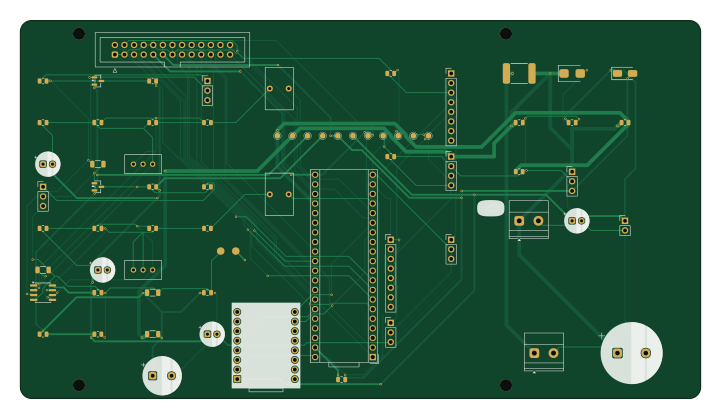
About the Cotuca cerebro PCB
Cotuca cerebro is an open source ESP32 PCB design by Belquer, published on GitHub. It is a 2-layer board measuring 180 × 100 mm, with 58 components from 40 distinct parts.
Its main chip is the ESP32-C3 SuperMini, from the ESP32 family. Other key parts include the OPA1642AIDR and Daisy Seed3. By type, the board carries 19 capacitors, 17 resistors, 12 connectors, 4 diodes, 3 ICs and 1 fuse.
It belongs with the test & measurement, audio and iot & wireless designs in this gallery.
From the project
Modular firmware for sound-sculpture instruments.
Modular firmware for sound-sculpture instruments. The core idea is that the same brain runs any sculpture: the instrument code is board-agnostic, and changing hardware means writing one new file — not rewriting the system.
1. HAL boundary. No vendor #include outside hal.cpp. main.cpp, params, macros and manifests do not know which board they are running on. The board is chosen with make BOARD=daisyseed. 2. Normalized parameters. Everything is 0.0–1.0 in one central table; the manifest is what translates to Hz, seconds, dB. 3. Macros. One physical knob can move several parameters, with weight…
Main components on the Cotuca cerebro
Cotuca cerebro bill of materials (BOM)
58 components, 40 distinct parts — part numbers from the project's BOM.
| Qty | Part | Footprint | Refs |
|---|---|---|---|
| 1 | OPA1642AIDR OPA1642 | SOIC-8_3.9x4.9mm_P1.27mm | U1 |
| 1 | Daisy Seed3 | Electrosmith_Daisy_Seed | U2 |
| 1 | ESP32-C3 SuperMini | ESP32C3_SUPERMINI_SOQUETE | U3 |
| 1 | 1715721 entrada decoy PD | TerminalBlock_Phoenix_MKDS-1,5-2-5.08_1x02_P5.08mm_Horizontal | J1 |
| 1 | 1715721 ao amp TPA3116 | TerminalBlock_Phoenix_MKDS-1,5-2-5.08_1x02_P5.08mm_Horizontal | J2 |
| 1 | 61304011121 step-down 5V fixo | PinHeader_1x03_P2.54mm_Vertical | J3 |
| 1 | 61304011121 a ponte ESP32 | PinHeader_1x02_P2.54mm_Vertical | J4 |
| 1 | 61304011121 fio -> jack piezo J5 | PinHeader_1x03_P2.54mm_Vertical | J5 |
| 1 | 61304011121 fio -> jack piezo J6 | PinHeader_1x03_P2.54mm_Vertical | J6 |
| 1 | 61304011121 modulo TPA3116 | PinHeader_1x04_P2.54mm_Vertical | J11 |
| 1 | 61304011121 fio -> TRS linha L | PinHeader_1x03_P2.54mm_Vertical | J12 |
| 1 | 61304011121 fio -> TRS linha R | PinHeader_1x03_P2.54mm_Vertical | J13 |
| 1 | 61202621621 IDC 2x13 -> painel | IDC-Header_2x13_P2.54mm_Vertical | J14 |
| 1 | 61304011121 fio -> DPDT tipo 2, canal L | PinHeader_1x08_P2.54mm_Vertical | J15 |
| 1 | 61304011121 fio -> DPDT tipo 2, canal R | PinHeader_1x08_P2.54mm_Vertical | J16 |
| 1 | MF-LSMF300/24X-2 PTC 3A | Fuse_2920_7451Metric | F1 |
| 2 | 3296W-1-104LF trim 100k | Potentiometer_Bourns_3296W_Vertical | RV1, RV2 |
| 1 | SMBJ24A | D_SMB | D1 |
| 1 | SS14 | D_SMA | D2 |
| 2 | BAV99,215 BAV99 | SOT-23 | D11, D21 |
Show 20 more
| Qty | Part | Footprint | Refs |
|---|---|---|---|
| 1 | EEU-FR1V222 2200u/35V | CP_Radial_D16.0mm_P7.50mm | C1 |
| 6 | 100N 100n | C_0805_2012Metric | C2, C4, C7, C9, C15, C16 |
| 1 | EEU-FR1C101 100u | CP_Radial_D6.3mm_P2.50mm | C3 |
| 1 | EEU-FR1E470 47u | CP_Radial_D6.3mm_P2.50mm | C5 |
| 1 | EEU-FR1E471 470u 25V | CP_Radial_D10.0mm_P5.00mm | C6 |
| 1 | CL31B106KAHNNWE 10u | C_1206_3216Metric | C8 |
| 2 | 22p C0G | C_0805_2012Metric | C11, C21 |
| 2 | C1206C223J5GACTU 22n C0G | C_1206_3216Metric | C12, C22 |
| 2 | UES1H220MEM 22u NP | CP_Radial_D6.3mm_P2.50mm | C13, C23 |
| 2 | MKS2C042201M00KN00 2u2 filme | C_Rect_L7.2mm_W11.0mm_P5.00mm_FKS2_FKP2_MKS2_MKP2 | C14, C24 |
| 3 | 100K 100k | R_0805_2012Metric | R5, R6, R8 |
| 1 | C17901 100R 1/4W | R_1206_3216Metric | R7 |
| 1 | 22K 22k | R_0805_2012Metric | R9 |
| 2 | C17477 0R | R_0805_2012Metric | R10, R20 |
| 2 | 4M7 | R_0805_2012Metric | R11, R21 |
| 2 | 1k | R_0805_2012Metric | R12, R22 |
| 2 | 4k7 | R_0805_2012Metric | R13, R23 |
| 2 | 100R | R_0805_2012Metric | R14, R24 |
| 1 | C17414 10k — L | R_0805_2012Metric | R50 |
| 1 | C17414 10k — R | R_0805_2012Metric | R51 |
Cotuca cerebro design files
The KiCad project lives in the Belquer/Cotucatronics repository on GitHub; these links point at the commit this page was built from.
Cotuca cerebro: common questions
What microcontroller does the Cotuca cerebro use?
The Cotuca cerebro is built around the ESP32-C3 SuperMini, from the ESP32 family.
How big is the Cotuca cerebro PCB?
The Cotuca cerebro measures 180 × 100 mm, has 2 copper layers and is 1.6 mm thick.
How many components are on the Cotuca cerebro?
58 components, from 40 distinct parts, with part numbers taken from the project's own BOM. The full bill of materials is listed on this page.
Where can I download the Cotuca cerebro design files?
From the Belquer/Cotucatronics repository on GitHub, which has the KiCad layout, the schematic and the BOM; the links under Design files point to each one.
Can I use the Cotuca cerebro design in my own project?
The repository has no license, so all rights stay with Belquer. Use it as a reference, and ask the author before reusing the design.
Can I test firmware for the Cotuca cerebro without the hardware?
Yes. HardLabs builds a simulation of the board from its netlist and BOM, so you can run and debug ESP32 firmware against it before you order a PCB.
More boards in Cotucatronics
Similar boards
 ESP32
OSO-BOOK-B1
joeycastillo
85 × 115 mm65 parts2LCC-BY-SA-4.08.1k ESP32
Powertrain
byrantech
64 × 45.4 mm171 parts4LMIT4.3k ESP32
Esp32 minimal
atopile
36.2 × 26.8 mm20 parts2LMIT4.0k ESP32
Badge
56.3 × 39 mm239 parts4LMIT4.0k ESP32
Racer
StuckAtPrototype
36 × 50.2 mm70 parts4LApache-2.03.8k ESP32
Controller
29 × 74 mm58 parts4LApache-2.03.8k