
BitaxeBIRDS

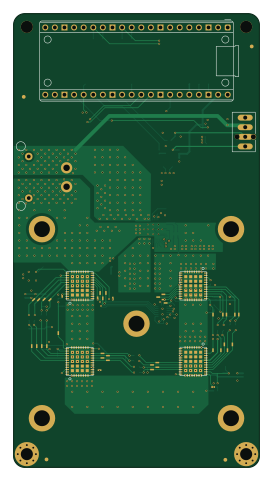
About the BitaxeBIRDS PCB
BitaxeBIRDS is an open source RP2040/RP2350 PCB design by bitaxeorg, published on GitHub under the CERN-OHL-S-2.0 license. It is a 6-layer board measuring 65 × 120 mm, with 129 components from 38 distinct parts.
Its main chip is the Raspberry Pi Pico 2W, from the RP2040/RP2350 family. Other key parts include the MCP1824T-1202E/OT, TPS546D24SRVFR, TPS22919DCKR, SN74AXC4T774 and BZM2_MODE0. By type, the board carries 65 capacitors, 34 resistors, 13 diodes, 8 ICs, 4 modules and 2 connectors.
It belongs with the iot & wireless and sensors designs in this gallery.
From the project
Bitaxe Intel Reference Design System
Bitaxe Intel Reference Design System (BIRDS) quad Intel BZM2 ASIC miner for BZM2 firmware development.
It is still an untested prototype! Don't build this expecting it to work out of the box. Do build it if you want to hack on some rad stuff.
- Open Hardware License; Real Open Source. - KiCAD design files. - Four Intel BZM2 ASICs, powered in series. - Each BZM2 is nominally 0.7V with approx 350 GH/s @ 1.15 GHz hash frequency. - On chip digital temperature and voltage sensors - ntime rolling - decent cross-domain level shifting, that hopefully works. - 11-13V XT30 input voltage - TPS546D24S…
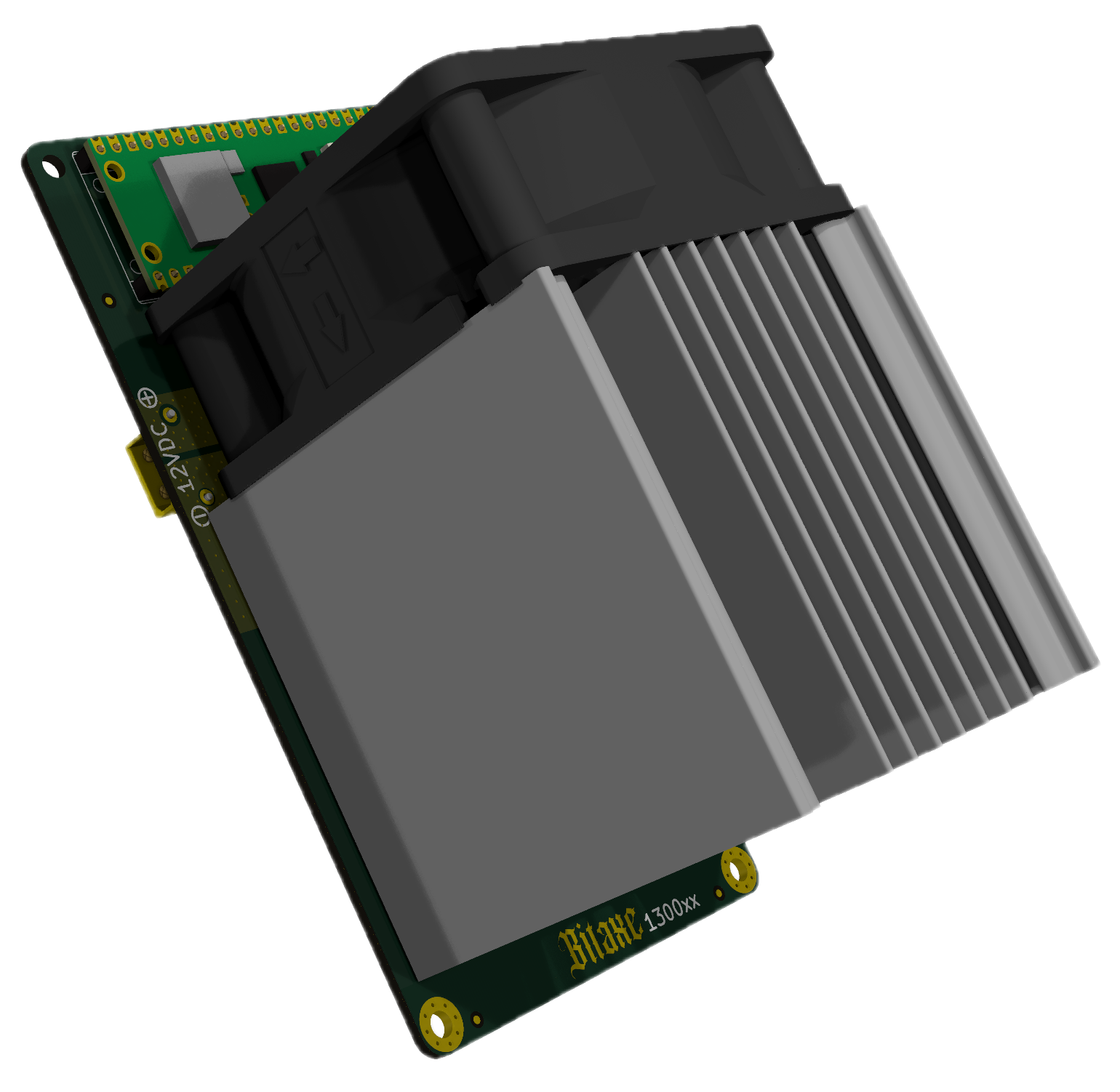
Main components on the BitaxeBIRDS
BitaxeBIRDS bill of materials (BOM)
129 components, 38 distinct parts.
| Qty | Part | Footprint | Refs |
|---|---|---|---|
| 4 | MCP1824T-1202E/OT | SOT-23-5 | U1, U3, U4, U6 |
| 1 | TPS546D24SRVFR | LQFN40-CLIP | U2 |
| 1 | TPS22919DCKR | DCK0006A_N | U5 |
| 1 | SN74AXC4T774 | BQB0016A-MFG | U8 |
| 1 | Raspberry Pi Pico 2W | RaspberryPi_Pico_Common_THT | U9 |
| 2 | BZM2_MODE0 | bzm2 | A1, A3 |
| 2 | BZM2_MODE1 | bzm2 | A2, A4 |
| 1 | BSS138 | SOT-23 | Q1 |
| 1 | 50MHz | OSC_ECS-3225MV-500-CN-TR | Y2 |
| 1 | XT30 | XT30PW-M | J1 |
| 1 | Conn_01x04 | 470531000 | J4 |
| 12 | DLLFSD01T-7 | D_SOD-523 | D1, D2, D3, D4, D5, D6, D7, D8 +4 |
| 1 | 3.3V Zener | D_SOD-123 | D13 |
| 1 | 1.2uH | XAL1060122MEC | L1 |
| 1 | 27uF | CP_Elec_5x5.9 | C2 |
| 4 | 22uF | C_1206_3216Metric | C3, C4, C5, C6 |
| 10 | 1uF | C_0402_1005Metric | C7, C15, C19, C25, C26, C27, C28, C45 +2 |
| 2 | 1uF | C_0603_1608Metric | C9, C10 |
| 1 | 4.7uF | C_0402_1005Metric | C11 |
| 1 | 4.7nF | C_0402_1005Metric | C13 |
Show 18 more
| Qty | Part | Footprint | Refs |
|---|---|---|---|
| 1 | 2.2nF | C_0402_1005Metric | C14 |
| 5 | 0.1uF | C_0402_1005Metric | C16, C57, C58, C59, C77 |
| 1 | 1000pF | C_0805_2012Metric | C17 |
| 1 | 100pF | C_0402_1005Metric | C18 |
| 1 | 47uF | C_1206_3216Metric | C20 |
| 4 | 100uF | C_1206_3216Metric | C21, C22, C23, C24 |
| 5 | 120pF | C_0402_1005Metric | C60, C61, C62, C63, C64 |
| 1 | 10uF | C_0603_1608Metric | C76 |
| 24 | 100uF | C_0805_2012Metric | C83, C84, C85, C91, C92, C93, C99, C100 +16 |
| 3 | 1000pF | C_0402_1005Metric | C142, C143, C144 |
| 21 | 1k | R_0402_1005Metric | R1, R4, R20, R35, R36, R37, R38, R39 +13 |
| 4 | 10k | R_0402_1005Metric | R2, R3, R9, R34 |
| 1 | 10 | R_0402_1005Metric | R5 |
| 1 | 1 | R_0805_2012Metric | R6 |
| 2 | 49.9 | R_0402_1005Metric | R7, R8 |
| 3 | 4.7k | R_0402_1005Metric | R23, R24, R25 |
| 1 | 20k | R_0402_1005Metric | R26 |
| 1 | 5.6k | R_0402_1005Metric | R33 |
BitaxeBIRDS design files
The KiCad project lives in the bitaxeorg/bitaxeBIRDS repository on GitHub; these links point at the commit this page was built from.
- LayoutbitaxeBIRDS.kicad_pcb
- SchematicbitaxeBIRDS.kicad_sch
BitaxeBIRDS: common questions
What microcontroller does the BitaxeBIRDS use?
The BitaxeBIRDS is built around the Raspberry Pi Pico 2W, from the RP2040/RP2350 family.
How big is the BitaxeBIRDS PCB?
The BitaxeBIRDS measures 65 × 120 mm, has 6 copper layers and is 1.6 mm thick.
How many components are on the BitaxeBIRDS?
129 components, from 38 distinct parts. The full bill of materials is listed on this page.
Where can I download the BitaxeBIRDS design files?
From the bitaxeorg/bitaxeBIRDS repository on GitHub, which has the KiCad layout and the schematic; the links under Design files point to each one.
Can I use the BitaxeBIRDS design in my own project?
Yes, under the terms of its CERN-OHL-S-2.0 license, which bitaxeorg chose for the repository.
Can I test firmware for the BitaxeBIRDS without the hardware?
Yes. HardLabs builds a simulation of the board from its netlist and BOM, so you can run and debug RP2040/RP2350 firmware against it before you order a PCB.
Similar boards
 RP2040/RP2350
Open Book Abridged Edition
joeycastillo
85 × 115 mm29 parts2LCC-BY-SA-4.08.1k RP2040/RP2350
Corne
foostan
277.2 × 107.5 mm164 parts2LCC-BY-4.07.7k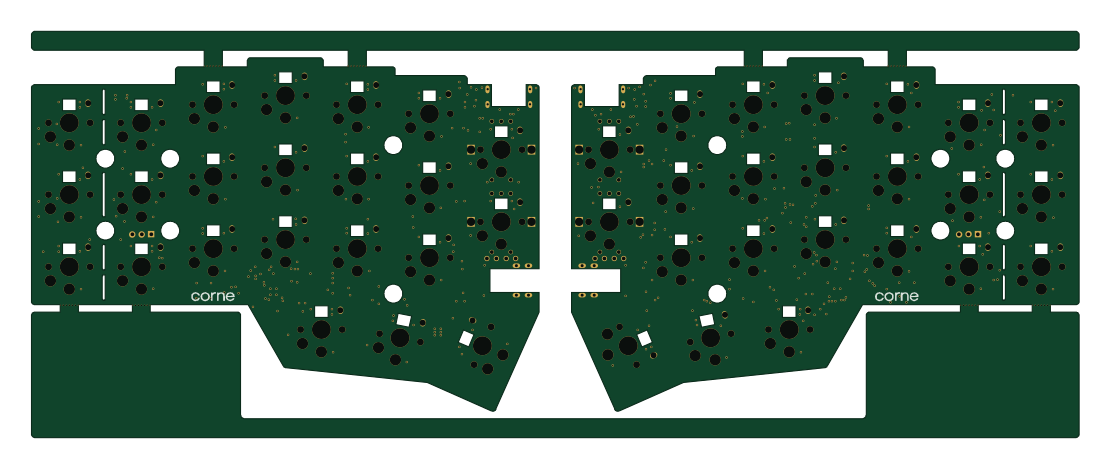 RP2040/RP2350
Corne
277.2 × 107.5 mm164 parts2LCC-BY-4.07.7k RP2040/RP2350
Jitx design
gusmanb
55.5 × 65 mm26 parts4LGPL-3.05.0k RP2040/RP2350
LogicAnalyzer
57 × 55.2 mm6 parts2LGPL-3.05.0k RP2040/RP2350
Main
google
98 × 71 mm102 parts2LApache-2.02.9k